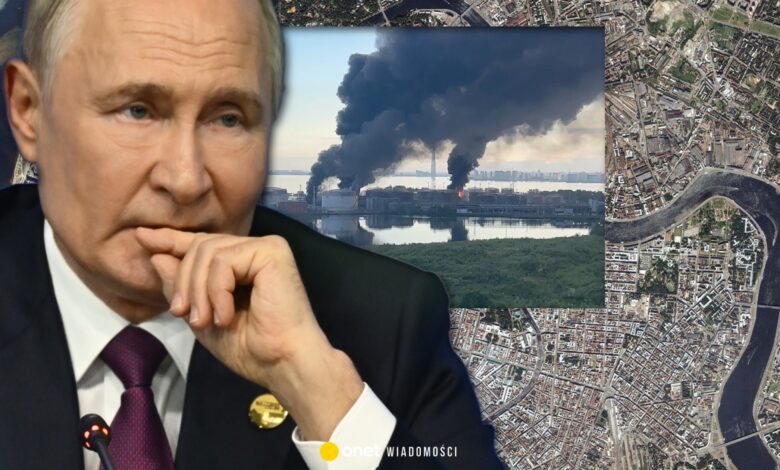
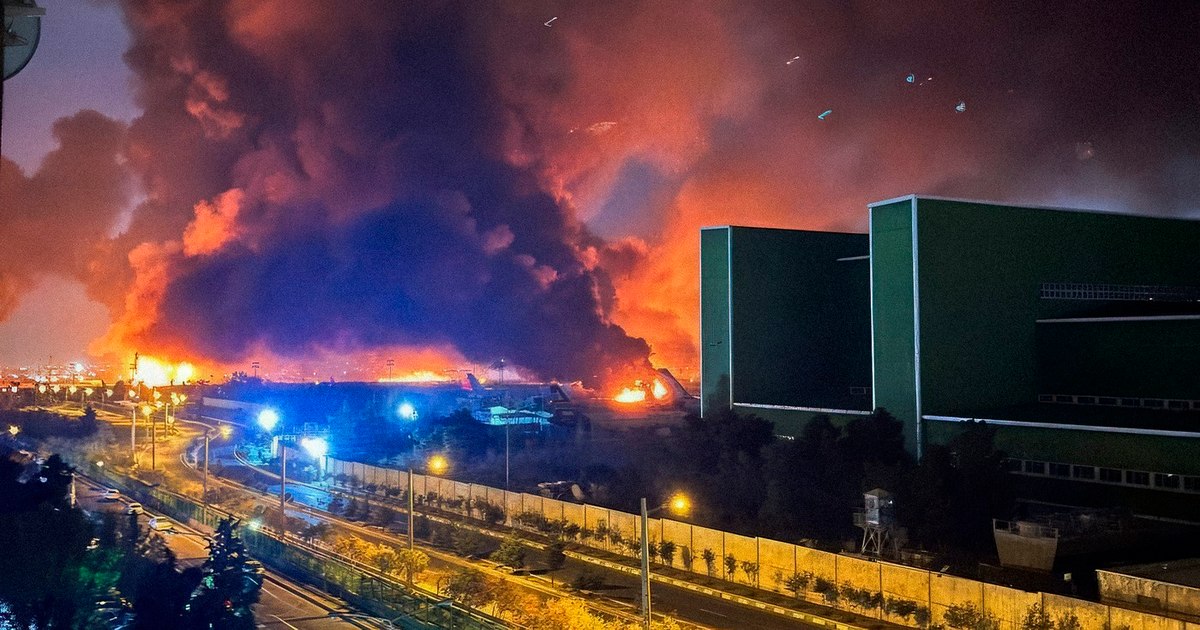
On the night of June 2-3, Ukrainian drones attacked the Leningrad Oblast, said the region's governor, Aleksandr Drozdenko. The attack lasted from two in the morning until seven in the morning. In total, according to the authorities, 50 drones were shot down during this time. The governor did not provide any information about the effects of the air attack.
As the local newspaper “Bumaga” writes, explosions were heard in various areas of Saint Petersburg: Admiraltyesky, Vasileostrovsky, Primorsky, Krasnoselsky. In the Kirov district, as a result of the attack, the Saint Petersburg Oil Terminal – a key oil transhipment complex on the Baltic Sea – caught fire.
It has a throughput of 12.5 million tons per year. There are 21 tanks for storing petroleum products. The plant is of strategic importance for ensuring Russia's security. However, attacking this infrastructure is not the end of Russia's problems. Much more happened that night.
The “Expoforum”, where the International Economic Forum in St. Petersburg will be held, is located 17 km from the attacked oil terminal. More than 29 flights were suspended due to the drone attack at Pulkovo airport.
The article continues below the video
On the same night, Ukraine attacked the city of Michurinsk in the Tambov Oblast. “As a result of the drone attack of the Armed Forces of Ukraine, a residential building, a library and a school were damaged. Windows were broken in the buildings. Outbuildings of a local industrial enterprise were also damaged. There are no casualties,” said the region's governor Yevgeny Pervyshov.
As determined by the Astra website, the target of the drones was the “Progress” factory, which produces equipment for aviation and missile control systems. This plant was already attacked in February this year, in June 2025 and in December 2024.
According to data from the Ministry of Defense of the Russian Federation, 354 drones were shot down over Russian territory last night. In total, air defense systems (PWO) intercepted drones over 16 regions, including the Belgorod, Bryansk, Voronezh, Kaluga, Kursk, Leningrad, Novgorod, Orlov, Rostov, Tula and Moscow oblasts.
From the evening of June 2, the Russian Civil Aviation Authority restricted the operations of Moscow's Vnukovo and Domodedovo airports, as well as airports in Kaluga, Saratov, Nizhny Novgorod, Yaroslavl and Pskov.
More and more “meat attacks”
The situation of the Russians on the front also does not seem favorable. After promising to Putin that they would capture Donbas by autumn, Russian generals are forcing the army to carry out a record number of “meat assaults”. These are almost suicidal attacks doomed to failure.
According to the OSINT analytical center DeepState, in May, Russian troops carried out approximately 7,000 assaults – by 37.5 percent more than a month earlier. Compared to the end of 2025, the number of assault attacks increased by a quarter and set a record in the entire history of statistics.
According to DeepState's calculations, generals sent the army to storm Ukrainian positions an average of 225 times a day, up from 180-190 times at the end of last year.
The Russian military command is in a hurry. According to Financial Times sources, the General Staff convinced Putin that Donbas would be completely occupied by autumn, so the president gave up the idea of freezing the war on the front line and now seeks full control over the Luhansk and Donetsk oblasts. “He is told that the Ukrainians are losing strength, the front is collapsing, the Ukrainians are running out of people,” said one of the newspaper's interlocutors, close to the Kremlin.
Despite the “meat attacks”, according to DeepState, May has become the worst month for the Russian army since 2023. This is also confirmed by experts from the American think tank Institute for War Studies (ISW). According to their calculations, the Russian army was losing territory rather than gaining it for the second month in a row. In total, in May, Russia lost as much as 281.1 square kilometers of territory. In April, territorial losses amounted to 116 square kilometers. Since then, the rate of their increase has increased 2.4 times.
The Russians' problems, as ISW assumes, are related to significant changes on the battlefield, including: drone strikes, ground counterattacks by the Ukrainian Armed Forces, blocking of Starlink satellite Internet terminals for the Russian army in February 2024, as well as the Kremlin's restriction of the operation of the Telegram messenger on the front.
I’m Ashley Davis as an editor, I’m committed to upholding the highest standards of integrity and accuracy in every piece we publish. My work is driven by curiosity, a passion for truth, and a belief that journalism plays a crucial role in shaping public discourse. I strive to tell stories that not only inform but also inspire action and conversation.