The transformation of the Alba Carolina Fortress continues. The monumental gates are restored and the moats become recreational areas

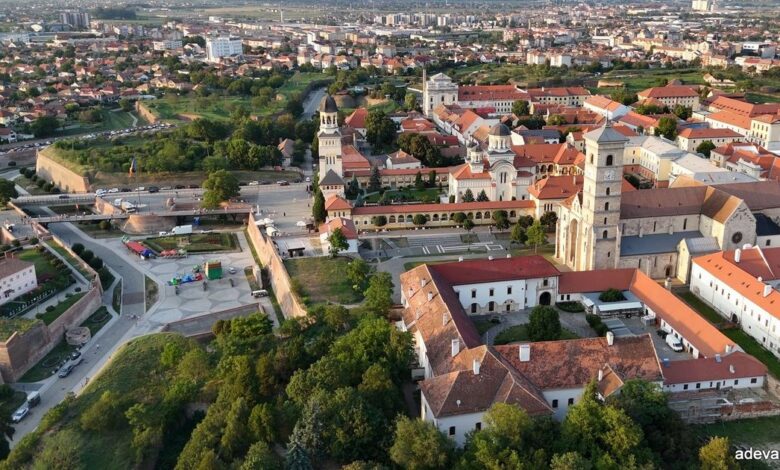
The Alba Carolina fortress is once again going through extensive transformations: its monumental gates are being restored, and the defense ditches are receiving new uses. Thanks to its fortress, Alba Iulia has become a tourist landmark of the region in central Romania.
Alba Carolina Fortress. Photo: Daniel Guță. TRUTH
Built three centuries ago on the site of the ancient Apulum, the Alba Carolina Citadel in Alba Iulia has undergone, in the last two decades, a complex rehabilitation process, which has transformed it into one of the most popular tourist destinations in Romania.
Starting from the 2000s, over 50 million euros, drawn from European funds, were invested to restore the splendor of the historical complex, left in a state of disrepair during the communist period and in the 90s, although it housed several representative monuments for Romania.
Ditches turned into parks
Due to its impressive dimensions, the works have not yet covered all areas. However, the citadel, the main tourist attraction in Alba Iulia, has turned the city into one of the most popular travel destinations in Romania.
Recently, several other representative monuments for the history of the Alba Carolina Fortress entered the construction site. An urban regeneration project, financed by European funds, will lead to the reconversion and re-functionalization of the outer moat in the eastern area of the citadel. The value of the investment amounts to almost 12 million lei, including VAT, and the works, which must be completed in 2027, aim to modernize the outer moat on an area of almost 20,000 square meters and set up a green area of almost 18,000 square meters on the eastern side of the fortress.
“The expected results are: 19,559 square meters of landscaped urban park, which includes a grass amphitheater, a volleyball court, a square for rest and socialization, an area equipped with ping-pong tables, a water mirror, two urban dog parks, a children's playground, two modular toilets, an access ramp for people with disabilities, two interactive signs and alphabet communication panels Braille, four information boards in Braille, paving and natural stone walkways, single ramp stairs, hexagonal geogrid walkways, urban furniture, 76 trees, 1,121 shrubs, 383 ornamental perennials, a public and architectural lighting system, a video surveillance system; 17,626.47 square meters of landscaped green space and an information and awareness campaign the population regarding the protection of nature and the conservation of biodiversity in urban areas”informs the Center Regional Development Agency.
The gates of the fortress are restored
Along with the outer moat in the east of the Alba Carolina Citadel, four of the seven monumental gates of the complex (Gates I, II, III and IV) are in the process of consolidation, conservation and restoration, following an investment estimated at 1.9 million euros, financed by the National Heritage Institute.
“These works are aimed at the intervention on the surface of the lithic material of the gates, in the perspective of stopping the biological actions, of the pre-consolidation of the support in question, in order to carry out the cleaning works, to consolidate and complete the support, to carry out the jointing works, as well as those of conservation, within the limits of the technical characteristics of the materials that will be put into the work, because, on the complex palette of the future restoration works of the monuments, the intervention on the stone components natural will be defining for the success of the entire restoration program“, informed the mayor Gabriel Pleșa.
In October 2025, the works on Gate II of the fortress were completed, and at the end of May 2026, the restoration works of Gate I were inaugurated. Currently, Gate III, located, like Gates I and II, on the eastern side of the Alba Carolina Fortress, is also in the construction site. In its case, the project requires more complex works, approximately 70 percent of which have been completed. However, their completion is expected only in 2027. Some preliminary works have taken place at the Fourth Gate, but conservation interventions could be completed in 2027.
The fortresses raised by the Habsburgs for fear of the Turks. What was the fate of the hard-to-conquer fortresses in Romania
The gates of the Alba Carolina Fortress
Gate I is located at the base of the terrace on which the fortress was built, on its eastern side, and is the first access point to the fortification. From here, travelers climb the slope at the end of which is the Second Gate of the citadel.
Image 1/19:
Alba Carolina Citadel Photo Daniel Guță (9) jpg
Gate I was built of stone and looks like a triumphal arch, with three entrances: one wider and two accessible only to pedestrians. It was decorated with bas-reliefs depicting Mars, the god of war, and Venus, the goddess of beauty. In the lateral areas, two short-barreled bombards are represented, and in the center, above the road access, there is a crowned double-headed eagle, on the chest of which the monogram of Charles VI is reproduced. Several heroes from Greco-Roman mythology are represented on the exterior facade. The decoration of the monumental gate was made in the period 1715–1738, during the construction years of the fortress. Gate I was rehabilitated and strengthened in the early 2000s.
The Second Gate, recently restored through the project carried out by the National Heritage Institute (INP), is the second access point to the citadel from the eastern side. Unlike Gate I, it was partially demolished in the mid-1930s, during the works on the obelisk dedicated to the three leaders of the 1784 Revolt: Horea, Cloşca and Crişan. In the late 2000s, the gate was rebuilt using original components preserved over time.
The third gate, also located on the eastern side of the fortress, is the main access point in the fortification, being the largest and most richly decorated. Featuring the appearance of a triumphal arch, it was built between 1715–1728 and its decor was meant to pay homage to Emperor Charles VI. For a long time, it was said that Horea, the leader of the mobs during the 1784 Uprising, was imprisoned in one of its rooms, before his execution. This gate was also rehabilitated in the 2000s, but time has taken its toll on it.
The 4th gate of the Alba Carolina Fortress is located in its western area, and in the past it ensured the exit of soldiers from the fortress to the training field. It too was rehabilitated in the 2000s. Also on the west side are Gate V and Gate VI. The last of the monumental gates of the Alba Carolina Fortress, Gate VII, was a secret exit, built with a thin layer of brick. It would have been used during the Revolution of 1848 by Avram Iancu and the Moti troops who came to help the inhabitants of the fortress.
The attractions of the Citadel of Alba Iulia
The Alba Carolina fortress, built at the beginning of the 18th century, impresses with its military architecture, characteristic of the Vauban style. Her main body is shaped like an irregular heptagon, and her seven bastions give her the image of a star.
Sarmizegetusa Regia, transformed into a huge construction site. The great Dacian andesite temple is rebuilt from the ground up
The settlement with massive brick walls loses its sobriety thanks to its gates adorned with art monuments. Many ancient vestiges have also been preserved here, reminding of the importance of the city of Apulum, one of the largest urban centers of Roman Dacia, where the 13th Gemina Legion was stationed.
In the Alba Carolina Citadel, tourists can visit the Coronation Cathedral, the place where, in 1922, King Ferdinand and Queen Maria were crowned. Nearby is the “St. Michael” Roman Catholic Cathedral, one of the oldest Gothic cathedrals in Romania, the place where John of Hunedoara was buried.
Union Hall is, in turn, one of the emblematic buildings of the fortress. Located in the premises of the former House of the Army, built between 1898 and 1900, this is the room where, on December 1, 1918, the 1,228 delegates who voted for the union of Transylvania, Banat, Maramureș and the Hungarian parts with Romania met.
Opposite the Hall of the Union, tourists can visit the National Museum of the Union, an equally impressive building built in the 19th century that houses valuable collections: more than 200,000 heritage objects and 70,000 volumes.
The Alba Carolina fortress was the place of martyrdom of Horea and Cloșca, in 1785, and the place where Avram Iancu, the leader of the Apuseni mobs, was imprisoned during the Transylvanian Revolution of 1848-1849. An obelisk dedicated to the three leaders of the uprising, Horea, Cloșca and Crișan, over 20 meters high, was erected near the 3rd Gate of the fortress.
Public buildings, such as the headquarters of the “1 Decembrie 1918” University, numerous terraces and recreational areas, ditches, art monuments, open spaces and cultural events also attract many tourists.