June 2 17:00
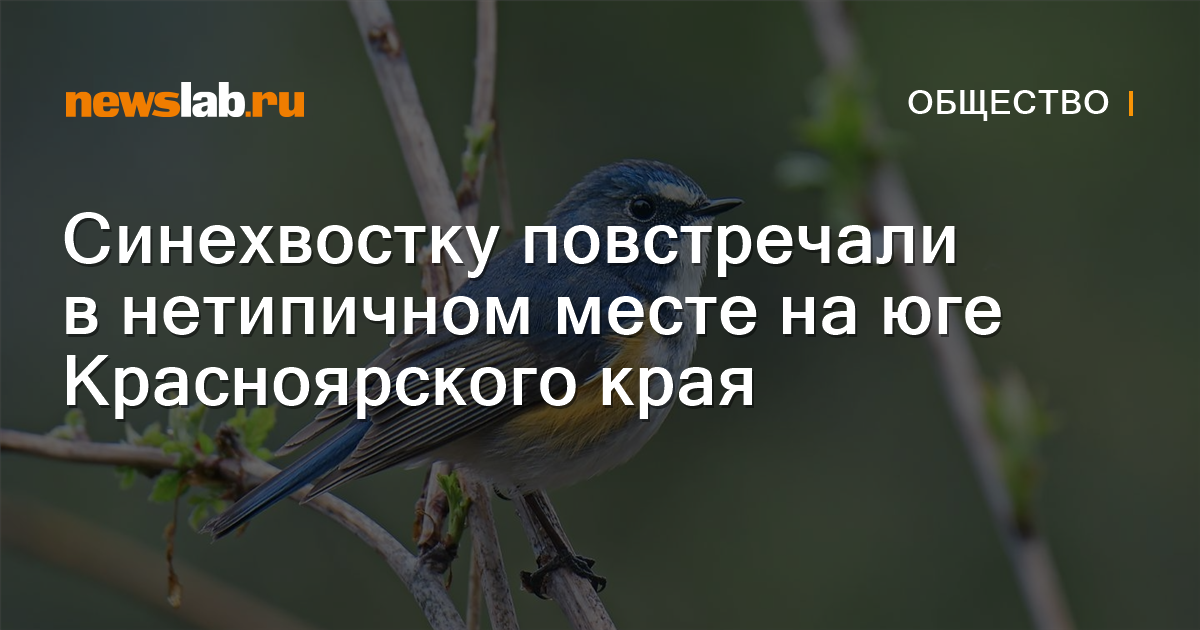
In the Krasnoyarsk Territory, on the territory of the Perovsky cluster of the Shushensky Bor national park, ornithologists unexpectedly noticed Bluetail is a small, showy bird.
For this location, the registration of this species was the first in the history of observations.
As ornithologist Sergei Petrov explained, the photographs taken in the Zhuravlinaya Gorka area show either a female or a young male: “One-year-old males (2nd calendar year) are colored like females, and some of them, even when they mature, do not change their outfit. Therefore, when meeting such individuals, one can easily confuse a male and a female, but the very fact of registration is extremely important for science.”
The bluetail is significantly smaller in size than a sparrow: the body length of an adult bird is only 13-14 cm, and its weight varies from 10 to 18 grams. The plumage of males is distinguished by a rich blue coloring of the tail, rump, wings and a significant part of the head, especially dark shades appear on the cheeks and neck, and bright red markings are visible on the sides and under the wings. Females have a more restrained palette: their tail also has a blue tint, the wings are painted in olive-gray tones, and there are red spots on the sides, the belly and throat are light, and there is a narrow white ring around the eye.

Bluetails mostly stay hidden, in thickets of bushes near the ground, but often descend to the ground, where they move by jumping. They collect food on the ground, bushes and trees, but they can also catch insects on the fly. When “bowing,” birds move their tail up and down or twitch it. They sing in a peculiar way, quietly, on low notes.
“The bluetail is widespread in the taiga zone from the Urals to the Pacific Ocean. In the Mountain Cluster of the Shushensky Bor National Park, the bluetail is a common migratory and nesting species. The bird prefers cedar woodlands, fir-cedar and mixed valley forests. Arrival in low mountains is recorded at the end of April – beginning of May. During periods of migration, the bluetail is also found on the Yenisei fields. A reliably recorded meeting of the bluetail in the Perovsky cluster not only proves that the boundaries of the species’ range are moving, but also confirms the high natural value of this territory. Further observations will make it possible to determine whether the bird is a random visitor or whether the Perovsky cluster is becoming a new place of regular meetings for it during migrations,” experts said.
Newslab now in MAX. News is also published in OK | VK | Zen | Telegram
Related links:
- For the first time in 30 years, a bird of prey in a black “mask” was seen in winter in “Shushensky Bor”
- In the Krasnoyarsk Territory it is allowed to hunt cormorants