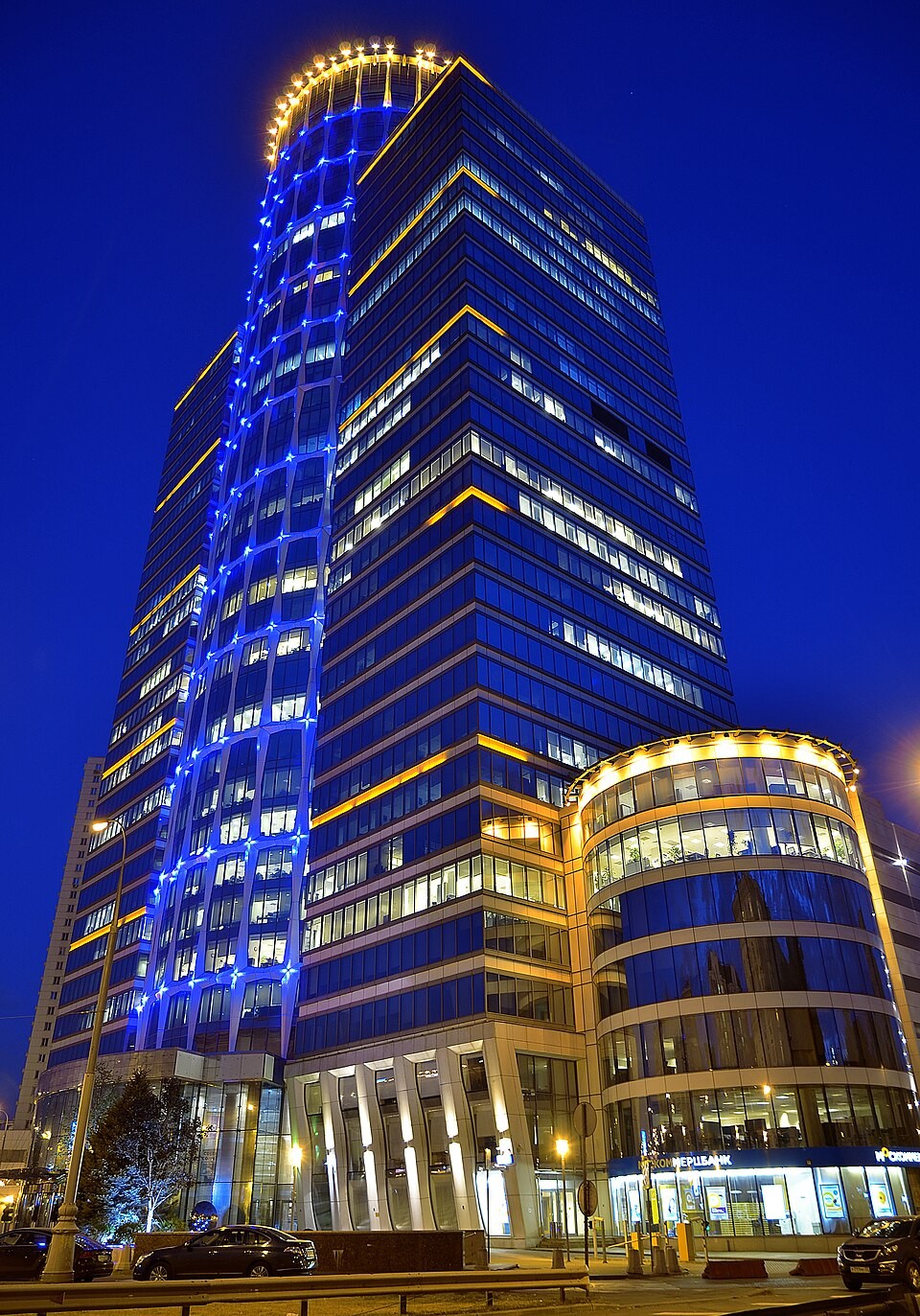
Russia has begun to create its third and largest outer air defense ring, encompassing Moscow and its surrounding suburbs. Its goal is to protect the capital from constant Ukrainian long-range drone attacks. As part of the inner layer of defense centered directly around the Kremlin, the Russian armed forces used Mi-26T heavy transport helicopters to place the new Pantsir-SMD-E anti-aircraft system on the roof of the Nordstar Tower business center.
As Defense Express reports, Russia has accelerated the militarization of its capital's skyline. In addition to the construction of the third, extensive ring of anti-aircraft systems, the transport and installation of a new generation of missile launchers on the roofs of civilian skyscrapers has also begun.
Drones have not yet reached the Kremlin, but they have clearly reached the imagination of its hosts. The result is a fortress built in haste and with increasing anxiety.
Russian defense planners have spent recent months building a vast third layer of surface-to-air missile systems that will completely surround Moscow and the densely populated metropolitan areas around the city, according to military reports and satellite data.
This outer ring complements two existing rings of specialized anti-drone towers – modern equivalents of the German Flakturm anti-aircraft turrets of World War II.
At the same time, the Russian military is strengthening a dense, local internal defense network designed specifically to protect the Kremlin. This urban security layer is based primarily on short-range mobile systems deployed directly in civilian space.
Pantsir moves into the office building
The latest stage of the expansion of the internal defense network was recorded on video. They show a huge Russian Mi-26T transport helicopter lifting the Pantsir-SMD-E anti-aircraft module and placing it directly on the roof of the Nordstar Tower business center in northern Moscow.
This is the fourth known Pantsir system permanently deployed on the roof of a Moscow office building. The first older Pantsir-S1 set was permanently mounted on the roof of the Russian Ministry of Defense headquarters, located southwest of the Kremlin, in 2023.
A second system was installed on the roof of a commercial office building southeast of the main administrative complex also in 2023. A third unit was installed in late 2023 on the roof of the Main Directorate of the Ministry of Internal Affairs, located north of the Kremlin.
The latest element of this defense network, the specialized Pantsyr-SMD-E model, was deployed in late May 2026.
Pantsir missile system at a military parade rehearsal on Red Square (stock photo)SEFA KARACAN / ANADOLU AGENCY / Anadolu Agency via AFP / AFP
Unlike the older Pantsyr-S1 sets, the new Pantsyr-SMD-E is a modified version without the standard dual autocannons. The system relies solely on an increased supply of interceptor missiles. It is armed with 95Ja6 rockets with a range of up to 20 km and smaller short-range TKB-1055 missiles, designed specifically to combat small drones and loitering munitions.
The system's on-board radar can detect and track air targets from a distance of up to 24 km.
The price of protecting the Kremlin
Military analysts sharply criticize the deployment of heavy weapons on non-military facilities. Defense Express points out that installing active air defense systems on the roofs of ordinary civilian office buildings is a direct violation of international humanitarian law.
By including these buildings in the city's air defense network, the Russian army is de facto transforming functioning civilian facilities into high-priority legal military targets in accordance with applicable rules of hostilities.
The article continues below the video
Moreover, the operation of such missile systems in a densely populated capital poses a direct and serious threat to residents. The operation of Pantsyr sets in urban conditions is associated with a high risk of collateral damage. The reasons include:
falling debris of downed drones,
limited effectiveness of target tracking in an environment that strongly interferes with radar operation
and heavy interceptor launch stages that, when detached, fall to the ground completely uncontrollably.
The Nordstar Tower business center is located in the immediate vicinity of high-rise residential buildings and a municipal school. In the event of a Ukrainian drone attack or failure during target capture, shrapnel, exploding warheads and falling missile components could fall directly onto school classrooms and surrounding streets.
Nordstar Tower in MoscowSergey Korovkin 84 / Wikipedia Commons
A costly warning
The hasty construction of a multi-layered “fortress” inside Moscow comes after a series of high-profile successes by Ukrainian units using long-range drones. On May 17, a Ukrainian drone attack successfully damaged an oil refinery in the Moscow Oblast, forcing the plant to completely cease production.
This operation followed an earlier attack on May 4, when a drone directly hit one of the iconic residential skyscrapers in western Moscow. This happened just days before Russia celebrated Victory Day on May 9 and the accompanying military parade commemorating the end of World War II.
These events have revealed deep weaknesses in the Russian security system, which the Kremlin is now frantically trying to remove by expanding its air defense even at the expense of the safety of its own civilian population.
I’m Ashley Davis as an editor, I’m committed to upholding the highest standards of integrity and accuracy in every piece we publish. My work is driven by curiosity, a passion for truth, and a belief that journalism plays a crucial role in shaping public discourse. I strive to tell stories that not only inform but also inspire action and conversation.