Digital sovereignty is one of the pillars of independence. At this year's April INCYBER Forum Europe in Lille, the European debate on cybersecurity was particularly strong. This topic increasingly goes beyond technical issues, becoming a dispute about the political and economic independence of countries from global technology concerns.
When working, communicating or shopping, we mostly use the services of American companies such as Amazon, Meta (Facebook and Instagram), Microsoft, Google and OpenAI (ChatGPT). Their European counterparts do not seem attractive to us for some reason.
The French gendarmerie runs on Linux
The rapid development of artificial intelligence, digital platforms and cloud services has made European countries increasingly dependent on infrastructure belonging mainly to American technology giants. There are more and more alarms about the dangers associated with this. Representatives of the French Ministry of the Interior emphasized in Lille that what is now at stake is not only protection against cyberattacks, but also “the continuity of the state's operations.”
France is investing heavily in solutions described as sovereign: national cloud services and its own administrative communication systems, as well as in cybersecurity training for local governments. This is a reaction to the growing awareness that control over data and digital infrastructure is becoming strategically important today, on a par with control over the energy and defense sectors. Digital dependence on the US in a situation of political pressure may end with the disconnection of some or even all digital services that Europe cannot provide on its own.
The decision that the French gendarmerie would work on Linux was made several years ago, initially for pragmatic reasons – to reduce licensing costs and increase the flexibility of the IT infrastructure. Over time, however, the desire to become independent from the American supplier prevailed. The National Gendarmerie gradually replaced Microsoft Office with the OpenOffice package, and then implemented its own version of Ubuntu (Linux operating system), the so-called GendBuntu. This saved over EUR 50 million and increased state control over the IT system.
Badge of a police officer from the National Cybersecurity Unit of the French Gendarmerie during the 18th edition of the “InCyber” forum, April 1, 2026.Sameer Al-DOUMY / POOL / AFP
France, with increasingly higher taxation of American giants and readiness to invest in European digital equivalents, seems to be the most consistent EU country when it comes to trying to reduce dependence on foreign technology suppliers. However, this process is accompanied by strong tensions, also on the internal political scene. The left emphasizes the issues of tax fairness and protection of public services, part of the right talks about national security and strategic autonomy (both camps basically agree on the need to limit foreign technologies), while the technology lobby and part of the business community warn of a conflict with the US and weakening the competitiveness of European economies.
The French dispute is subject to pressure from Brussels, which on the one hand wants to regulate the functioning of digital giants and, on the other hand, wants to maintain good trade relations with Washington. In this context, the issue of optimal taxation of Big Tech comes up more and more often. European governments realize that American digital platforms not only achieve huge profits thanks to their operations on the European market, but also have a stronger economic position than many nation states.
The debate on digital tax is therefore not only about fiscal justice and limiting the transfer of profits to tax havens. It is an attempt to regain some control over the digital economy, where today only a few global corporations decide on the flow of data, information and capital.
Tax capitulation to the USA
In France, the digital tax has become part of a broader policy towards global technology companies. Already in 2019, Paris introduced a three percent tax on digital services for companies such as Google, Apple, Meta and Amazon, and is now trying to increase it. The Parliament decided to double it because it found that the existing tax system is completely unsuited to the scale of Big Tech's digital and economic expansion.
Google, Amazon, Facebook and Apple have been generating huge revenues on the French market for years, but their profits are transferred to tax havens, and as a result, France makes almost no profit from them. Therefore, during the work of the Finance, Economics and Budget Control Committee, there were proposals to increase the tax even five times. Ultimately, they were withdrawn – but not for economic, but political reasons.
This shows how much pressure American lobbyists exert on politicians. The Minister of Economy and Finance, Roland Lescure, stated directly on the LCP Assemblée Nationale website that excessive taxation of GAFAM (Google, Apple, Facebook, Amazon, Microsoft) may result in direct retaliation from Donald Trump. Therefore, the parliamentary debate ceases to be a discussion about tax justice and becomes a calculation of political risk.
Ultimately, in October 2025, a compromise was adopted – an amendment was introduced to the 2026 budget setting the tax at 6%. instead of 15 percent However, this limited variant was also calibrated in terms of possible repercussions.
Initially, it was to cover all technology groups achieving at least EUR 750 million in global revenues per year and at least EUR 25 million in revenues in France. However, in the draft reform of 2025, the global revenue threshold was raised to EUR 2 billion. This means that the tax may only apply to the world's largest technology concerns (amendment No. 1746 was submitted by Senator Nadège Havet on this matter). The tax is intended to cover key segments of the digital economy: targeted advertising, trade in user data and the activities of intermediary platforms (e.g. Booking.com, Airbnb, Amazon).
The revenues from this tax instrument are estimated at approximately EUR 800 million annually – they are to come mainly from American Big Techs. On the scale of the state budget, this has more symbolic than structural significance. However, the political importance of this undertaking, if the amendment comes into force, will be incomparably greater.
The debate around this regulation revealed deep divisions in parliament. The left is openly talking about capitulating under pressure from the United States. He points out that the fear of Washington's reaction is increasingly paralyzing European legislative sovereignty. In turn, part of the right argues that an overly aggressive policy towards American companies could hit French exports, especially the luxury goods and wine sectors, which are particularly sensitive to possible trade wars. This means that even such a limited attempt to tax global technology giants today takes place with the approval of the USA. The state's fiscal sovereignty, at least in the field of the digital economy, is becoming more and more relative; regulations depend not on the decision of parliament, but on the reaction of external, private power.
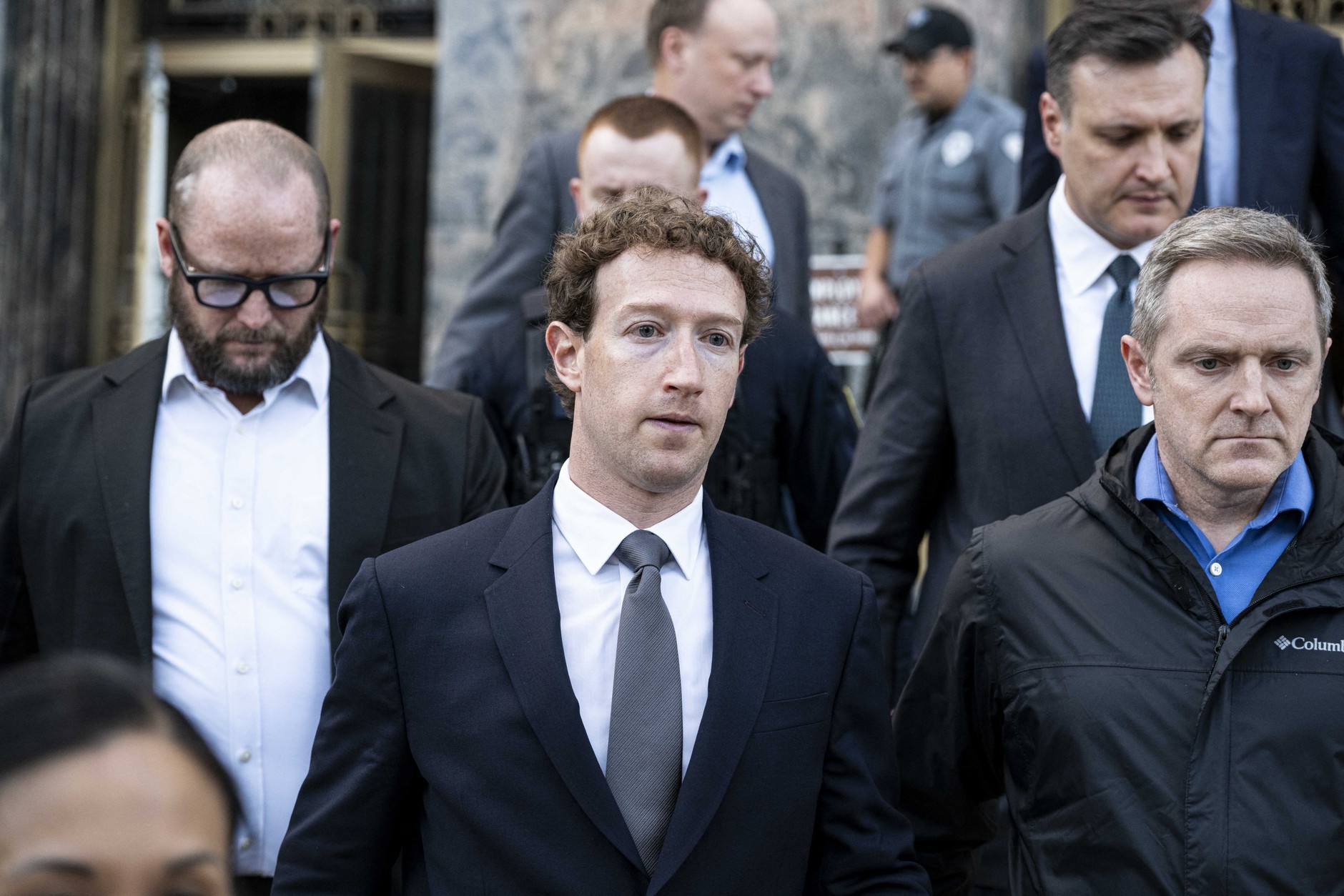
Mark Zuckerberg leaves a Los Angeles court after presenting his defense on the addictive nature of social media, February 19, 2026.Jon Putman / AFP
But international negotiations have been bogged down for years, mainly due to the opposition of the United States. Another problem is the aggressive tax optimization of GAFAM, which settles in Ireland or Luxembourg (where taxes are lower), avoiding paying tax rates applicable in other parts of Europe.
What do large companies give us?
Today, when companies whose capital exceeds the GDP of some countries operate on the markets, the principles of functioning of societies will increasingly be determined by the interests of large investors and corporations, and not by democratically established rules or the interests of citizens. If people like Mark Zuckerberg, Elon Musk or Jeff Bezos gave at least 10%. companies' profits to the countries in which they are active, this could largely plug the budget holes of these countries. And yet, tax avoidance is increasingly being justified by following the American vision of liberalism.
Also in some European countries, more and more people are demanding the reduction or partial abolition of taxes. Interestingly, these ideas come from people who do not have capital, but defend large corporations in the name of a strangely understood freedom.

“Tygodnik Przegląd” No. 22Press materials
In the face of these changes, France is taking a more radical direction, although the increase in liberal tendencies is also strongly felt in French society. If we believe the January results of the study “L'Observatoire des marques dans la Cité” (“Observatory of brands in society”) conducted periodically by the Havas Paris agency, there is a growing belief in France that enterprises should take over some of the roles traditionally assigned to the state. Today, part of society considers large companies to be more effective than the state, e.g. in solving some social problems. For example, 66 percent respondents believe that enterprises are better at fighting unemployment, and 62 percent believes that they support the integration of young people more effectively by offering them employment.
At the same time, as the study shows, companies are gaining the status of political and moral actors – as many as 86%. respondents believe that they can be both profitable and ethical. However, despite the growing influence of large companies, the state is considered the main and most authorized decision-maker in key areas of social life, such as education, social integration and the defense of republican principles. This means that although respondents recognize the effectiveness of enterprises' activities in some economic issues, they are not ready to completely replace public institutions with them.
And this is not about simple replacement – rather about a gradual shift in social expectations: enterprises are increasingly perceived as co-responsible for solving public problems and, in order to survive, they must offer real benefits, not only economic, but also social.