Hanna Notte, a recognized expert in the field of Russian foreign policy, sees the danger that the Kremlin dictator, Vladimir Putin, given his limited military capabilities in Ukraine, will start looking for other ways to increase pressure on Kyiv and its allies.
Because even brutal rocket attacks on Ukrainian cities they will not force Ukraine to surrender militarily or to make painful compromises. Although Notte clearly emphasizes that such a scenario does not have to happen, he warns: – In such a case, there is only one option: escalation towards Europe.
Putin has been attacking Ukraine with missiles and drones for years, but without breaking the spirit of the local society. Simultaneously Ukrainian strikes are increasingly hitting targets deep in Russian territorywhich destabilizes the Kremlin system. The key question from Moscow's perspective is whether Russian military means will be enough to force Ukraine to make concessions.
The article continues below the video
Attacks on the “backroom”, i.e. on Ukraine's European allies
That's why Notte says: – I'm not saying this will definitely happen. But there is a possibility that Russia will reach the point where it will say: Ukraine with its campaign deep strike [głębokich uderzeń] it constantly hits our base.
According to the expert, in such a scenario, Ukraine's strategic support, i.e. European allies, may also become important “more vulnerable to attack”. This concerns the European arms industry, logistics centers and routes through which military aid is delivered to Ukraine.
Notte does not foresee a major attack on NATO or the opening of a new front in Europe. On the contrary. — The most likely scenario of a Russian attack on NATO territory is, in my opinion not a major offensive or large-scale war. Rather, “targeted” strikes against the arms industry.
“Russia's ability to open a second major front elsewhere is minimal.”
Also on the issue of Russian military power, Notte calls for a careful distinction. As long as the war in Ukraine continues, Moscow's options are limited: — As long as Russia is fighting in Ukraine, its ability to open a second major front elsewhere is minimal.
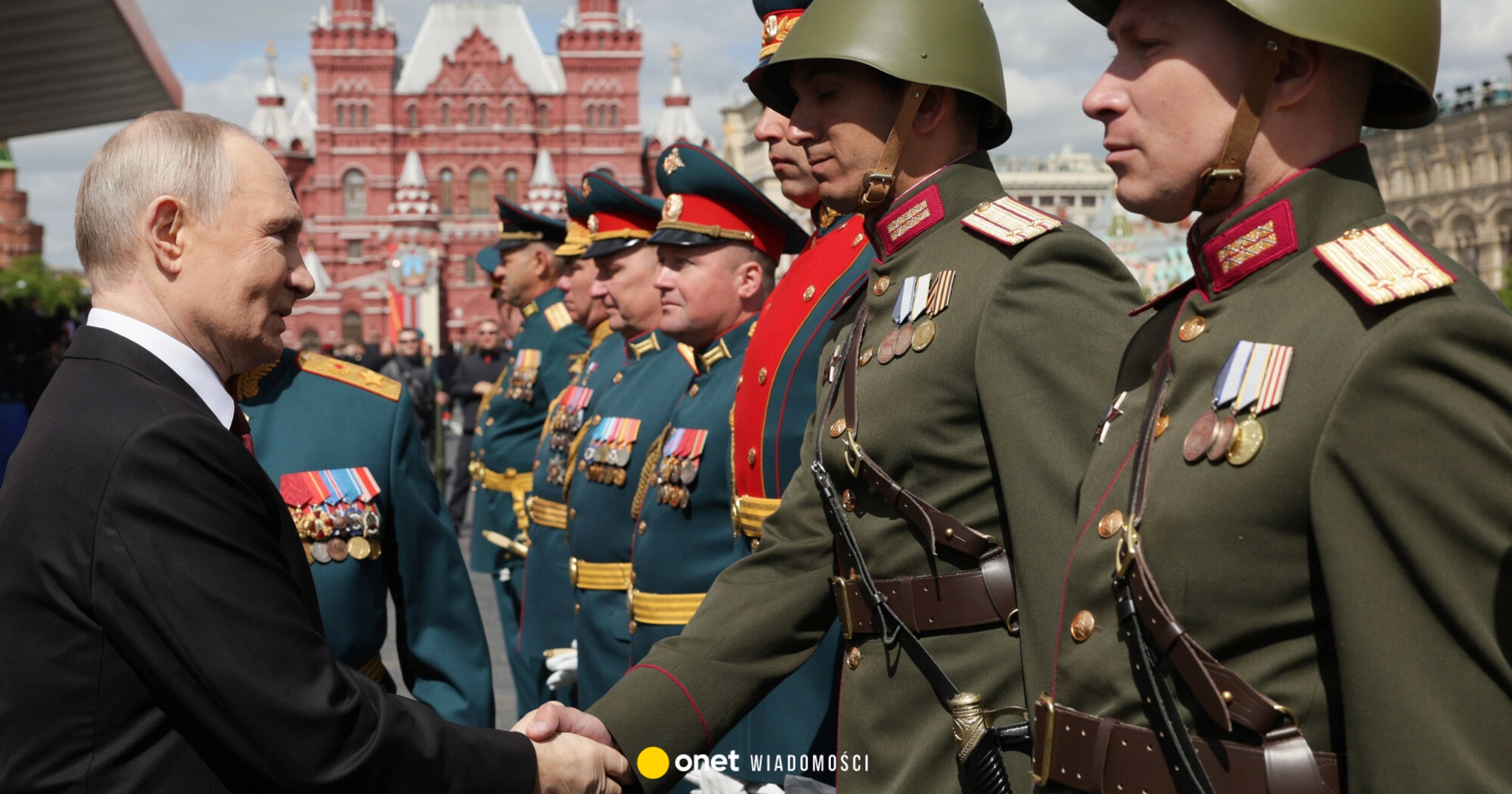
A screen showing Vladimir Putin's speeches on Victory Day. Moscow, May 9, 2026EPA/MAXIM SHIPENKOV / PAP
Her concerns are therefore primarily about limited strikes that may have political consequences. An attack on a single target in a NATO country could trigger difficult debates within the alliance: how to react? How far to go? And will the alliance remain united?
From the Kremlin's point of view, this may be the point. In her opinion, the most important thing for Russia would be to “increase fear among European societies and political elites and the breakdown of the consensus on the durability of support for Ukraine.
“Let's imagine that several cruise missiles hit a hypothetical weapons warehouse in Poland.”
The question for NATO countries in Europe is then: how will we respond?
Notte draws the following scenario: – Let's imagine that several cruise missiles hit a hypothetical weapons warehouse in Poland […] and 12 people die. What is happening politically in Europe then? Will everyone immediately recognize: this is Art. 5, so collective defense comes into play? And will we respond militarily together? Or maybe Poles will respond themselves, and other NATO members will say: “We don't want to enter into a confrontation with Russia because of this, it's too risky.”
In this way, Russia would be able to seriously weaken NATO in a political sense, without having to launch a major attack.
I’m Ashley Davis as an editor, I’m committed to upholding the highest standards of integrity and accuracy in every piece we publish. My work is driven by curiosity, a passion for truth, and a belief that journalism plays a crucial role in shaping public discourse. I strive to tell stories that not only inform but also inspire action and conversation.