INTERVIEW Reported in Romania as a possible technocrat prime minister, I spoke with Anca Dragu, the Governor of the National Bank of Moldova

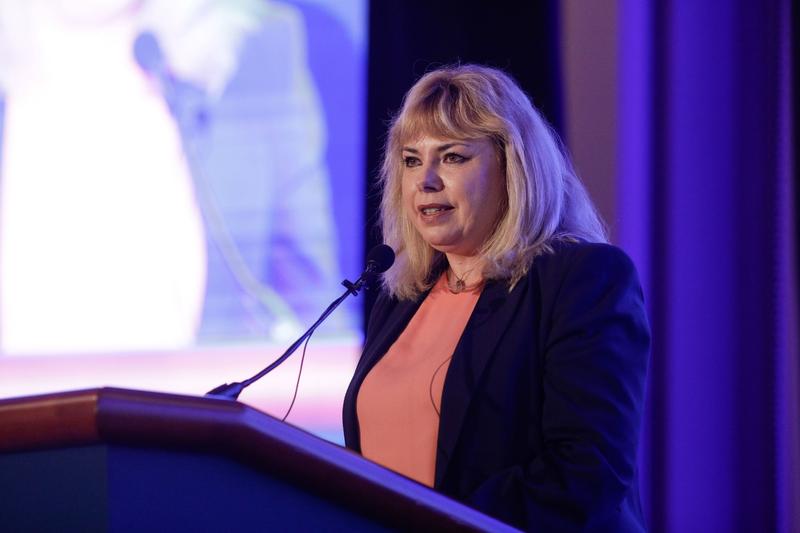
Anca Dragu talked about what she can – and what she can't – say about politics in Romania.
- By definition of his job, the governor of a national bank talks little. Anca Dragu is no exception.
- I asked her about the union and she answered about the connection between the National Bank of Romania and the National Bank of Moldova.
- I asked her about a technocrat prime minister and you'll see what she said. The discussion focused on economics, not politics, we don't want to fool anyone.
- But what does an economic discussion look like in a country like Moldova, where 90% of the economy is represented by SMEs?
Answer: There is a narrative that talks about a possible union of Moldova with Romania. There are several connection programs between the two countries, such as the BNR with the NBM. However, there are several national institutions that run similar programs in Moldova. Do you see the union possible, achievable, plausible?
Dear Anca: I want to talk about the collaboration we have with the BNR. And yes, it is a very natural, natural collaboration that we have at the NBM, not only with the BNR, but also with the ASF, because we also manage the insurance area from 2023. That means we have to learn insurance on the fly very quickly. So our collaboration with Romanian institutions is very good, intense and auspicious.
– Is Moldova's economy ready for EU accession?
–Yes, absolutely.
– I am asking you because I know that there is an informal segment of the economy in the Republic of Moldova that is quite well defined, quite consistent.
–The evaluations that I have been doing, at least I am talking about the financial banking sector, look very good from the point of view of legislation, institutions and good practices.
A year ago we started an assessment with the European Banking Authority, the European banking authority that gives the exact time in the banking field in the EU. We passed the first stage, there was a self-assessment from our side, then a first stage from their side, now we are in the second stage. In September this year we expect to complete the assessment with the EBA. We hope that this evaluation will show us that yes, from the point of view of the banking sector, we are aligned with EU legislation.
This means that any EU investor can invest in the Republic of Moldova as if in another EU country.
“please understand me”
-A question related to politics in Romania. Do you think a technocratic prime minister is suitable, would a technocratic prime minister be suitable?
-As the governor of the Bank of the Republic of Moldova, please understand that I cannot make any kind of comment related to politics in Romania.
-BNM raised the base rate to 6.5% in May 2026, after keeping it at 5% — how hard was that decision, knowing that the domestic economy was already in contraction? I understand that Moldova's economy is slowing down this year.
– We remain with the forecast somewhere over 2% in our estimates. The growth forecast is not made by the National Bank, although of course we have our own estimates. Economic growth for 2026 has been revised downward worldwide due to shocks at the start of the year.
“I would go to bed and wake up with the numbers in my mind”
-The question was whether the “step” was too big, if it did not strangle growth.
–Look, in all honesty, I say that about two weeks before the decision I was going to bed, waking up with these analyzes and numbers in my mind. We were looking at the evolution of prices in March, they had already accelerated a bit. So we started the year with somewhere around 5% inflation, that is, we were at the target level.
January, February – I was in range though. Even March, although inflation in March went to 5.8%. So from a 5.1 in February, to 5.8 in March, and this was immediately seen in the prices – we saw an increase slightly above estimates in the prices of fruits and vegetables. Here, probably, the explanation comes from a more difficult winter and the need for heating, you know, in greenhouses for example, where heating is needed for a longer period of time.
In April, the price increase continued and that's why we kind of went with this forward looking approach.
Let's prevent the developments that followed and those of the second round and really provide an inflationary anchor, let's have a forward looking approach.
Of course, these are not simple decisions. But a few days after our decision, inflation came out for the month of April and inflation was 6.7%. So an increase. From 5.8% to 6.7%, an increase of almost one percentage point is quite a lot. And then, we did some analysis and it turned out that we have to come up with this decision.
We had taken a similar decision in 2025. In January 2025 the monetary policy rate was 3.6%, which we almost doubled to 6.5%. And I saw then that this shock therapy worked.
-How is the monetary policy decision taken at the NBM? Is it like the BNR?
–The National Bank of Moldova has a management system consisting of the Executive Committee and the Supervisory Board.
Decisions on monetary policy are made by the Executive Committee, which consists of the 5 executive members. The Monetary Policy Directorate is the one that comes up with the proposal and presents it, we discuss it extensively, or in several rounds.
I also had discussions with the IMF team on this subject, as a rule, because now we have already started a new agreement, an agreement without financing. It is an agreement to anchor our policies and for credibility.
We have these consultations with the IMF teams and I, since I have been at the National Bank of Moldova, have always had consultations with the IMF as well. We sometimes had disagreements, but we each have arguments on his side and in the end we make the best decisions.
-When you made the decision to increase the monetary policy rate, did anyone of the 5 oppose it?
–Not. All 5 executive members were in favour. We had a unanimous decision for this increase.
-The report explicitly talks about a persistent structural deficit — not cyclical. How much can monetary policy do without real fiscal reforms?
–In this program with the IMF, the Ministry of Finance comes with a very important component in terms of reforms in the fiscal sector and they are reforms in the area of VAT, income tax and profit tax. The goal is to align with the best European practices, but also to eliminate multiple fiscal regimes with high administrative costs. The Ministry of Finance is in a serious process of analysis and reform towards the public finance sector, the fiscal sector.
“In Moldova, SMEs represent over 90% of the economy”
-According to the NBM reports, financial intermediation increased from 20% to 30%, if I'm not mistaken. And my question was to whom do the banks give loans, because the economy is quite small.
-SMEs have a much higher share than in Romania and than the European average, for example. Over 90% of the economy is represented by SMEs.
By activity sector, the first place is the trade sector. Here it was a battle for first place between real estate and commerce, between real estate and commerce. We see recently that real estate has significantly reduced the rate of growth.
Prices have reached quite a high level. I could see a plateau on which he sat down. So, trade, real estate, agriculture is coming quite well. Then there are government programs. It is a public entity, ODA, the Organization for the Development of Entrepreneurship.
It is an organization similar to the Loan Guarantee Fund (FNGCIMM) in Romania and there are credit support projects for SMEs. There is also this growth plan, as EU member countries have PNRR.
We have a similar concept to PNRR: a combination of reforms and investments. The value of the growth plan is 11% of GDP, also for 3 years. It also includes a financial support component for SMEs.
But once we saw funding costs come down in 2024-25, that was immediately felt in the increase in demand and bankable demand for the banking sector.
“The earlier the economy is at the beginning, you have to work on data quality”
-Do you think AI is useful in macro forecasts, for example?
–Interestingly, we have an internally developed tool called MihAI. He is a new colleague, who has learned all our regulations and knows how to correspond with banks.
The application helps us to use all the information in the regulation and correspondence with the banks. He is our smart colleague.
-What about the inflation forecast, for example?
–On the forecast we have a model that has been working with for some time. This year we are also starting to do an evaluation of the model. I hope we have a couple of years to come up with improvements. These models are not that dynamic anywhere in the world. They need some time to test themselves.
And then, the earlier the economy is in the beginning you have to work on the quality of the data. That is the biggest challenge.