How a young woman from Chisinau wants to revolutionize bionic prostheses with the help of AI. Her project, awarded at a famous science competition

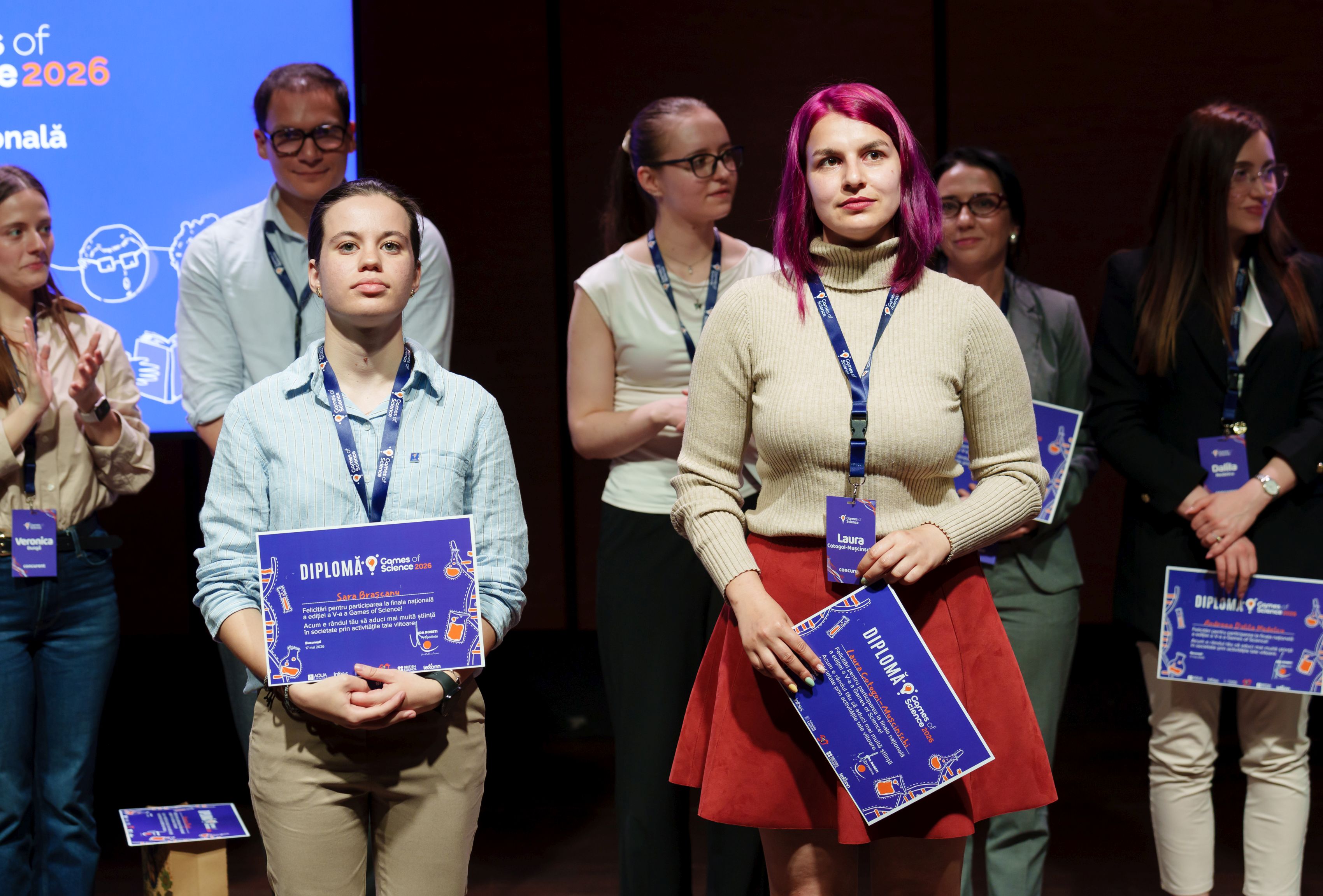
A young woman from Chisinau, a master's student in Timișoara, is researching methods by which bionic prostheses can reproduce more natural and precise movements. Laura Cotogoi-Mușcinschi won this year's edition of the “Games of Science” contest, in which 16 finalists participated.
The winner of the competition is a master's student in Biomedical Electronics at the Faculty of Electronics and Telecommunications at the Polytechnic University of Timișoara.
Her research is on prostheses controlled by muscle signals and technologies that reproduce gestures and movement.
At the moment, Laura Cotogoi – Mușcinschi is doing research on the theoretical side, with different simulations and techniques for processing electromyographic signals on the computer, she explained to HotNews. She hopes to move on to practical research within a year.
“I'm also thinking about a PhD and I want to work more with hardware equipment than with signal processing, but also in the area of biomedical technology,” says the 23-year-old. She is from Chisinau, but has been living in Timișoara for five years, where she moved to study.
Games of Science is a science communication competition held every year, it has a total of eight stages (plus the final), and the idea is for young masters and researchers to talk about their work, presenting complex ideas in language that can be understood by the general public and without PowerPoint presentations. The winners receive a scholarship worth 2,000 euros “for further training in science communication”.
“After an amputation, the brain continues to send commands to the limb that no longer exists, and these remain in the form of very weak electrical signals. I study methods by which these signals can be captured and filtered, so that bionic prostheses become more effective,” explains Laura Cotogoi – Mușcinschi.
Prostheses “could make much more complex and much more natural movements and there would no longer be that jerky, robotic movement. (…) Robotic exoskeletons could also be developed adapted not only for hands or feet, but also for other areas of the body”, explains the master's student from Timișoara.
What would the prostheses have in addition, if the research proves successful? Very small sensors capable of sensing any electrical impulse, sensors capable of filtering between different signals, she says. What could come next? “After a lot of practical tests, maybe I could end up teaching a smart sensor myself, maybe with the help of new AI technologies, so that it knows which signal is responsible for a certain movement. It would mean that only that one can be used further to operate the prosthesis,” says the Games of Science winner.
Myoelectric prostheses are prostheses controlled by electrical signals produced by the muscles. They are most often used for hands and arms
A bionic prosthesis is an advanced prosthesis that can be controlled electronically and that attempts to reproduce some of the natural functions of a human limb.
What is Games of Science
Games of Science is a national program dedicated to communicating scientific topics in a way that the general public can understand, in which young researchers present their work in short and accessible formats.
Games of Science is a science popularization project, organized by the PublicSciForum Association. The 2026 edition started in February and there were eight local stages, leading up to the national final on 17 May.
Games of Science is open to students, masters, PhD students and young researchers from all fields, with a recommended age of 20 to 35, who want to get involved in promoting science to the public. Previous experience is not required, and the lack thereof is not an impediment to participation.
The contest is coordinated by former journalist Ada Roseti and has reached its fifth edition, the first being organized in 2022.