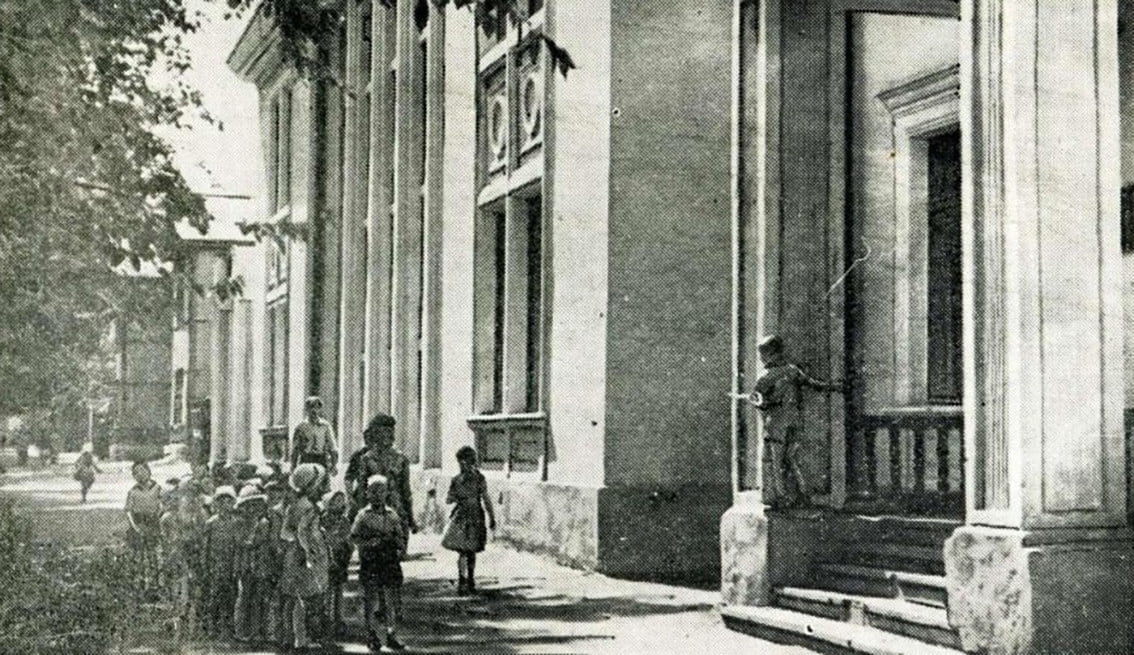
Region library named after Sholom Aleichem and the JAO Museum on the street. Lenin
Photo: State Archive of the Jewish Autonomous Region
May 23, 1942
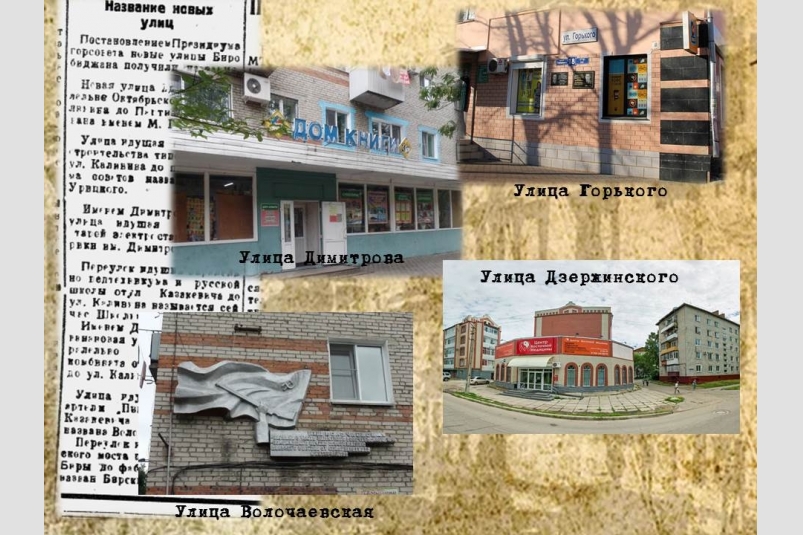
The newspaper “Birobidzhanskaya Zvezda” (12+) published an article by regional political education inspector A. Brezinov about the work of libraries in the Jewish Autonomous Region during the Great Patriotic War.
Clippings from the newspaper “Birobidzhan Star”. Photo: Photo: Regional Library
“…this year, despite the war situation, large funds have been allocated for library work. The closure of not a single library is allowed.
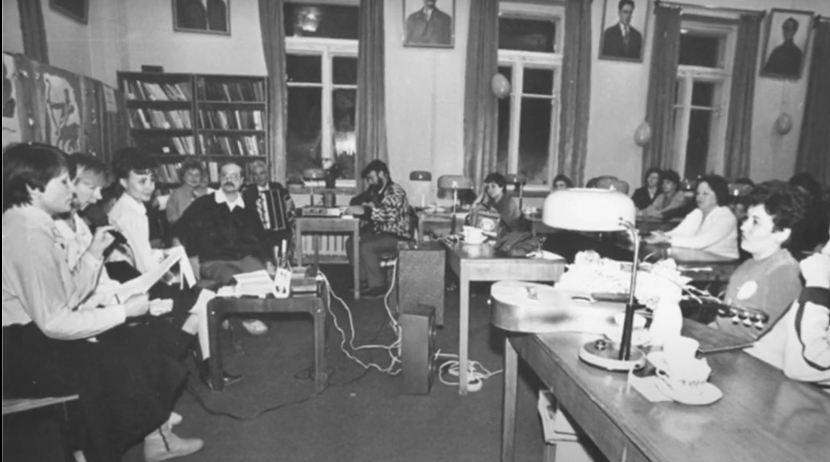
Regional Library named after. Sholem Aleichem has over 2 thousand readers. During the months of the Patriotic War, the number of library readers doubled. In February alone, 895 new readers were reached.
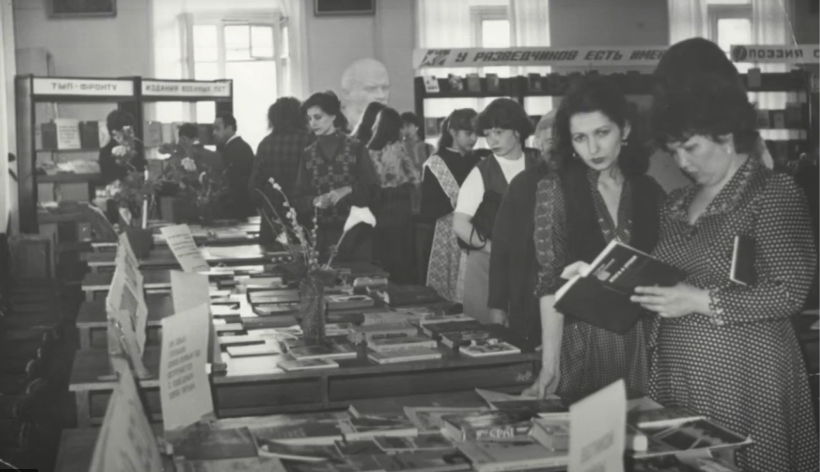
The library carries out a lot of mass work, systematically preparing book exhibitions, installations, and lists of recommended literature. A number of exhibitions have been prepared on the theme: “The Patriotic War of the Soviet People” (12+). The library serves a number of collective farm political and educational institutions and city industries with mobile vehicles.
The regional library of the Smidovichi district works well (the head of the library is Comrade Gusev). On the walls there are photo displays (12+), boards with pasted newspaper clippings (12+), three book exhibitions (12+), which are constantly changing. Albums about the activities of Lenin and Stalin, an atlas of the commander of the Red Army (18+) are prepared on the tables for visitors. A military corner has been created, and fresh newspapers are posted daily.
There is a children's activist group at the library. The library serves up to 400 readers. In the first quarter of 1942, 4,198 books were issued here. The library collected many books as gifts to the Red Army. Three transports with books were sent to collective farms.
The library of the village of Volochaevka (headed by Comrade Glushkov) has now taken all its work out into the field, into the camp. Comrade Glushkov conducts readings and conversations with collective farmers. He created a considerable asset around the library. In the circles working at the library, 15 badge holders of the PVHO and GSO were trained. A wall newspaper is published twice a month.
I completely devoted myself to working with the books of the manager. library of the village Nikolaevka t. Nenado. In many ways, the chairman of the village council, Comrade Zaidman, helped her in her work. The village council has allocated a new spacious room for the library. In the first quarter, 2,270 people visited the library. There are four book exhibitions organized here, and there is an information desk.
Head library with Dezhnevo, Leninsky district, comrade Khodzinskaya conducts conversations almost daily in the vegetable growing brigade.
May 23, 1943
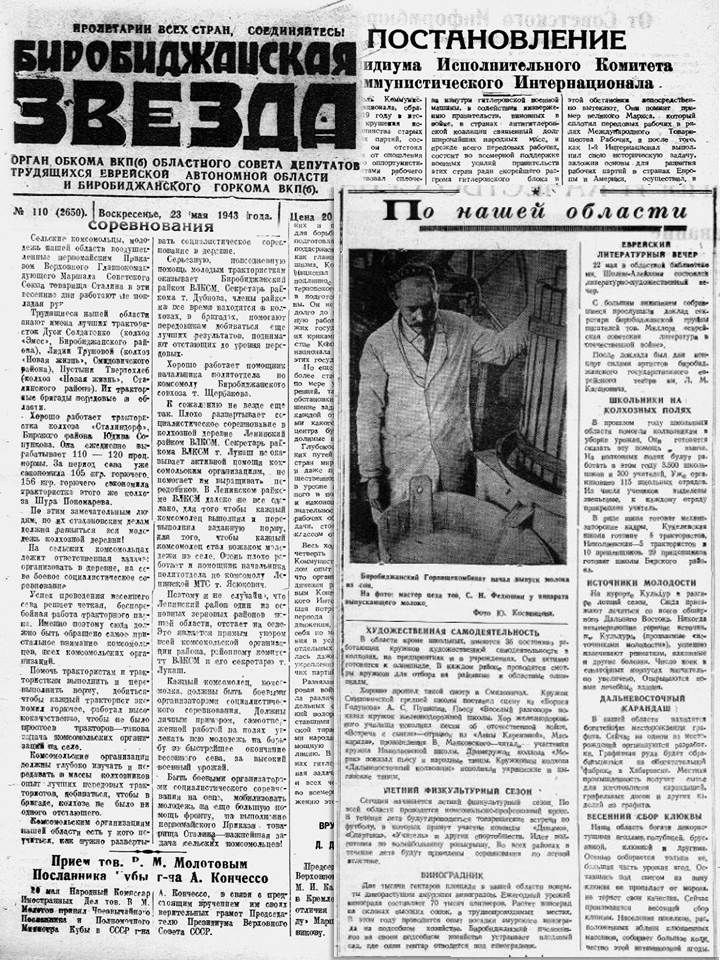
Clippings from the newspaper “Birobidzhan Star”. Photo: Photo: Regional Library
The newspaper “Birobidzhan Star” published the following facts in the section “Across our region”:
“Birobidzhan Gorpishekombinat began producing milk from soybeans.”
“In the region, in addition to schools, there are 35 constantly working amateur artistic circles on collective farms, enterprises and institutions. They are actively preparing for the Olympiad. In each district, reviews of circles are held for selection for district and regional Olympiads…”
“The summer physical education season begins. Komsomol-trade union cross-country (6+) is being held throughout the region. During the summer, friendly football matches (6+) will be held, in which the teams of Dynamo, Spartak, Uchitel and other sports societies will take part. Preparations are underway for the volleyball (6+) competition. Athletics competitions (6+) will be held in all regions during the summer.”
“Two thousand hectares of area in our region are covered with wild-growing Amur grapes. The annual grape harvest is 70 thousand centners. Grapes grow on the slopes of high hills, in hard-to-reach places. This year, an experiment is being carried out in planting Amur grapes on a subsidiary farm. The Birobidzhan bee farm is setting up an orchard on its subsidiary farm, where one hectare is allocated for a vineyard.”
“This year, 3.5 thousand schoolchildren and 300 teachers will work on the collective farm fields. 115 school teams have already been organized. From among the students, there are team members, and a teacher is assigned to each team.
A number of schools train machine operators. The Kukelevo school trains five tractor drivers and 10 trailer drivers. 29 trailers are being trained by schools in the Birsky district.”
“In our region there are rich deposits of graphite. Now development is being organized at one of the deposits. Graphite ore will be processed at a processing plant in Khabarovsk. Local industry will receive raw materials for the manufacture of pencils, slate boards and other graphite products.”
“Our region is rich in wild berries, blueberries, lingonberries, cranberries and others. In the fall, only a small part of the berry harvest is harvested. Left under the snow for the winter, the cranberries do not disappear from frost and do not lose their quality. Now the spring harvest of cranberries is underway. The population of villages located near cranberry tracts collects large quantities of this vitamin-rich berry.”
May 23, 1953
The bureau of the regional committee of the CPSU discussed the issue “On work with party candidates in the Obluchensky district party organization”, drew the attention of the bureau of the Obluchensky district committee to the need to improve the management of admission to the party and work with candidates.
May 23, 1963
The plenum of the regional committee of the CPSU discussed the results of the meeting of industry and construction workers of the RSFSR. The Plenum fully approved and accepted for strict implementation the recommendations and conclusions of the All-Russian Conference of Industry and Construction Workers and outlined specific measures for their implementation.