
The PSD strategy behind the “monocolor government” and why the minority option is just a decoy

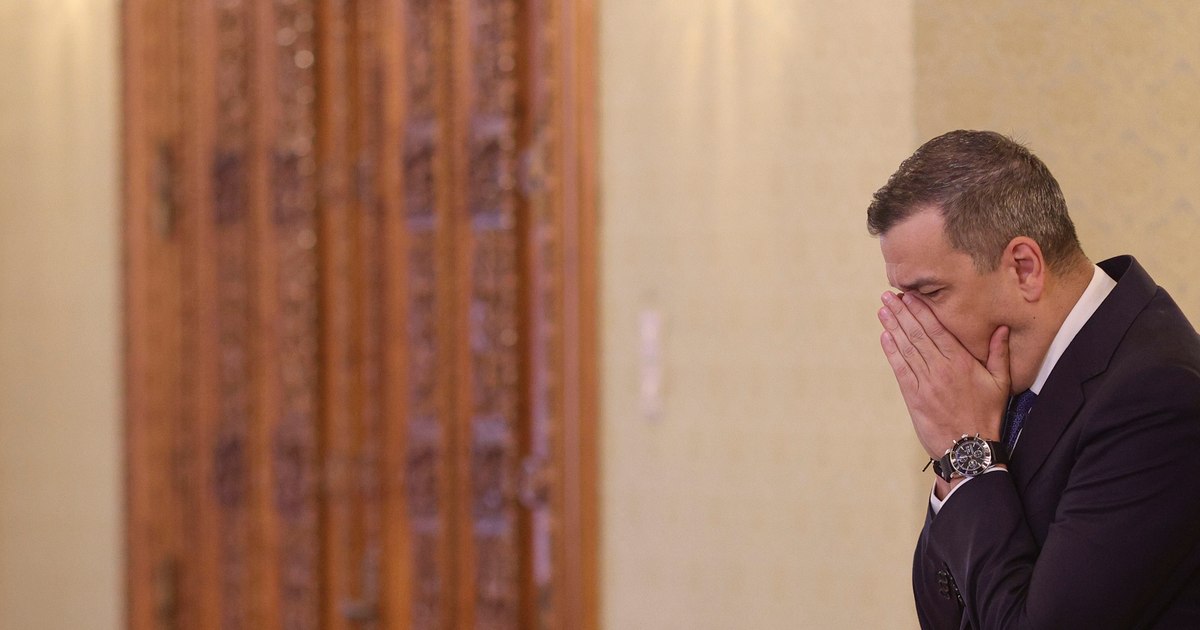
The consultations in Cotroceni this week were under the auspices of securing a majority for a government, whatever it may be. The PSD would have a majority even if the UDMR does not join the social democrats in government. The variant of a single-color government is only a working one, at this moment, and represents a stage in the solution of the political crisis.
Sorin Grindeanu at the consultations in Cotroceni Photo: Octav Ganea/Inquam Photos
“Adevărul” spoke with political analyst Radu Delicote, who is of the opinion that a single-color government will not materialize and the negotiations these days between the parties will ensure a wider consensus for the new Executive.
“It will be a crippled government. I am not discussing representativeness, in the sense that it is not relevant, because PSD is the largest political party in Parliament. But it will be a crippled government. I don't even believe in this version of work, the version of a minority government, rather, this positioning of the PSD suggests that it has the ability to collect the necessary votes for the inauguration of a government, in our case, even a minority one. And, in fact, it invites the other political actors to dialogue, to see who, in the context in which the UDMR, the group of national minorities, has declared its desire to participate in a functional governmental arrangement, will move forward.
And there are probably other votes he can muster in Parliament, but only after political negotiations with other parties. A part of the PNL, in the context of which maybe also a part of the opposition parties, as well as unaffiliated senators and deputies.”
Radu Delicote also says that the announcement sent by sources inside the PSD is aimed at unblocking discussions with the other parties.
“The fact that we still do not have a prime minister's name these days is due to the negotiations that are taking place at the party level to gather a parliamentary majority, and what the PSD is doing now is only an invitation to negotiate for the government formula that we talked about.”
The leader of the UDMR, Kelemen Hunor, declared on Tuesday that he will not go only with the PSD in a minority government. Asked if there is a possibility of a PSD-UDMR minority government, he rejected the idea from the start: “There isn't. We don't want to, we can't.”
“We are on the side of the former coalition, brought down by PSD and AUR. Logically, I cannot wake up with AUR. There is a red line, AUR. I cannot cross it. If there was such a solution, it would mean that you are in the hands of those from AUR”then explained the president of the UDMR.
Sorin Grindeanu and Kelemen Hunor at the UDMR congress Photo: EPA
“The main party will be the PSD and, later, the UDMR. This is what the calculations look like at first glance”
Radu Delicote is of the opinion that if other political forces come together, the UDMR could be open to the idea of returning to government. The PSD leaders lack votes at the moment, however.
“It won't be just the two. There will probably be another formula, we'll see. But the two main parties, the main party will be the PSD and, subsequently, the UDMR. This is what the calculations look like at first glance. The situation shows that there is a risk that not all parliamentarians will vote for this government formula, or that only a smaller part than anticipated will support this government. In both situations, votes are collected every day.”
The PSD scenario involves a close collaboration with the AUR parliamentarians which, on certain legislative projects, is already functional. The analyst says that the vote for the adoption of the censure motion was not the trigger for this agreement and that the support of certain projects by both parties existed in the past.
“It's not the first time it's happened. If it's about the NGO law, which has upset civil society quite strongly and is now being used in the context of the no-confidence motion, there have been cross-party collaborations in the past as well.
So it is not a first that we now notice that PSD and AUR have joined hands in a committee, which in the Parliament is something absolutely normal. I understand the anger of public opinion, I accept this argumentation, but in Parliament, in the reporting committees, that's how things work.
In order to pass a bill, regardless of which party you belong to, you need the votes or the support of your fellow parliamentarians. And then, in this context, regardless of the political color, you have to ally contextually”, shows the expert.
In the context of the joint votes between the PSD and the AUR on certain legislative initiatives, questions arose regarding the existence of a possible political directive by which the social-democratic parliamentarians would have been encouraged to punctually support projects promoted by the AUR, and the analyst states that the vote in the Parliament usually follows a political direction established by the group leaders, who indicate to the parliamentarians how to vote on each bill. According to him, the leaders sit in the front rows of the hall and signal the party's position by raising their hands, as the parliamentary vote is, in essence, “a political act”.
“As a rule, the group leader indicates, at least in plenary sessions — that's how Parliament works — which way the respective senators and deputies should vote on a bill. That's why the group leaders sit at the front of the room and raise their hands or not, depending on the political direction the vote needs to go, because we have to recognize, unfortunately or unfortunately, that voting is a political act.” Delicote explained.
The analyst concluded by saying that the scenario in which PSD will attract UDMR and maybe other members to the government, along with other formations, is the most likely in the next period.


