May 17: The Great National Assembly in Blaj ended, after which Romanians from Transylvania declared themselves an independent nation

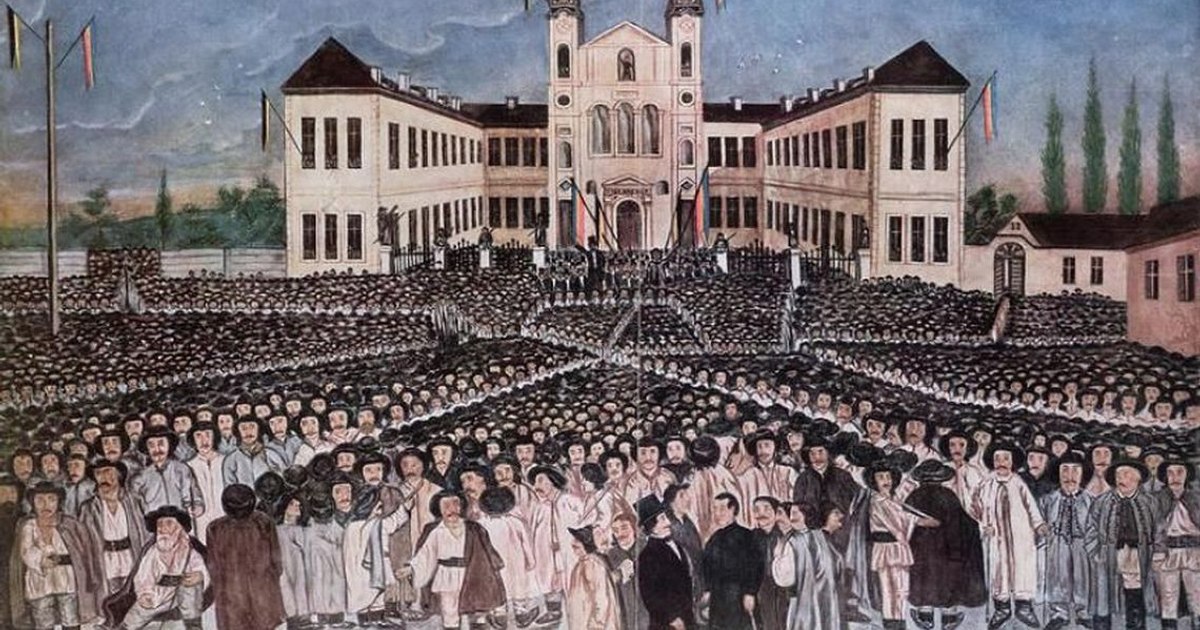
On May 17, in 1395, the Battle of Rovine took place, and on the same day, but in 1848, the Great National Assembly in Blaj ended. Also on a day of May 17, the Irish singer Enya was born and the televised hearings in the United States Senate in the Watergate Affair began.
The Great National Assembly from Blaj. PHOTO: archive
1395: The Battle of the Ruins took place. The mountain troops defeated the Ottoman ones
The Battle of Ruvine, considered one of the most important confrontations in the history of Wallachia and transposed on the big screen during the communist period, is seen by the general public as the decisive victory by which Mircea the Elder drove out the Ottomans and saved his country. The historical reality is, however, more nuanced.
It should be noted from the outset that historians have not reached a consensus regarding the exact date of the battle, some placing it in 1394, a year earlier than the established version. What is certain is that Mircea prepared his defense in a marshy place called Ruins, described as a natural “cauldron” with only one access road, supposed to be in the Făcăi or Balta Verde area, on the Argeș river.
The Battle of the Ruins. PHOTO: archive
One day in October, the voivode carefully organized the battlefield: hidden trenches were dug, reinforced with stakes, and archers were strategically positioned to strike the waves. Constantly harassed by surprise attacks from the Wallachians, the Ottomans were lured into the trap at the Ruins, where they were greeted by a hail of arrows.
The sultan's cavalry was decimated by the obstacles prepared in time, and the hand-to-hand combat, fought in the swampy terrain, favored Mircea's troops. The battlefield quickly turned into a slaughterhouse.
During the confrontation, Sultan Bayazid himself was said to have been close to death, after a night attack launched by Mircea on the Ottoman camp. Although everything seemed to point to a decisive victory for the Wallachians, the situation quickly changed: Bayazid sent reinforcements, and Mircea, with his weakened and decimated army, was defeated. The voivode had to retreat over the mountains, temporarily losing the throne, then occupied by Vlad the Usurper, supported by the Ottomans. However, Mircea would return to leadership, later choosing to pay tribute to the Ottoman Empire to ensure the stability of the country.
1792: Founding of the Wall Street Stock Exchange, the world's most important stock exchange headquarters
On May 17, 1792, the Wall Street Stock Exchange was born, later becoming the most important stock market center in the world. That day, 24 of New York's most influential traders met in secret to find solutions to organize the financial securities market, which is in a period of chaos and lack of regulation.
On May 17, 1792, the Wall Street Stock Exchange was born. PHOTO: archive
According to legend, the meetings took place under a plane tree, and two months later they signed the famous agreement known as the Buttonwood Agreement. The document stipulated that the signatories would trade securities exclusively among themselves, set common prices and not participate in other securities auctions. Thus was laid the foundation of the institution that would eventually become the New York Stock Exchange.
However, the first stock exchange in the United States had been established as early as 1790 in Philadelphia. In New York, the founding group established its headquarters in a rented room on Wall Street at number 40, where every morning the chairman of the exchange, Anthony Stockholm, announced the stocks available for trading. In its beginnings, the exchange functioned as an exclusive club: the access of new members was strictly controlled, and admission was made only by the vote of those already accepted into the organization.
1848: The Great National Assembly in Blaj ended, through which the Romanians declared themselves an independent nation
The Blaj National Assembly, held between May 3/15 and May 5/17, 1848, represented one of the most important manifestations of the Romanians from Transylvania in the context of the Revolution of 1848. Within it, the Romanians publicly formulated their national, political, religious and social demands, demanding that the Romanian nation from Transylvania benefit from equal rights with the other peoples of the province.
The Great National Assembly from Blaj PHOTO: archive
49 years have passed since the 1977 earthquake. The balance sheet of a disaster that changed Romania
The proclamation adopted at that time, structured in 16 points, was addressed to Emperor Ferdinand I of Austria, to whom the approximately 40,000 Romanians gathered on Freedom Square swore their allegiance. The document requested, among other things, the abolition of serfdom, the recognition of national and religious independence, freedom of speech, the elimination of tithes, the establishment of schools in the Romanian language, the establishment of a national guard, the amendment of the Constitution of the Principality of Transylvania and the rejection of the forced annexation of Transylvania to Hungary.
In the name of the entire Romanian nation, the participants in the assembly took the oath to defend these ideals even at the cost of their lives, in the spirit of the revolutionary values of freedom, equality and fraternity.
1961: Irish vocalist Enya was born
On May 17, 1961, Enya Patricia Brennan, known worldwide by her stage name Enya, was born in Ireland. Often referred to as the 'Queen of New Age Music', the artist is one of Ireland's most successful solo singers, with tens of millions of albums sold worldwide.
Born into a family deeply involved in music, Enya made her artistic debut in 1980 as a member of the band Clannad alongside her brothers, where she played keyboards and provided backing vocals. Two years later, he chose to build his own musical path.
Together they have forged a unique style that blends Celtic, new-age, classical and choral influences, complemented by the artist's signature layered vocal harmonies and subtle electronic orchestration. Throughout her career, Enya has performed in ten languages, including English, Irish, Latin and Welsh.
His impressive record includes over 75 million records sold worldwide, four Grammy Awards for Best New Age Album, seven World Music Trophies and an Ivor Novello Award. Enya also received Oscar and Golden Globe nominations for the song “May It Be” featured on the soundtrack to The Lord of the Rings: The Fellowship of the Ring (2001).
1973: Televised US Senate Watergate hearings begin
The Watergate affair represents one of the biggest political and media scandals in the history of the United States, which broke out in the 70s and resulted in a deep institutional crisis, which ultimately led to the resignation of the American president Richard Nixon.
Investigative journalism by the Washington Post, through reporters Bob Woodward and Carl Bernstein, was instrumental in uncovering the entire affair and was awarded the Pulitzer Prize.
The name of the scandal comes from the Watergate hotel complex, the site of the break-in that triggered the investigation and which represented the starting point of the subsequent revelations.
May 14: The first smallpox vaccine was administered in 1796. In less than ten years, the discovery spread globally
Under pressure from the Supreme Court, on July 30, 1974, Nixon was forced to release all audio recordings relevant to the investigation. Shortly thereafter, on August 9, 1974, he tendered his resignation, becoming the first and, to date, the only president of the United States to leave office in this manner.
International Day Against Homophobia
May 17 is the International Day Against Homophobia. Homophobia is the term used to describe a set of negative emotional reactions—such as anxiety, discomfort, disgust, aversion, anger, or fear—displayed toward people who identify as part of the LGBTQ+ community.
Parade to support LGBTQ+ rights. PHOTO: EPA-EFE
This involves not only the rejection of homosexuals, but also hostile attitudes towards those perceived as homosexuals, as well as towards the symbols, values or aspects associated with this community.
Although there are specific terms such as “biphobia” or “transphobia”, the notion of “homophobia” is often used in a broader sense to denote fear, hatred or prejudice directed against the entire LGBT community.
From a social perspective, homophobia is considered a form of intolerance and can be included in a broader category of discriminatory attitudes, similar to xenophobia.