What do glitter and the atom bomb have in common? An inconspicuous decoration is a military secret

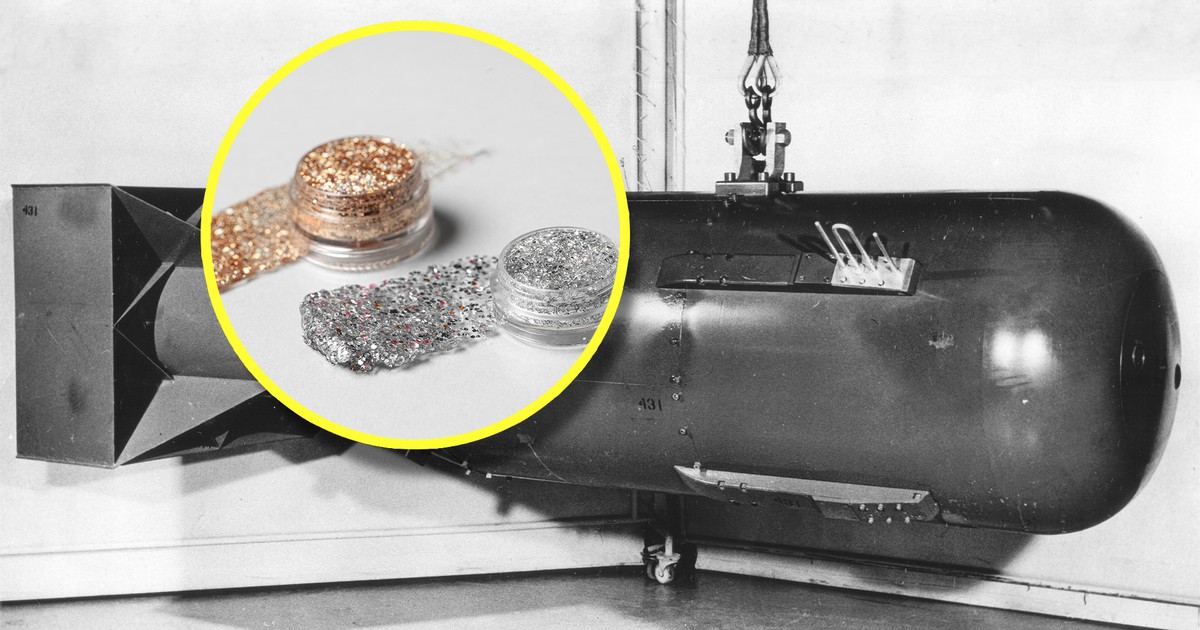
In December 2018, The New York Times journalist Caity Weaver visited one of the two largest glitter factories in New Jersey. When she asked a seemingly innocent question about the company's biggest customer, she heard the answer that went around the world: “I don't want to tell you. You'd never guess. And they don't want you to know it's glitter.”
This sentence went viral and gave rise to a phenomenon called “GlitterGate” – a “glitter scandal” that continues to ignite discussions on the Internet to this day.
Read also in BUSINESS INSIDER
The answer lies in the story of a German immigrant who accidentally invented modern glitter, and his precise foil cutting machine was used to build… an atomic bomb. It is a story about non-obvious connections: from waste photographic film, through a Christmas tree, to secret air defense systems. Glitter remains one of the most enigmatic mass-produced substances in the world.
- Read also: Atomic bombs also end up in the trash bin. We check what is happening to them
Its history is not only a technical curiosity – it is a fascinating network of connections that start with sparkles on the Christmas tree and end in places that are not talked about much. And that's why it's worth getting to know her.
Read also: The end of the Tim Cook era at Apple. You can learn a lot from his mistakes and successes
Henry F. Ruschmann – the man who cut
Henry Frank Ruschmann did not look like someone who would change the history of technology and at the same time become part of one of the most secret military projects of the 20th century. Born in Frankfurt, Germany, in 1926, as a young man, he sailed to New York on the MS Bremen ship.
While still on the wharf, he was employed as a machinist at Westinghouse in Irvington, New Jersey. It quickly turned out that this was no ordinary worker – Ruschmann had extraordinary technical talent and patience for precise cutting. Over time, he specialized in cutting thin-layer materials: photographic foils, paper, and later also metals and plastics, designing and improving machines for this purpose himself.
His real genius was not the idea for glitter itself, but the machine he constructed in the 1930s. It was one of the most accurate foil cutting devices in the world at that time, which divided sheets into perfectly even fragments. Ruschmann was then working with partner Harry Goetz; together they ran the Goetz and Ruschmann workshop in Maplewood. Orders came mainly from the photographic industry – cutting film and photographic plates for Kodak and Ansco required the highest precision, which Ruschmann's equipment guaranteed.
The accidental invention of glitter
The machine, which Henry F. Ruschmann constructed in the 1930s, was to become famous due to a completely accidental discovery. As a result of very precise cutting of materials, microscopic, irregular filings were created – tiny, shiny flakes of acetate cellulose covered with a layer of aluminum. Employees at the Maplewood workshop jokingly called them “schnibbles.” Initially, they were swept and thrown into the garbage, but over time, some employees began to find a completely new role for them.
Close up of holographic glitter
|
Inkwina/CC BY-SA 3.0
Instead of throwing away these filings, they started taking them home. During the holiday season, they sprinkled them on Christmas trees instead of traditional artificial snow. The effect was magical – the tree sparkled with thousands of tiny reflections of light, and the whole thing looked as if covered with real frost.
- Read also: They found him in the mud. It could be worth up to $7 million
Ruschmann quickly saw the potential. Instead of treating waste as a problem, he started producing it on purpose. He processed metalized foil waste into colorful, shiny flakes in various shapes and sizes.
The Manhattan Project – The moment where glitter meets the atomic bomb
In the 1940s, when the secret Manhattan Project was entering its decisive phase, American scientists and engineers faced a problem that seemed almost insoluble. They had to find a way to cut perfectly precise, microscopically accurate components for the core of the atomic bomb—specifically, the mica pads through which the plutonium rods or detonator mechanisms would pass. The slightest error in dimensions could cause an asymmetrical implosion and, consequently, a complete failure of the test. The US government was searching throughout the country for a person with the most precise machine for cutting thin-film materials in the world.
They found Henry F. Ruschmann.
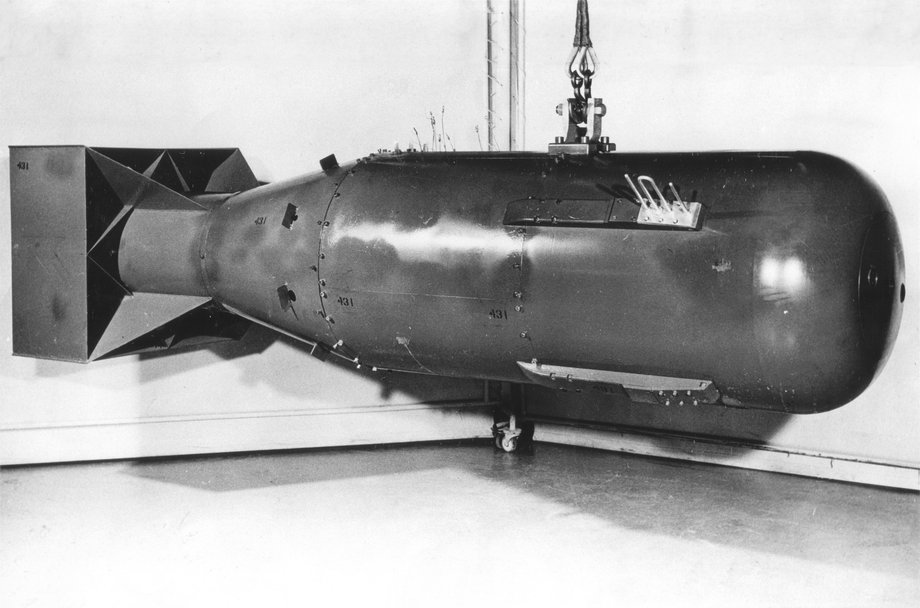
“Little Boy” atomic bomb
|
US Atomic Energy Commission / public domain / wikipedia
His device, constructed in the 1930s, was unrivaled at that time. Ruschmann received a government order and got to work. When cutting sheets of mica, the machine produced microscopic, shiny filings, just as it used to cut photographic foil. The same shavings that were once sprinkled on Christmas trees were now used to create components for the most powerful weapons in human history. Documents and subsequent interviews with the family confirm: Ruschmann completed the task successfully, and his machine played a key, although still little known, role in the project that ended with the dropping of the bombs on Hiroshima and Nagasaki.
From glitter to military designs
In 1948, Ruschmann and his family founded Meadowbrook Farm Inventions (later shortened to Meadowbrook Inventions) on the purchased Meadowbrook Farm in Bernardsville. However, the cutting and filing business was supposed to be only an addition to the breeding of purebred Guernsey cows and a way to earn extra money to maintain the farm.
- Read also: The Americans used an atomic bomb in space. “The experiment got out of control”
However, it was not ordinary “plastic glitter” in today's colloquial understanding. Ruschmann created something much more sophisticated: precisely cut foil that could be produced in millions of variations – squares, hexagons, rectangles, even stars. Each batch reflected light in a different way, depending on the thickness, color and type of metallization. Thanks to this, Ruschmann's glitter was not only cheaper, but also more durable than earlier versions. Over time, it turned out that “side hustle” could turn out to be a more profitable business.
Dipole – Glitter that fools enemy radars
After the war, the Ruschmann family and the Meadowbrook Inventions company remained in contact with the Pentagon and over time became involved in further secret military projects. One of the most important was the improvement of a technology called “chaff”, which in Polish translates as “reflecting dipoles” or “radar window”.
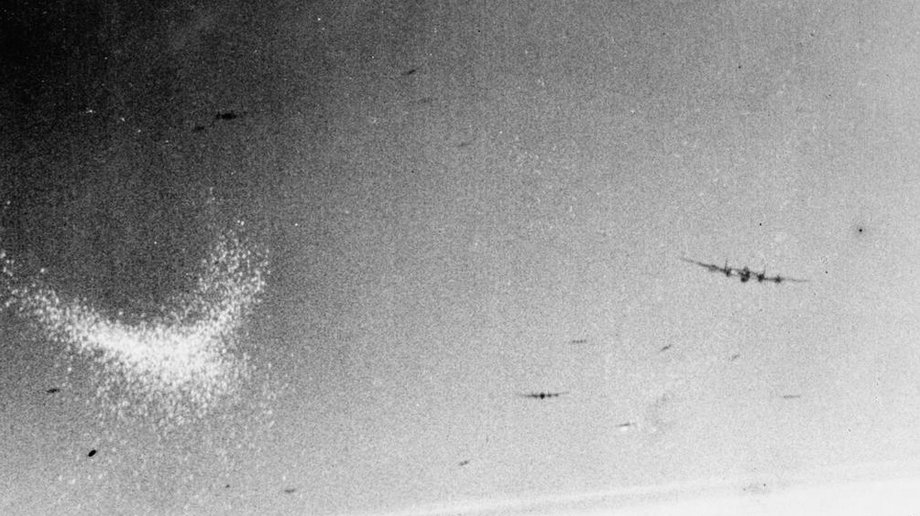
A cloud of dipoles sprayed during operations during World War II
|
Royal Air Force official photographer/Public Domain
Reflecting dipoles are millions of microscopic strips made of aluminum foil or metalized plastic – in practice, exactly the same material as glitter, only in a military version and in the form of strips. When an aircraft drops such filings along with an explosive charge that scatters them into a form, a huge, moving cloud of particles is created in the air, which reflects radar waves in such a way that the enemy radar sees hundreds of false targets instead of one real target.
The effect is spectacular: anti-aircraft missiles lose their targets and real planes disappear behind the curtain. The technology was created during World War II (the British used it as “Operation Window”), but Ruschmann and his precision machine allowed it to be improved to a level previously unthinkable.
It was at this point that glitter stopped being just a Christmas decoration. It has become a strategic material.
The Ruschmanns' further career
Over time, Meadowbrook Inventions became a discreet but highly valued supplier of precision materials for a variety of military programs. The company received orders for aircraft brake components – where microscopic glitter flakes improved the friction properties and thermal resistance of the linings. They were also used in special protective coatings on boats and ships, where they increased resistance to corrosion and fouling by marine organisms.
- Read also: They sent half a billion needles into space. This is one of the strangest US projects
However, these were not the only applications. The Ruschmanns' glitter appeared in paints with unique optical effects, in toothpastes as polishing microspheres, and in the production of holograms, banknote and passport security features – wherever the highest cutting precision and exceptional light reflection properties were required. The company even supplied ingredients for rocket fuels, where controlled combustion depended on particles of a precisely defined size and shape. One of the most important projects was the modernization of Redstone rockets – the same ones that later carried the first American astronaut into space.
Henry W. Ruschmann Jr., the inventor's son, bluntly confirmed these connections in an interview in 2023. He admitted that the glitter produced by Meadowbrook was used not only for money, passports and rockets, but primarily for military applications. The family never sought publicity. Meadowbrook Inventions remained a fully private company, operating on the same farm in Bernardsville, New Jersey, in the hands of successive generations of Ruschmanns. To this day, he avoids publicity, does not publish client lists and does not comment on the details of government contracts.
GlitterGate – The glitter secret that shocked the media
Even though glitter has been produced for over 70 years, it remains one of the most enigmatic mass-produced substances. Few people know what exactly it consists of and how it is produced. There are only two large factories in the United States that specialize in its production on an industrial scale: Meadowbrook Inventions – still owned by the Ruschmann family – and Glitterex. Both of them surround themselves with almost spy-like discretion. They do not publish full client lists, do not organize open days and rarely give interviews.
And perhaps the topic of glitter would not be widely discussed at all if it were not for a journalistic investigation from 2018. Then Caity Weaver, a journalist from “The New York Times”, contacted Glitterex and asked a seemingly simple question: who is the largest recipient of glitter in the USA?
The response from the company's representatives was shocking and gave rise to many conspiracy theories. Glitterex replied: “I don't want to tell you that. You would never guess. And they don't want you to know it's glitter.”
This sentence triggered a wave of speculation and memes called “GlitterGate”. Officially, glitter is used in antifouling paints on boats, aircraft brake linings, toothpastes as delicate polishing microspheres, as well as varnishes, cosmetics and document security. All of these uses are known and legal. So why does one of the largest glitter producers in the world respond in such a mysterious way?
- Read also: The nuclear tomb in the ocean is bursting. Disaster may only be a matter of time
Experts point to the army. The U.S. military has been Meadowbrook Inventions' and probably Glitterex's largest customer for decades. Today, this technology is even more advanced and is most likely used in the latest generation defense systems, stealth coatings, tracking tags and camouflage materials.
Meadowbrook Inventions is still in operation
Today, Meadowbrook Inventions still operates on the same farm in New Jersey and remains the oldest glitter factory in the world. The company is in the hands of the Ruschmann family – discreet, private and publicity-averse. This is where the glitter we know was born: a substance so ordinary on store shelves, yet so extraordinary in its history.
The glitter we see in toothpaste or paste into a card may be the same material that is currently protecting strategic bombers or reconnaissance drones from being targeted.