The leaders of the two largest economies met in China, drawing attention from around the world. During his conversation with Donald Trump, Xi Jinping emphasized that there are no winners in trade wars. According to media reports, the Chinese leader emphasized the importance of Sino-American relations for the world. He also assessed that the world was at a “new crossroads” and that “profound changes” were taking place. He expressed his belief that China and the US should be partners, not rivals.
See also: Trump in Beijing fulfilled Xi's dream. “What better way to do it?”
The last time Donald Trump was in China was in 2017. A lot has changed geopolitically and economically during this time. We took a closer look at this second sphere.
China is competing economically with the US and has had many successes
How have the United States and China changed economically between 2017 and 2026? Which country made better use of this time? Economists have no doubt that recent years have seen a significant increase in China's importance in the global economy.
Comparison of US and Chinese economic statistics
|
Created using AI/ChatGPT
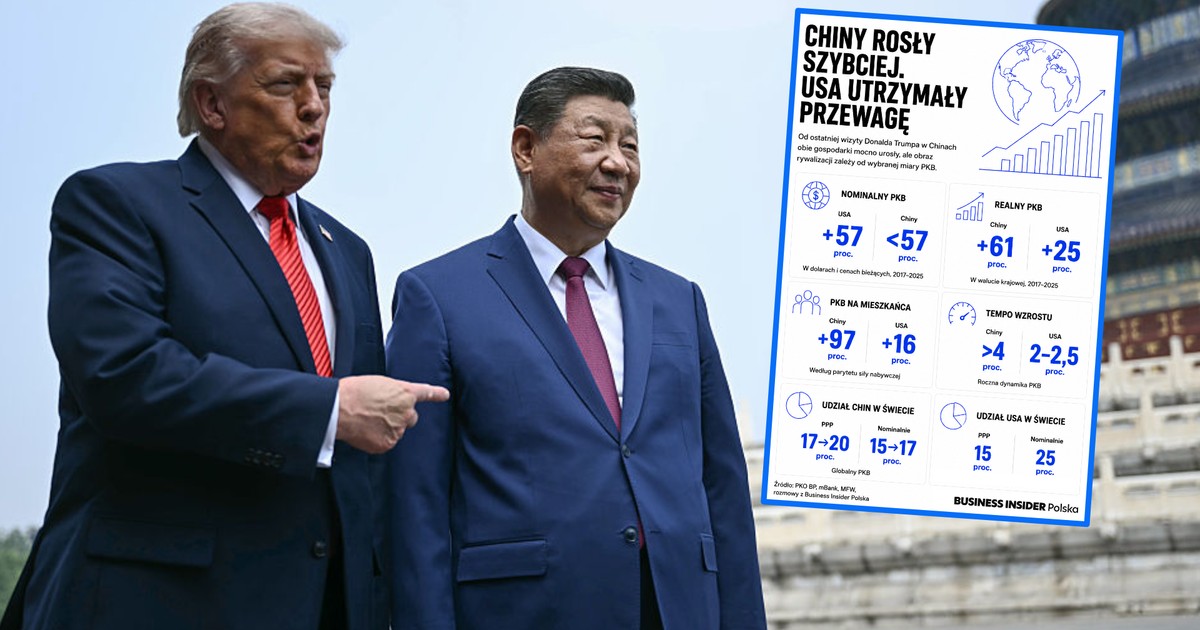
— Comparing the US and China depends on the metric you choose. In nominal terms, i.e. in dollars and current prices, both economies grew in the years 2017-2025 on a very similar scale: the US GDP by approximately 57%, and China's GDP by almost 57%. – Kamil Pastor, economist at PKO BP, enumerates in an interview with Business Insider.
He emphasizes that the result is strongly dependent on exchange rates – a strong dollar and a weaker yuan limited the growth of China's GDP when converted into dollars.
See also: American business and politicians are begging Trump. It's about China
The comparison of real GDP in national currency is different. As a PKO BP economist calculates, China grew significantly faster than the USA – by approximately 61%. compared to approximately 25 percent in the case of America. It gives a similar picture GDP per capita at purchasing power parity: in China it increased by approx. 97% and in the USA by approx. 16%.
China is chasing the US. They started from a lower ceiling
— However, China started from a much lower level, so it was easier for them to achieve high dynamics. So the conclusion is mixed. China increased real production and per capita income fasterbut this did not fully translate into their position compared to the USA in nominal GDP calculated in dollars. The US maintained its advantage as the world's largest economysupported by a strong dollar, a deep capital market and (still) technological advantage – comments Kamil Pastor.
There are more interesting statistics of this type.
— Data from the International Monetary Fund show that over the last decade, China's share in global GDP has increased from 17 to 20 percent. after taking into account the purchasing power of currencies and from 15 to 17 percent if we look only at the value in dollars – says Jakub Rybacki, mBank economist, in an interview with Business Insider.
He notes that at the same time The United States only maintained its global shares – they amount to 15 percent. after taking into account the purchasing power correction and 25%. in dollars. It emphasizes that attempts to maintain the status quo involve significant economic costs – American public debt increased from 102 to 123 percent. GDPand attempts at reindustrialization by increasing customs duties are criticized internationally.
See also: Stock exchanges react to talks between US and Chinese leaders. One detail changes the forecast
— China is beginning to clearly dominate in terms of investment and industrial production. The share in global results is close to 30 percent, while the role of the USA here is half as much – points out Jakub Rybacki.
Why this change? The mBank economist explains that this result is partly related to subsidizing production by China, which is increasingly generating tensions not only between these two powers, but also in Europe. Such practices have allowed China to gain a leading position in the production of high-technology goods, such as electric cars and photovoltaic panels.
USA or China? Which economy has better prospects?
We asked economists what they think the economic prospects for the United States and China look like over the next 10 years. This raises the question: is there a chance that the USA will lose its title as the world's largest economy?
— China's economic growth continues to consistently exceed 4%. per year, while American GDP is growing at a rate close to 2-2.5%. – points out Jakub Rybacki.
The mBank economist adds that China still has considerable potential to increase the wealth of its western provinces. He suggests that improving activity in relatively technologically simple sectors is enough.
Additionally, China is the main exporter of rare earth metals – it is responsible for 70-80 percent. mining. – In this case, export control provides tools to influence other developed economies, especially since the exploitation of deposits in other regions of the world often requires significant expenditure – he says.
On the other hand, it draws attention to the challenge of the relatively rapid aging of society, which is a long-term consequence of the one-child policy. Although demographic changes also hit the USA and Europe hard.
China or USA? Which economy is the largest in the world?
— After taking into account purchasing power, China is already the largest global economy, and the gap with the US will probably only widen. – notes Jakub Rybacki.
This is also admitted by Kamil Pastor, who specifies that in terms of PPP, China has already been larger than the USA since 2016, because this measure takes into account differences in price levels. The PKO BP economist points out that this is not the best measure of global financial strength.
— In the debate about the “largest economy in the world”, nominal GDP in dollars remains crucial. Today, it is more likely that the US will maintain its position as the world's largest economy in nominal terms for at least another decade. China will remain its main rival, but the scenario of quickly taking over the first place is much less likely today than a few years ago, says Kamil Pastor.
It shows in concrete numbers how it has changed over time. In 2000, the Chinese economy, measured nominally in dollars, accounted for approximately 12 percent. size of the US economy. In 2010, it was already approximately 41 percent, and at the peak in 2021, approximately 77 percent. Then the ratio began to decline and in 2025 it amounted to approximately 64%.
— Not only has China stopped rapidly catching up with the US, but in recent years some of the gap has widened again. This is mainly the effect of China's exchange rate policy, i.e. keeping the yuan too weak to promote exports at the expense of domestic consumption – comments a PKO BP economist.
Forecasts compiled by The Economist suggest that the moment of possible overtaking of the USA by China may occur between 2040 and 2050. Some forecasts even allow for a scenario in which China will never permanently take over the first place in nominal GDP.
Author: Damian Słomski, journalist of Business Insider Polska