The declaration adopted in Bucharest by the European leaders participating in the B9 summit. The reason for Hungary's abstention

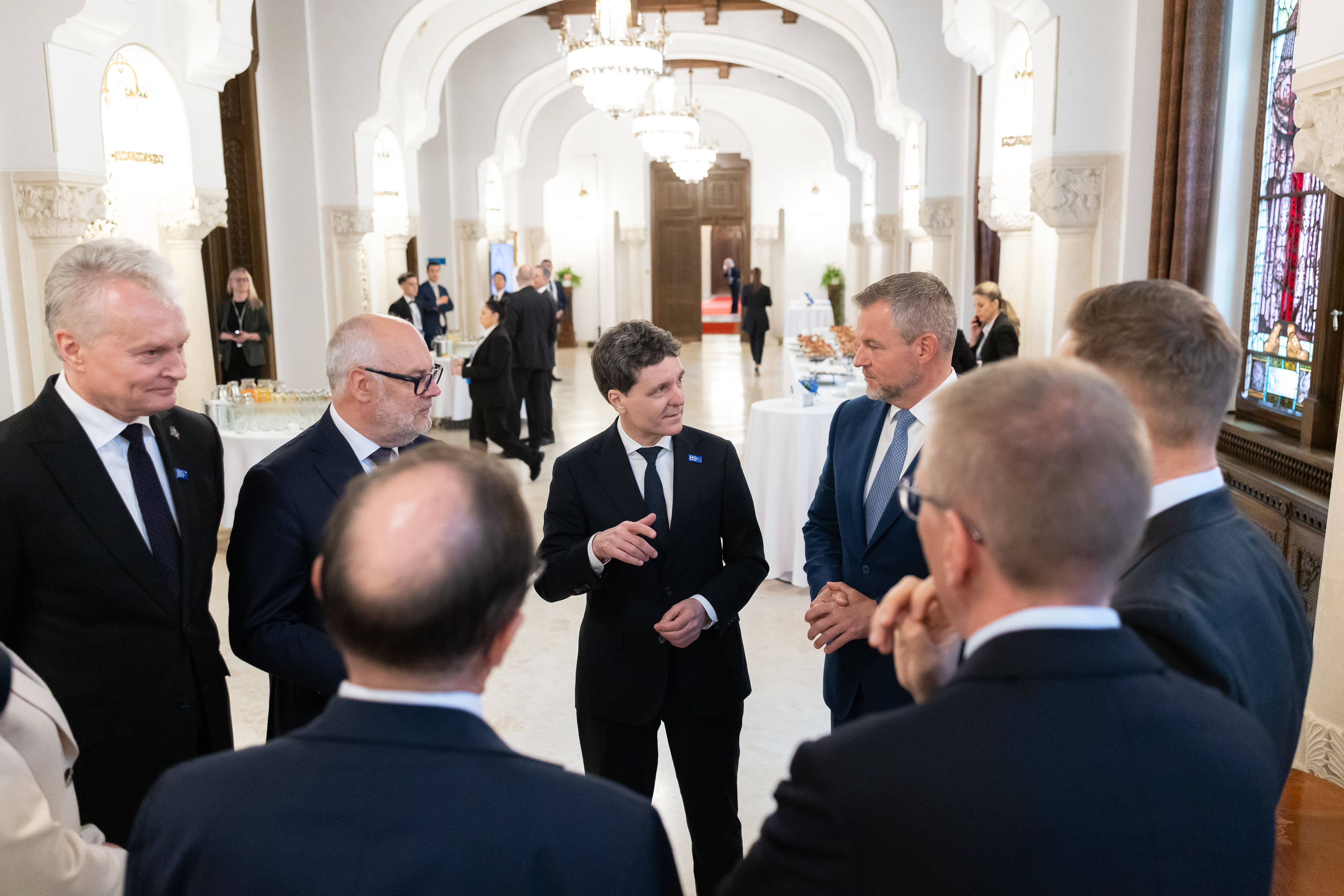
The leaders of NATO's B9 and Nordic countries adopted a statement defining Russia as the “most significant and direct long-term threat” to NATO. Hungary announced that it was “expressing constructive abstention” to the language agreed by the participants.
The signatory countries are committed to strengthening defense cooperation on NATO's eastern flank, stating that the space from the Black Sea to the Baltic Sea and up to the Nordic and Arctic regions is “a strategic line” that must be defended by a stronger NATO, including from the perspective of transatlantic cooperation.
“We are taking on greater responsibilities through increased burden-sharing and increased defense investment as Allies work towards the 5 percent of GDP commitment. To date, significant progress has been made across the Alliance, with some Allies already meeting or exceeding the defense investment target,” the statement said.
Russia, “a long-term threat”
The signatories condemn Russia's “highly confrontational” actions against NATO allies and partners, such as sabotage, cyber attacks, airspace violations and other hybrid attacks.
“Russia is and will remain the most significant and direct long-term threat to the security of Allies. Given the threat environment, NATO must focus on the fundamental task of collective defence, including through a robust forward defense posture. We remain committed to ensuring that NATO's defense plans are fully resourced and to meeting capabilities, mobility and military activation objectives, including the expansion of NATO's fuel pipeline system to the Eastern Flank.” shows in the joint statement.
The NATO countries gathered in Bucharest announce the maintenance of the commitment to protect critical maritime infrastructure and freedom of navigation, including through the Baltic Sentry and Arctic Sentry missions.
“Further expansion of the transatlantic defense industrial base, including through increased production capacity, more resilient supply chains, efficient multinational procurement, sustained investment in research and innovation, and capitalizing on lessons learned through close cooperation with Ukraine, is essential to meet today's security challenges,” is another commitment from the Nordic and B9 countries.
They reaffirm condemnation of the war waged by Russia and support for the independence, sovereignty and territorial integrity of Ukraine within its internationally recognized borders. At the same time, it is said that the support for Kiev, including weapons, represents an investment that the countries on the eastern flank of NATO make in their own security.
“The B9 and Nordic Allies support a just and lasting peace in Ukraine, in accordance with international law and based on solid and credible security guarantees. We welcome the continued peace efforts of the United States, supported by Allies and partners, and congratulate Ukraine for its constructive engagement,” it added with reference to Ukraine.
The Republic of Moldova is also mentioned in the declaration, in the paragraph in which the participating states undertake to deepen collaboration with “key partners”.
“We are united and ready to continue to ensure a more combat-capable, resilient and better-prepared Alliance, always ready to defend every inch of Allied territory. Our main strategic objective is to deliver more for Euro-Atlantic security,” the statement concludes.
Budapest's “constructive abstention”.
A footnote says that the document was not signed by Hungarian representatives: “Hungary wishes to express a constructive abstention. In this regard, Hungary is unable to support the current wording of the declaration as agreed language. Any decision on the use of this agreed language in the future will be taken by the future government of Hungary.”
Later, the public communication department of the Presidential Administration specified that Budapest's abstention is related to the fact that it is in a period of transition from one government to another.
“At the time of finalizing the negotiation of the text of the declaration, as also today, Hungary did not have an invested Government, as a result they had no instructions whether to associate or not. The abstention is constructive, as it is also written in the text of the declaration and is a step forward compared to Hungary's previous position which was one of rejection. The message of the Hungarian delegation is a positive one”, says the clarification sent from the Cotroceni Palace.