The Iran War and Its Lessons for China: A Conflict with Global Echoes (Can China Produce a Billion Drones Annually?)

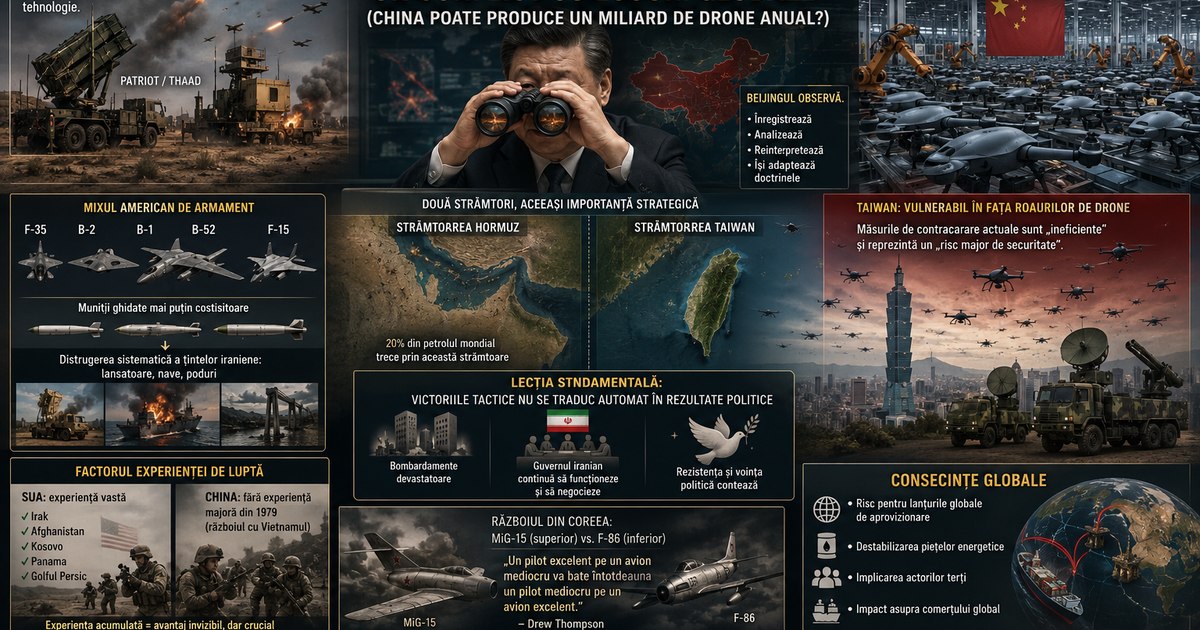
One of the great revelations of the current conflict for outside observers — including Beijing — is the surprising resilience of the Iranian regime in the face of a U.S. bombardment of unprecedented intensity in the modern era
More than two months after the outbreak of armed conflict between the United States of America and the Islamic Republic of Iran — launched on February 28, 2026 — the world is witnessing the first major war of the age of drones and maritime blockades in the 21st century. Beyond its immediate size, this conflict provides a valuable analytical window into how US military capabilities perform under the actual pressure of battle. And the one looking most closely through this window is undoubtedly China. Experts from China, Taiwan and other regions of the world, consulted by CNN, converge on one essential conclusion: the war in Iran is not just a regional matter, but a real-time strategic laboratory, the lessons of which will shape the military and geopolitical calculations of the great powers for decades to come.
Beijing observes, records, and — certainly — reinterprets its own doctrines in light of what is happening in the Persian Gulf. Still, experts warn that China risks jumping to the wrong conclusions — overestimating its own forces, ignoring its inexperience in combat and taking too narrow a view of the nature and consequences of a potential conflict with Washington.
The Defense Lesson: The Vulnerabilities Iran Exploited
One of the most surprising revelations of the current conflict is Iran's ability to penetrate US air defense systems in the Gulf with relatively primitive technology. Low-value Shahed drones and cheap ballistic missiles have been able to bypass high-tech defense systems such as Patriot and THAAD (Terminal High-Altitude Area Defense). This reality did not go unnoticed in Beijing. Fu Qianshao, a former colonel in the Chinese Air Force, emphasizes that the People's Liberation Army (PLA) must not neglect the defensive component of its military doctrine. While the People's Liberation Army has invested heavily in offensive capabilities — hypersonic cruise missiles capable of evading interceptors, fifth-generation J-20 stealth fighters (roughly equivalent to the US F-35) and a long-range stealth bomber under development — the defensive side remains, experts say, a weak spot.
On the other hand, the US air campaign against Iran has demonstrated the effectiveness of a mix of weaponry: state-of-the-art aircraft such as the F-35 and B-2, combined with less expensive guided munitions launched from the B-1, B-52 and F-15. The result was the systematic destruction of missile launchers, warships and bridges. It's exactly the kind of mix Beijing needs to integrate into its own defense planning, according to military analysts.
The Taiwan Strait — the mirror of the Strait of Hormuz
The Strait of Hormuz and the Strait of Taiwan share remarkable structural similarities from a geopolitical perspective: both are maritime chokepoints of immense strategic value, both are potential theaters of asymmetric conflict, and both involve a major power—the US—facing an adversary that uses unconventional tactics to compensate for its conventional technological inferiority. China is the world leader in drone production. Analysts cite a 2025 report from the platform War on the Rockswhich estimates that Chinese civilian manufacturers have the ability to convert production lines in less than a year to manufacture one billion militarized drones annually. This figure is likely to radically change the calculation of any potential opponent. Chieh Chung, a researcher at Taiwan's Institute for National Defense and Security Research, warns that long-range missiles and swarms of drones will play a central role in any Chinese military operation against the island. Taiwan, for its part, is not prepared to deal with such quantities.
A recent report by a government watchdog concluded that the counter-drone measures available to the Taiwanese military are “ineffective” and pose a “major security risk” to critical infrastructure and military bases. Gene Su, CEO of Taiwan's Thunder Tiger, the island's top drone maker, called for massive investment in mass production capacity. The Iran war also highlighted a lesson that the US is learning: in a potential conflict in the Pacific, America could find itself in the position of defender, not attacker. Admiral Samuel Paparo, commander of the Indo-Pacific Command, pleaded before the US Senate for filling the Taiwan Strait with thousands of aerial, naval and submarine drones in order to prevent the passage of Chinese military forces. Every ship or aircraft destroyed by a cheap drone is worth incomparably more than the drone that destroyed it—this is the logic of asymmetric deterrence.
The enemy also has a say
One of the great revelations of the current conflict for outside observers—including Beijing—is the surprising resilience of the Iranian regime in the face of a U.S. bombardment of unprecedented intensity in the modern era. The government in Tehran continues to function, negotiating and maneuvering diplomatically, even while being subjected to devastating military strikes. This fact underscores a fundamental lesson: tactical victories do not automatically translate into political results.
Craig Singleton, a senior fellow at the Foundation for Defense of Democracies, articulates this lesson with remarkable clarity: “Military pressure has not translated into a lasting political settlement. For China, it reinforces an essential lesson: success on the battlefield does not automatically produce the end you want.” A Taiwan scenario would therefore not be a simple military operation with a predictable outcome — it would be a conflict with political, economic and diplomatic ramifications of a complexity that is difficult to anticipate. There's also the battle experience factor. The People's Liberation Army has not participated in a major armed conflict since 1979, when China fought a short and costly war with Vietnam. Meanwhile, US forces have gained extensive experience in Iraq, Afghanistan, Kosovo and Panama, and now in the Persian Gulf. This accumulated experience—in campaign planning, tactical adaptation, loss management, and the execution of high-level precision warfare—is an invisible but crucial advantage. Drew Thompson, a researcher at the S. Rajaratnam School of International Studies in Singapore, cites a telling historical example: In the Korean War, China had superior fighter jets—the Soviet MiG-15s—but American pilots, although flying the inferior F-86s, performed better because of their World War II experience. “A great pilot in a mediocre plane will always beat a mediocre pilot in a great plane,” concludes Thompson.
Global consequences and warnings for Beijing
The conflict in Iran demonstrated that a war between a great power and a lesser power cannot always be an orderly operation with a predictable outcome. Iran's ability to exploit the Strait of Hormuz — through which 20 percent of the world's oil passes — and inject risk into global supply chains has shown how quickly a localized conflict can internationalize, drawing in third parties and destabilizing global energy markets. For Beijing, the caveat is clear: any Taiwan scenario would immediately implicate global trade, energy flows and third parties in a way that is difficult to anticipate.
China is the world's largest exporter and depends on free sea routes for its own trade. A conflict in the Taiwan Strait could, paradoxically, backfire on China's own economic interests. Chinese military analyst Song Zongping viewed the conflict with rare candor: “This is what modern warfare really looks like.” It is a reminder that regardless of technological or numerical superiority, the enemy always has a say. And in the event of a conflict in the Pacific, this word could reshape the world order for decades.
ConCluSIonS
The war in Iran is not just a regional conflict—it is a stress test of the global security architecture and an open textbook for any military strategist in the world. China is reading this playbook carefully, but risks selecting the convenient lessons and ignoring the inconvenient ones. Lack of combat experience, defensive vulnerabilities, and the unpredictability of the political consequences of military success are caveats Beijing cannot afford to underestimate. In a world where cheap drones can penetrate billion-dollar defense systems, where a maritime choke point can cripple the global economy, and where military victories do not guarantee desired political outcomes, the strategic calculations of all great powers must be recalibrated. The lessons of the Gulf arrive in time—before a new crisis turns theory into bloody practice.