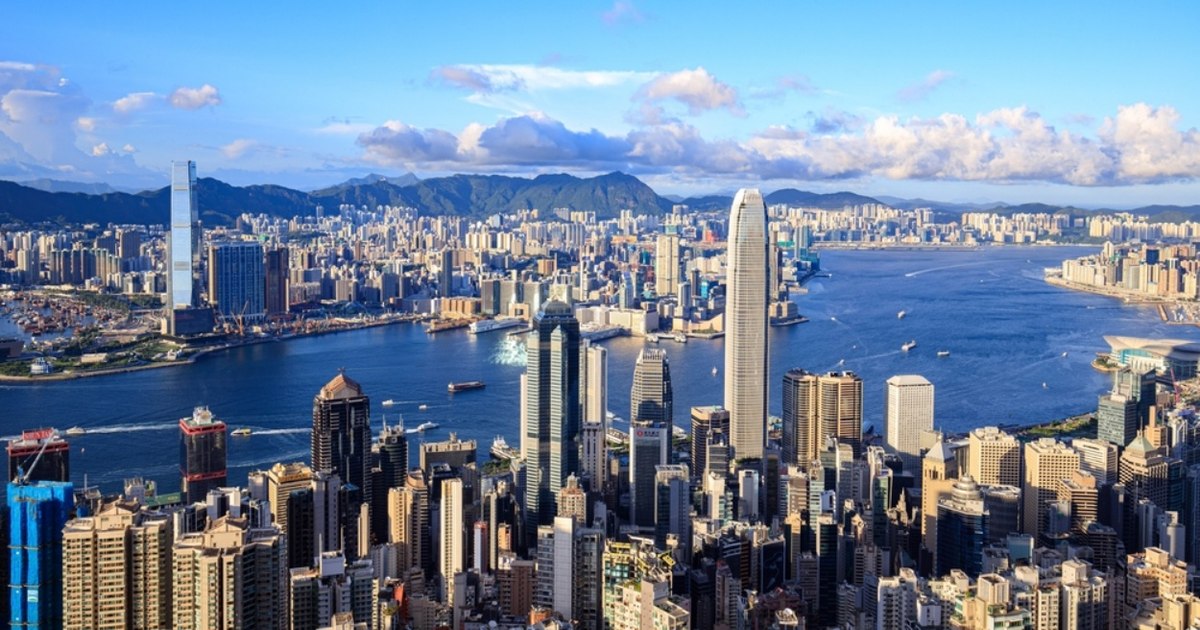
The Beijing-controlled metropolis is stepping up its efforts to lure international researchers to work here, promising very high salaries and access to state-of-the-art equipment. After decades of excelling in trade and capital flows, the city now aims to become a major hub for science and technology.
Hong Kong, former British colony/PHOTO: Archive
Skyscrapers, many of them over 70 stories, house compact housing. The streets are alive with luxury shops and crowded markets, and the big global banks flaunt their illuminated logos on the rooftops. Hong Kong, one of Asia's megacities, offers the image of a mature and intense capitalism. An uninitiated observer would hardly guess that this place belongs to a communist country. The former British colony — which retains a degree of autonomy and remains a key financial and commercial center — is now aiming for a new goal: strengthening its role as China's science capital.
“We are calling on the international community to join us,” says Timothy Tong, a 73-year-old engineer and chairman of the Hong Kong Laureate Forum, an event held in early November to award the Shaw Prizes, dubbed the “Nobels of Asia.” The forum brought together 12 laureates of previous editions and 200 young researchers from 20 countries, with the aim of strengthening international scientific collaboration. It is, Tong admits, also a showcase for Hong Kong's science sector—and, by extension, for China.
China has already become a world leader in certain scientific fields
The atmosphere of the event, which was also attended by the newspaper El País, combined discussions about the future of research with memories of Cold War-era rivalries. China has already become a world leader in certain scientific fields. The United States appears to be entering a period of decline, and Europe is realizing that if it is to remain competitive, it will need to work much more closely with the Asian power—even if that means overcoming some political reluctance.
In 2019, Hong Kong was the scene of violent protests against Beijing, accompanied by the slogan “Hong Kong is not China”. The movement was eventually suppressed, and new national security laws eliminated public demonstrations, at least for the time being. Today, authorities are sending a different message: The city can be a gateway to China for Western researchers, offering them hefty salaries — a professor can earn about $14,000 a month — a greater level of academic freedom than on the mainland and easy visa-free access. Modeled after economic success, Hong Kong wants to replicate this performance in science and technology.
Wolfgang Baumeister, winner of the Shaw Prize for Life Sciences and Medicine, explains why he has been working in China for many years. The German researcher, professor emeritus at the Max Planck Institute, collaborates with ShanghaiTech University. “In a ten-minute conversation with the rector, you can get a microscope worth over ten million euros,” he says. China already owns 40 of the 80 cryo-electron tomography microscopes globally.
At 80, Baumeister also appreciates the fact that there is no mandatory retirement age for researchers in China, and the required annual presence in the country is limited to 100 days. But he admits that geopolitical tensions make collaborations difficult, especially for American scientists, who cannot cooperate with Chinese institutions if they receive government funding. “Science is no longer a borderless activity,” he warns.
The Shaw Awards Foundation was created in 2002 by producer Run Run Shaw, a Hong Kong film industry mogul. Before his death in 2014 at the age of 106, he donated a large part of his fortune to educational and medical projects, as well as to the funding of the three annual prizes — in medicine, astronomy and mathematics — considered predictive of some of the Nobel laureates.
Reinhard Genzel, a German astronomer who won the 2008 Shaw Award and the 2013 Nobel Prize for discovering the supermassive black hole at the center of the Milky Way, says he is increasingly concerned about the global political climate. “The United States is falling apart; their president is destroying everything that made America great,” he states. In his view, the situation could push Europe to collaborate more with China, if the government in Beijing agrees to integrate into a common goal, even at the cost of a lower profile.
Eva Nogales, a biophysicist originally from Madrid and the only woman present among the laureates, also observes the effects of geopolitical tensions. US authorities allowed him to attend the forum in Hong Kong, but without a laptop, fearing cyber security risks. She points out that in the field of cryo-electron microscopy, China has enormous resources, highly trained specialists and very ambitious projects.
Simon White, an astronomer and foreign member of the Chinese Academy of Sciences, says he has witnessed China's rise in recent decades. China already produces the most scientific studies in the world, and in his view, it will only be a matter of time before it dominates in quality as well. But he warns that barriers imposed by European authorities on Chinese researchers could undermine Europe's geopolitical advantage.
Some of China's spectacular achievements can also be seen in its scientific infrastructure, such as the huge FAST radio telescope, which has no equivalent in the West. Shaw Astronomy Laureate Mathew Bailes believes the investment puts China at the forefront of several areas of radio astronomy.
30 research centers inaugurated in Hong Kong from 2020 onwards
The newspaper El País visited four of the 30 research centers inaugurated in Hong Kong from 2020, following an investment of more than one billion dollars — a considerable sum for an autonomous city of 7.5 million inhabitants.
Some of these centers offer a glimpse into the future of medicine. For example, in the institution dedicated to neurodegenerative diseases, researchers are building a huge biobank with samples from thousands of residents to identify the risk of Alzheimer's early. The team is also developing molecules that could modulate the immune system's response, slowing the progression of the disease. The center also creates functional human brain models with active neurons to test new treatments and collaborates with renowned Western experts.
In the same technology park, another institute is testing new generation surgical robots on cadavers donated to science. The objective is the development of devices with a “third arm”, capable of removing areas affected by gastric tumors through a minimally invasive intervention. The team is also working on nanorobots capable of dissolving blood clots, already successfully tested in animal studies.
Another center explores the transformation of knowledge from traditional Chinese medicine into modern medicines recognized by international regulatory authorities.
At the Chinese University of Hong Kong, researchers treat innovation and efficiency as priorities. Astronomer Renbin Yan is developing a low-cost multiple objective telescope that could provide the most extensive coverage of its kind worldwide. And his colleague, Li Huabai, is preparing an instrument to be installed on the Greenland Telescope.
“Besides finance and dim sum, we also do quality science,” says Cheng Shuk-han, director of one of the city's largest research and development centers, with a smile. Although Hong Kong — and China — is going through a difficult economic period, she points out that investment in innovation continues to grow. “Our message is simple, regardless of nationality: if you're good, come.”