Farmers, at the end of their powers: equipment confiscated and productions in half, despite the chains that went crazy on the Internet

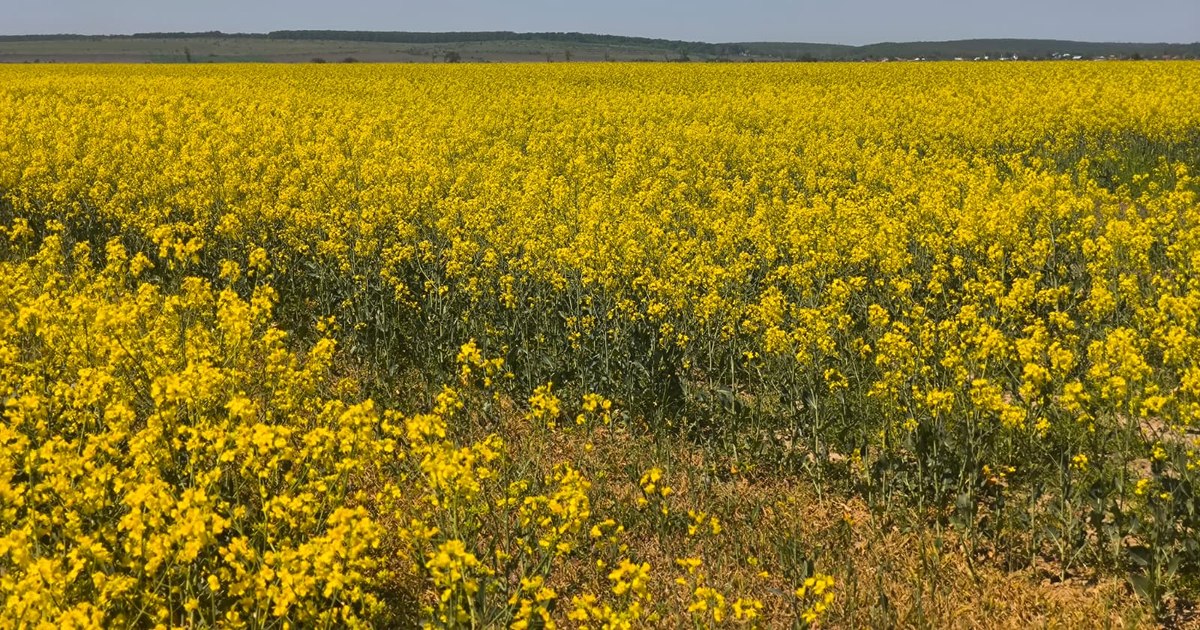
Dominated by intense yellow, the fields in the south of the country have become the attraction of those who want the perfect photo. The canola crop has replaced sunflowers and corn on large areas, with farmers hoping it will be the one that brings them profit. However, the surprises could be big, warns a farmer from Dolj.
The south of the country was colored yellow PHOTO: Ionelia Nucă
In Dolj county, according to the data of the County Agricultural Directorate, the lowest area of agricultural land cultivated with corn in the last 11 years is recorded, only 66,892 hectares, compared to 94,243 hectares in 2015. The areas cultivated with sunflowers also lost significant land, reaching 89,611 hectares cultivated in the fall of 2025, compared to 113,714 hectares in 2019 (the largest area in the 2015-2025 interval) or 103,964 hectares in 2024.
Instead, wheat and canola acreage increased, as farmers tried to protect themselves from another dry year that could leave them with empty barns, after the disastrous experience of the last two years when corn and sunflowers made them indebted.
The wheat, cultivated in Dolj last autumn on 168,346 hectares, brings them not much profit, the costs being high, and the prices – the same for many years. Rapeseed remained, the only crop considered profitable by more and more farmers. The area cultivated with canola increased to 30,409 hectares, compared to less than 20,000 hectares last year and only 7,720 hectares in 2020 (the year with the lowest area in the analyzed range). Prices are relatively stable and there is a high demand for export, being used both in the food industry and to obtain biofuel.
Win or lose
“Canola crop in 2026 may be the only profitable crop” says farmer Petre Petrescu, from Coțofenii din Dos, Dolj county. He grew canola on 250 hectares and until recently things seemed to be going well. An important part of this surface was instead forced to turn and sow, if necessary, sunflower.
The heat of the last 10-15 years forces the farmers to seriously violate the technological rules, returning with canola at an interval of less than four years on the same site. It arrived, says the farmer from Coțofenii din Dos, at a so-called short technology, basically rotating only two crops: wheat and rapeseed. This instead implies more phytosanitary treatments and an expected lower production, but which will still bring them profit. Specifically, they are not hoping for 4,000-5,000 kg/hectare, but they are betting on at least 3,000 kg/ha. As the average price is 2,000 – 2,200 lei/ton, the calculations show an increase at the end of the year.
However, the calculation did not turn out the same everywhere. In the fall of last year, heavy rains came, which was expected, except that such a large amount in such a short space of time caused great damage.
“500 – 600 liters of water per square meter within 100 days caused not only waterlogging, but the soil, especially in these areas where clay is a higher percentage in the structure and texture of the soil, retained water and the roots of the plants rotted. It was a scam. Many of us, including myself, saw the super ok rape crop in the spring. We were glad that we didn't have the canola very well developed in the fall, because the allicin that is present in the canola roots is what causes rotting and destruction of the roots. And we said that, yes, look, our rapeseed, being a bit later, did not do this matter. In spring I checked densities, everything OK. The moment the canola grew, elongated its stem and began to flower, we found ourselves at the first wind, about 3 weeks ago, with 30-40% of the canola crop lying on the ground. We wondered what was happening and when we entered the field we found that if we pulled a rapeseed plant out of the ground, the phenomenon of shoeing had taken place”, said the farmer.
The phenomenon was caused by heavy rain falling on the frozen ground, which damaged the roots. The finding came much later, after the farmer had made the necessary treatments.
“From a crop that promised 4-5 tons per hectare, if we made 2 tons we would be happy”says the farmer.
Farmers have meanwhile signed contracts with the big traders, now the big fear is that they will not be able to honor their contracts from the production obtained.
The farmer abolished the crop on a third of the area cultivated with canola, sowing again, this time with sunflowers. “Together with the insurance companies we went to the field and saw and we all came to the conclusion that it is not economically justified to keep the canola crop in vegetation. And then, reluctantly, one third of the 250 hectares that we have we abolished and we reseeded the sunflower crop, so that we could benefit from the fertilizers and fungal treatments that we had applied. Under these conditions, the only crop that was profitable in 2026, which brought us a plus there, is now…” added the farmer.
Farmers in the south of the country are giving up corn and sunflowers. “We went on a dangerous journey”
Rapeseed production could be below expectations, says a farmer from Dolj PHOTO: Ionelia Nucă
On a complete technology, says the farmer from Dolj, he has so far spent over 6,000 lei/hectare. The excess moisture prevented him from going in with ground machinery and doing fertilization, herbicides or foliar treatments. So he purchased drones, even though he owned state-of-the-art equipment for applying phytosanitary products.
“We bought drones and over 1,500 hectares, until now, we fertilized them, weeded them, we did treatments with drones. When the terrain allowed us to enter, we also entered by land means”, Petre Petrescu also said.
Possible loss in “beginner” culture as well
What happened to canola was repeated with barley, “an easy, beginner's crop”. Spring came and the barley crop was not growing. Fertilized twice, without the expected effect.
“I found that the exact same thing happened with barley. The fact that it was waterlogged and the land was waterlogged caused all the old roots of the barley to die. Simply. Now they gave him vegetative mustaches again and he left, and on these hills near us, in the north-west of Oltenia, the barley no longer has the roots from autumn, it has new roots. For this reason the culture is delayed and the production will be significantly less. In technological conditions that should have ensured me 9 – 10 tons per hectare, if I do 6 I will be super satisfied”, the farmer also specified.
Although the canola fields are perfect for photographers, farmers who walk through them find that the canola does not sprout and bloom as much as they expected, the Doljean farmer says.
Night temperatures are still low, only 3-4 degrees, at most 5 at night, and the differences between day and night have affected development.
“That will make those who have ventured to contract or who hope to make 4-5 tons per hectare have a big, big disappointment”, he Petrescu also said.
And if the price for rape remained at a high level, in the case of barley it is derisory, only 0.60-0.70 lei, given that the price of diesel has increased, the cost of labor has risen, the price of fertilizers has exploded.
Why rapeseed crops are becoming a strategic pillar of Ukrainian agriculture: plans to expand and increase production for biodiesel
“It makes us think that we have to completely and completely change our strategy in the perspective of the following years, because, analyzing the evolution of prices in Romania, it has never happened that the price of a product increased and then decreased. I had bread for 1 leu when the price of wheat was 60 pennies and he never returned the price of bread. Neither of diesel, nor of gasoline, nor of machinery. In contrast, the price of cereal products is constant. We have the same price as in 1989 for barley, wheat, corn, and sunflowers. We didn't really grow rapeseed before 1989. Rapeseed is a technical crop, and if you don't have specific equipment and professional training, you can have total losses with it”the farmer also said.
Risk of even lower productions in the coming years
Agricultural production in 2026 will be at least 30% lower than last year – this is the farmer's estimate, and this is because many farmers can no longer afford fertilization, they skip certain stages, settling for a lower production, but for which expenses are also reduced.
“Many, many farmers no longer have the opportunity to use chemical fertilizers. If you go to the big traders, you will see in their yards tractors, machinery, what they confiscated. People stopped giving them money and then they took their tractors. Others sold farms. Others are selling their land. (…) There will no longer be an average of 4.5 tons of wheat per hectare, there will be 3″, said the farmer.
On the other hand, the short rotation of crops is very likely to favor an appearance of pests in the following years. The suppliers of chemical substances are already talking about requests for new substances, the farmer also specified, because the pests can no longer be fought with the current products.
“I expect that, even if the area cultivated with rapeseed and wheat in the coming years will increase, the productions will be much more modest”concluded the farmer.