On a typical Wednesday, a family from Cluj opens their laptop to look for a two-room apartment. The prices – 95,000 euros, 112,000 euros, 87,500 euros – are displayed with the same naturalness as in Amsterdam or Frankfurt. No one finds this strange.
On Wednesday morning, Bloomberg quoted one euro at over 5.23 lei – a new historical record, a sign that the leu is weakening under the pressure of the political crisis. Romania has long had two currencies – one on the payslip, another for the most important purchases in life.
No one asks why a country with its own currency – denominates its most important private life asset in a currency it has not adopted, cannot issue, and therefore cannot control.
This is, in essence, the story of Romania's Euroization – an economic phenomenon with deep psychological roots that has quietly transformed the way Romanians think about value, risk and the future.
A degree of euroization of ~32%, but the numbers tell only half the story
Economists measure financial euroization simply: how many bank loans and deposits are denominated in foreign currency relative to the total. At the level of the bank balance sheet, Romania currently stands at approximately 32% – a number that, taken out of context, seems modest. But context changes everything.
Foreign currency deposits (% of total): 31.4%
Loans in foreign currency (% of total):32.2%
Aggregate euroization index (method used by the IMF): ~31.8%
(Source: National Bank of Romania, monthly release on monetary aggregates, May 2026.)
Compared to the peak before 2015 – when foreign currency loans exceeded 60% of the total – the decline seems dramatic.
But this hides a more nuanced truth: the reduction of financial euroization was, to a large extent, the result of the BNR regulations that very strictly regulated banks to grant loans in euros to people with incomes in lei. In other words, euroization did not decrease because Romanians gained more confidence in the leu – but because the option was taken away from them.
However, Romania did not get rid of its dependence on the euro. It has only changed the form in which it manifests itself: from credits in euros, to prices in euros.
A distinction that the numbers do not capture: the real estate market is a parallel economy one hundred percent in euros
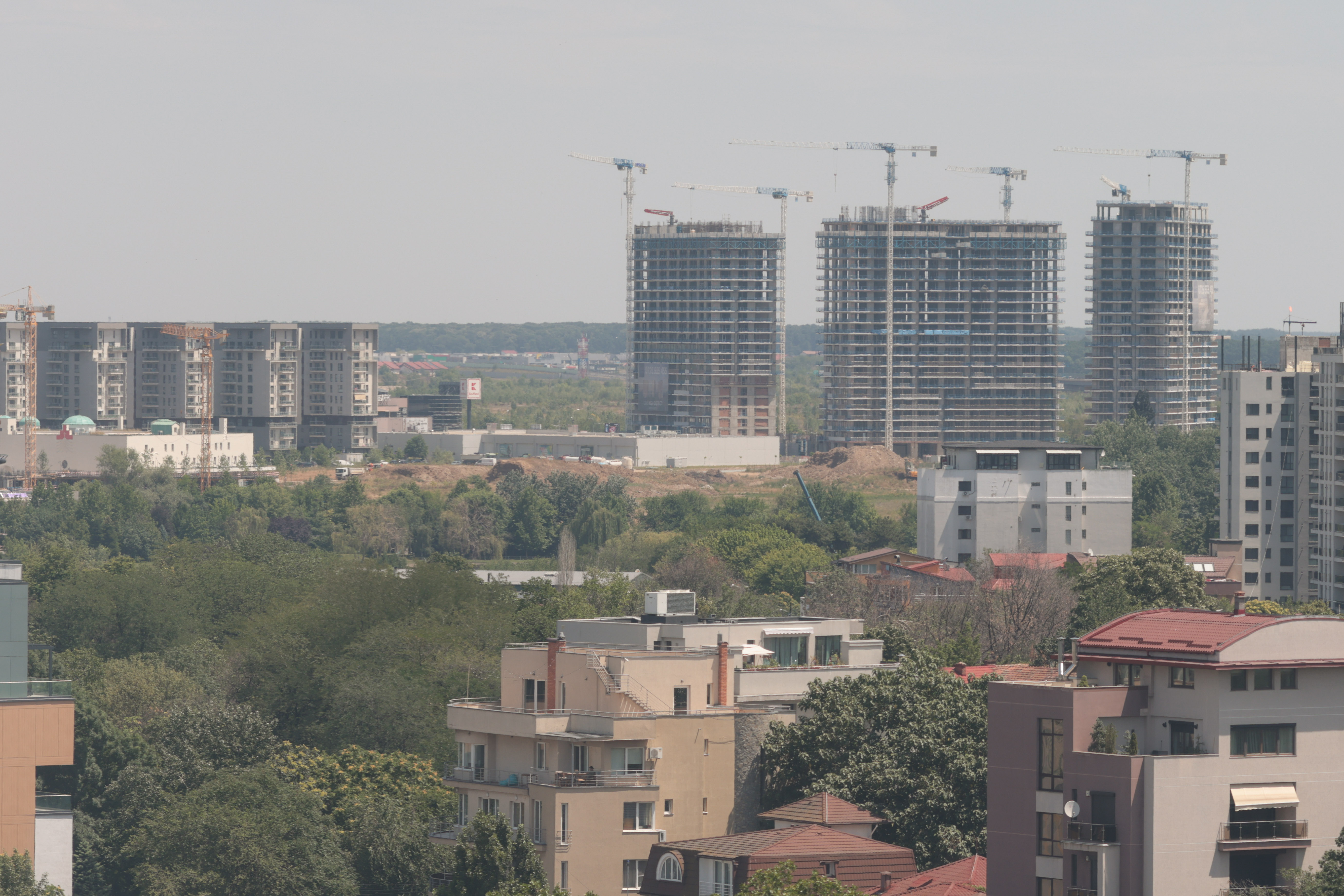
No other market better illustrates Romania's monetary paradox than real estate. On the ad platforms, the prices are displayed almost exclusively in euros – from the studios in Bacău to the penthouses in the north of the Capital. The final transactions are technically done in lei, at the BNR exchange rate on the day of signing – but the negotiation, evaluation and price psychology are entirely in euros.
This practice reflects a lesson learned in decades of post-communist inflation: the leu is not a safe long-term store of value. An apartment valued in lei runs the risk of appearing to have “increased in price” simply because the currency has depreciated, not because the property is worth more. The Euro removes this “noise”.
The INS and BNR data that we analyzed mathematically confirm this intuition: an apartment quoted at 100,000 euros in May 2020, when the exchange rate was 4.82 lei/euro, was worth 482,580 lei. The same apartment, at the May 2026 exchange rate of 5.21 lei/euro, is worth 521,800 lei – an apparent increase of 8% in lei, generated exclusively by the depreciation of the currency, not the market. If the price had been expressed in lei and indexed with the accumulated inflation (estimated at ~59%), the owner would have had to ask for 767,302 lei to keep his real purchasing power. The difference – almost 245,000 lei – is exactly what the seller who lists his property in lei loses.
Why the euro protects the value of the property – illustrative calculation
Diaspora, remittances and the euro circuit
The Romanian real estate market operates according to a logic that many analysts underestimate: it is, in part, a diaspora market. More than four million Romanians live and work outside the borders, most of them in the euro area. They send home between 8 and 10 billion euros annually – a flow that, compared to Romania's GDP, represents one of the highest levels in Europe.
This money enters the economy in euros and is often spent directly on real estate. A Romanian from Madrid or Düsseldorf who buys an apartment for his parents or as an investment does not think in lei. He thinks in euros. The seller knows this. And so the entire upper segment of the residential market gravitates around the European currency, dragging the rest of the market along.
A regional practice, not a Romanian exception
It would be incorrect to treat the euroization of real estate as a Romanian peculiarity. Bulgaria, before adopting the euro, had practically the same practice. Serbia – which is not even a member of the EU – quotes apartments in euros with the same naturalness. In Bosnia and Herzegovina, the euro circulates de facto as the second currency in daily transactions.
What these economies have in common is a past of currency instability and an overwhelming trade orientation towards the Eurozone.
Foreign trade, strongly euroized as well
Over 70% of Romania's exports go to the EU. The EUR/RON exchange rate directly influences the competitiveness of the automotive industry, IT and agriculture. The euro is not a foreign currency – it is the economic air in which the Romanian economy lives, even if officially it does not breathe.
The role of the NBR and “dirty floating”
The National Bank of Romania manages what economists call a “dirty float” or “managed float” – an officially floating exchange rate, but which in practice is kept within narrow bands by interventions of the central bank. The lion did not depreciate steeply, and that deliberately. The NBR buys and sells from the foreign exchange reserve to prevent excessive volatility, knowing that a sudden depreciation would reactivate the pressures towards full euroisation.
But this strategy also has a hidden cost: it prevents the economy from sending the right signals. Artificial course stability only dampens these signals
Why euroization will not go away
In theory, Romania could reduce euroization by adopting the euro. This would eliminate exchange rate risk, standardize prices and fully integrate the economy into the European monetary area.
In practice, joining the euro seems more distant than ever: the budget deficit far exceeds the convergence criteria, inflation remains high, and political will for the necessary reforms is inconsistent.
In an alternative scenario, Romania could reduce organic euroization if the leu would become truly stable and if inflation would drop sustainably to the level of the euro zone. This would require a fiscal discipline that no government in the last ten years has demonstrated.
What probably remains is a third scenario: the status quo. Romania will continue to live with two currencies – one on the salary slip, another on the real estate ad. Partial euroization is an unstable equilibrium, but stable enough to perpetuate itself. Each generation that buys its first apartment in euros becomes, in turn, a seller who quotes in euros. The circle closes