How Europe came to be increasingly “contaminated” by sovereignist parties. Populism expert: “The PSD-AUR alliance is not unique”

The so-called sovereignist parties are gaining more and more ground in the EU, and the mainstream parties are starting to be more and more “contaminated”, and the policies of the European governments influenced by them. Political scientist Sorina Soare, (University of Florence), explains this mechanism, in an analysis for “Adevărul”.
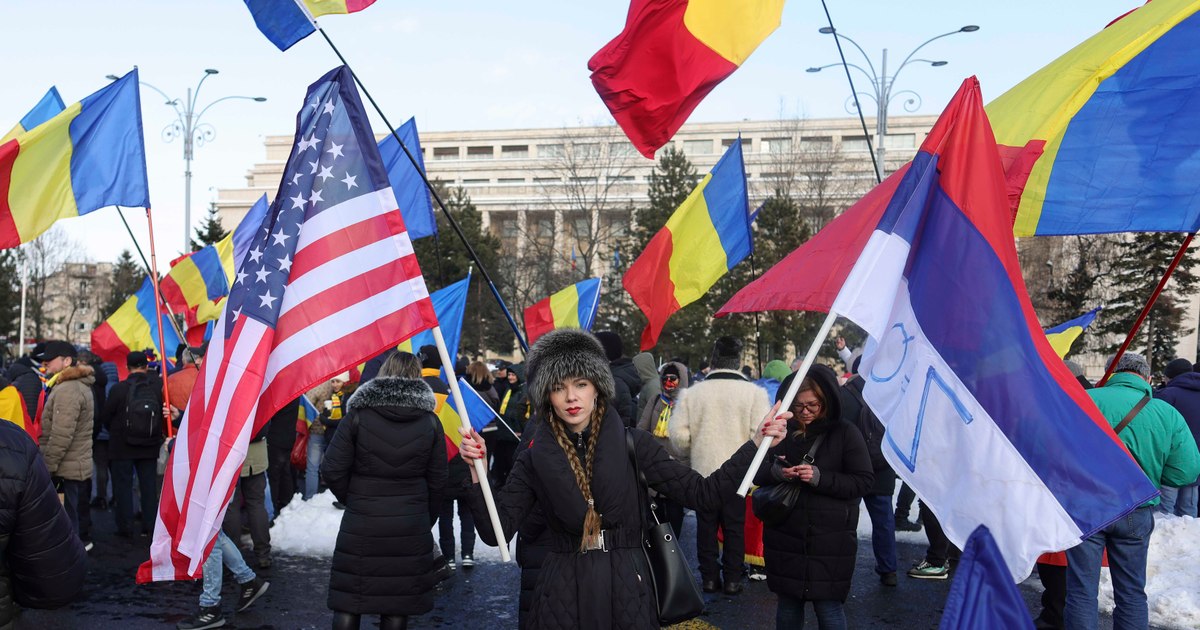
Supporters of Călin Georgescu protest in Piața Victoriei in Bucharest. PHOTO: Inquam Photos
The government led by Ilie Bolojan was dismissed on Tuesday by a no-confidence motion adopted by the Parliament, following a collaboration between PSD and AUR. However, this is not the first time that AUR has overthrown a government and allied itself with a mainstream party. Five years ago, AUR, allied with USR, toppled the Cîțu Government.
We can even talk about a trend at the European level. With the coming to power of Donald Trump in the United States of America, but especially since this year, it is increasingly obvious that the so-called radical (illiberal) parties are contaminating the others, which end up taking on themes and ideas specific to populist parties, argues political scientist Sorina Soare, from the University of Firenze, in Italy. Sorina Soare, who is an expert in the field of comparative politics with expertise on European political parties, democratization processes and populism, believes that the cordon sanitaire created around the parties that until yesterday were considered unfrequented is slowly cracking. In addition, mainstream parties are increasingly receptive and take cues from them, even adopting policies that until recently they condemned. All in the fight for an electorate that seems increasingly receptive to populist ideas.
The USR – AUR and PSD -AUR alliances are not really accidental
One example is that of increasingly tough anti-migration policies in Europe, which are beginning to resemble Trump's. At the same time, in Romania, but also in other countries, certain parties are flirting with radical formations. If in Romania we had the USR alliance with AUR, in 2021, for the dismissal of the then government, today we have the PSD – AUR alliance, although both PSD and USR have denied any approach to AUR. In Europe, in France, Macron had occasional collaborations with Marine Le Pen's party, and in Germany, Friedrich Mertz's Christian Democrats were suspected of certain agreements with the AfD.
“Recently, it has become more and more obvious that a constellation of actors has been created that support radical right-wing parties. And our PSD-AUR alliance is not unique”says Sorina Soare, with reference to the alliance that existed between USR and AUR, in 2021, but also many other collaborations at European level between liberal and illiberal parties.
In his opinion, the policies and pressure of the Trump administration, spearheaded by JD Vance, but also the skills of some radical European leaders to ask for and receive support from across the Atlantic mattered enormously.
“Somehow even the performance of JD Vance, with his visit to Budapest, led to a legitimization of these actors, but here we can also include the visit of George Simion to Poland. Because I saw Simion with the president of Poland, he speculated that moment and went to watch the matches with him. Through the construction of international networks, you can see that illiberalism tends to become more and more mainstream“, she says.
The tone is set from Washington
Besides, the tone was set by Washington, and under America's pressure, more and more European countries tend to legitimize or at least tacitly accept the adoption of MAGA practices. Sorina Soare talks about a contamination. Here, she gives as an example the migration restriction policies adopted by several European states and largely inspired by the United States of America.
“Practically, Trump's behavior legitimizes a lot of political behaviors and themes in Europe and beyond. For example, the question of migration and the fact that tough policies must be adopted. There have been certain forms of contamination. The policies applied by the Trump administration in the United States have been somewhat celebrated by certain parties when they were in opposition. An example is Germany. And in Italy we have seen this kind of accentuation of the discourse related to the securitization of migration and the harshest possible reaction. And these elements I think that, even if existed in the United States, they are now becoming more visible and harder to criticize, to some extent, as long as the President of the United States enforces and upholds them“, explains Sorina Soare.
The fact that states like Romania and Bulgaria were present at the Peace Council in Washington, but even the European Union did the same by delegating an observer, only sent a signal of acceptance towards MAGA.
Who else can convince the US and Iran to sit at the negotiating table. “He built a very good relationship with Trump”
“I think that another quite interesting element was, somehow, the way in which several countries, including Romania, participated and legitimized, for example, the Peace Council. An initiative that obviously challenges the traditional role of international organizations, the UN, but on the other hand it shows that states, including those led by parties considered mainstream, as in the case of Romania, are forced to make quite a few compromises in order to adapt to this political period. We even saw that the European Union had a representative in Washington, of course, with observer status, but he was present”adds the expert.
Eastern Europe needs the US and makes concessions
States like Romania are somehow forced to do this in order to preserve the partnership with the United States of America and not risk being abandoned. The security interests of Eastern European countries make them more open to the advances of the United States, believes Sorina Soare.
“Of course, it's also very hard to ignore something like this as the cost is very high. The cost, obviously, is related to the involvement of the United States in NATO and especially on the Eastern border”, she also shows.
At the same time, the United States of America is acting more and more defiantly in some respects and violating the political right without any motive. If in the past Washington acted much more discreetly when it got involved in the elections of other states and used intelligence services and other methods to secure friendly regimes, in 2026 it did not hesitate to violate international law and act openly, says Sorina Soare.
“On the other hand, we can see and, from my point of view, really, one of the most interesting concepts that has been talked about lately is that of a change from regime change to regime compliance. The fact that what Donald Trump has done in Venezuela is not regime change as we are used to seeing in the period after the Second World War, when the United States camouflaged practically all interventions in the name of democracy, in the name of freedom. Now these elements are less and less interesting, let's say, for foreign policy, and the United States is very pragmatic,” supports the expert.
The US has changed its motivations
And Washington's motivations have changed to a great extent, believes Sorina Soare.
“The United States no longer wants a regime change and the promotion of democracy, but a regime that gives them an economic and also political advantage. For example, in the case of Milei, the support package that the United States gave to Argentina before the parliamentary elections was also interesting. And it worked, because Milei won. So all these elements are very interesting because, from my point of view,it's a sight, an increasingly strong alliance is somehow being strengthened at the international level”, she also says.
Romanian software that detects terrorists before they attack. How an AI firm from Cluj became a partner of the Pentagon
However, there are exceptions and situations in which certain European states, close allies of the United States, have chosen to defy Washington. A surprise in this regard was the way Giorgia Meloni's Italy, one of Donald Trump's favored European leaders, refused to support certain American files, culminating in the Iranian one.
The best example in this regard was when Rome banned the overflight and use of its bases for American planes that were going to bomb Iran.
Sorina Soare explains the motivation behind the unexpected gesture made by Giorgia Meloni, one of Trump's main allies in the European Union.
“There is also a lot of international politics here. Ms. Meloni is one of the closest women in politics, or well, politician, to what Donald Trump represents, and not from now, but even before 2016, after 2016 and, for example, after 2020. But Ms. Meloni, if she made this decision, she also made it in the context of losing an important domestic referendum related to justice reform, a topic that has been highly politicized since Berlusconi. So it was somewhat the flag of the right-wing parties in Italy. And the latest decisions are also being made for the fact that he has started to drop in the polls for the first time since 2022 when he sees some decline in the polls. Sure, this drop is insignificant at the moment, but enough to scare them. Also scaring him is the fact that new parties have appeared, such as the party of General Vannacci, who, on the other hand, is married to a Romanian woman (as an anecdote), with a speech much more to the right, much more radical and which somewhat challenges Italy's involvement in international matters that do not concern it, which could lead to the sacrifice of Italian lives in conflicts that are not related to Italy's interests. They are not only foreign policy decisions, they are often foreign policy filtered by the needs of the moment,” says Sorina Soare.