Yesterday, May 5, 2026, the Romanian Parliament adopted a censure motion with the largest number of votes in the history of post-December democracy. 281 MPs voted for the dismissal of the Bolojan government, only 4 against. A record vote. A vote that, in other countries, would be celebrated as a sign of democratic maturity, the ability of a parliament to firmly express its will.
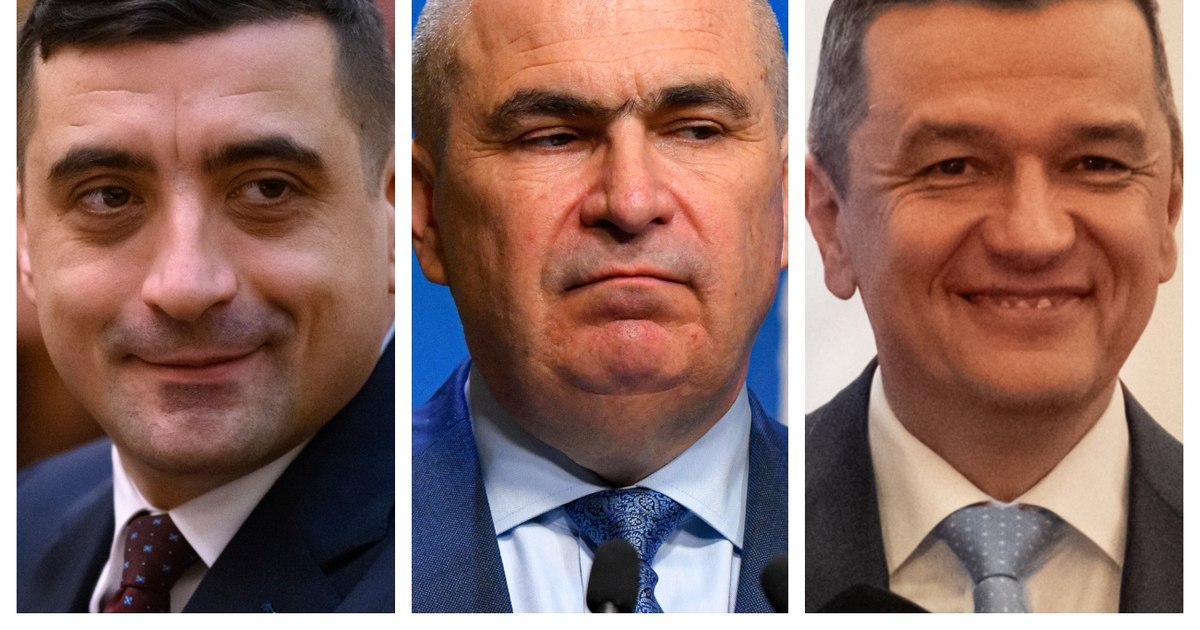
George Simion, Ilie Bolojan, Sorin Grindeanu PHOTO Mediafax
Except that with us, voting was not the expression of maturity. It was the expression of hypocrisy. And of a political calculation so crude that it seems taken from a textbook of institutional cynicism.
Let's say it straight, without any detours: GOLD sold for several silvers.
The party that for five years screamed into every microphone that it is against the system, against the PSD, against the “cartel of old parties”, against everything that represents classic Romanian politics, today voted side by side with the PSD to bring down a government. Not only that he voted alongside, a co-initiator motion with PSD. The motion is named “STOP the Bologna Plan to destroy the economy, impoverish the population and fraudulently sell the state's wealth” and was submitted jointly by PSD, AUR and PACE.
Five years of anti-system discourse. Five years of “we are different”. Five years of promises that “we will sweep PSD-ist corruption from the roots”. And then, in a single day, the road partner is exactly the PSD, the party that AUR called, in hundreds of public statements, “Romania's political cancer”. Those who believed, voted and hoped for AUR as a real alternative witnessed today the most eloquent demonstration of the old Romanian saying: they are all one water and one earth. Not because it's a cynical thing to say. But because, unfortunately, it's true. All the parties that ever promised “total change” in Romania ended up, sooner or later, in the arms of those they denounced.
But even PSD does not come out clean from this story. Or shouldn't.
The PSD has been in government constantly in recent years, in various formulas, with various prime ministers, in various coalitions. He was Bolojan's partner in the current coalition, until a few weeks ago, when the social democrats withdrew their political support and the PSD ministers and deputy prime minister resigned from the Executive. They sat at the table of power. They signed documents. They passed laws. They shared functions.
And then, when it suited them, they overturned the table.
Their main accusation, that Bolojan would have sold “state wealth”, comes from a party that has been in power for almost three decades and which, in these years, has had enough time and enough opportunities to show how to manage “state wealth” differently. The results are visible to anyone who looks honestly. Hypocrisy is of an ugly nature, because it precisely masks the lack of a real alternative under a pretended moral indignation. And now, the question no one asks clearly enough:
What are we doing as a country in the middle of this circus?
Romania changes prime ministers with a speed that has long ceased to be a curiosity and has become a systemic tragedy. Bolojan, dismissed on May 5, 2026, is only the latest in a long series. In recent years, we have had so many premieres that even informed citizens can no longer list them without stopping from time to time to remember the order. Each prime minister comes with his own “strategy”. Each one leaves behind unfinished projects, abandoned reforms, rewritten plans. Each new minister rewrites what the predecessor did. Each coalition meeting produces a new compromise which, two months later, is denounced by one of the signatories.
All this time, the country stands still. Or worse, it regresses. Because political instability is not just an image problem, it is a real economic, social and strategic problem.
Foreign investors see Romania as an unpredictable market. The European bureaucracy is losing patience with a country that cannot maintain a government long enough to implement what it has pledged to do. Structural reforms remain on paper. Big infrastructure projects drag on. The PNRR is blocked every month by every new minister. And the ordinary Romanian? The ordinary Romanian pays. It pays through bills, through taxes, through public services that degrade, through hospitals that close, through schools that are not modernized, through roads that are not built.
We are the laughing stock of our own political class.
I don't say it with gratuitous fierceness. I say it with pain. Because the ones who really pay the cost of this chronic instability are not the politicians, who, regardless of the election cycle, always find a coalition to fit into. We are the ones who pay.
We pay with salaries that do not keep pace with inflation. We pay with pensions that no one can guarantee in the long term. We pay with a collapsing public health. We pay with an education that produces, year after year, generations more and more ready to leave the country. We're paying with a collapsing demographic, because nobody's having kids anymore in a country where the future depends on who loses and wins the next no-confidence motion.
And, perhaps most painfully of all, we pay with trust, with that fundamental trust that a society must have in its own institutions in order to function. Surveys show the constant erosion of trust in the Parliament, in the Government, in the parties. No wonder. How can you trust a system that, every few months, proves that alliances are circumstantial, principles are negotiable, and electoral promises are only valid until the first coalition meeting?
what is happening now
President Nicușor Dan announced that he will start informal consultations with the parties and ruled out the scenario of early elections. We will probably have a new coalition, a new prime minister, a new government. And probably, in a few months, we will witness a new motion of censure. Because that has become the Romanian political normality: not the government, but the constant preparation of the next fall.
And the “pro-Western” parties that were dismissed today will continue to accuse each other. USR announced that it will not negotiate with PSD. PNL is still deliberating. Leaders will make calls for accountability. And everything will appear to be moving, when in fact everything is standing still.
What is left for us?
We are left with perhaps the hardest and most precious thing: clarity. The clarity to see what happened today for what it is, not a democratic victory, but a political transaction. Not an act of courage, but an act of opportunism. Not a historic turning point, but just another page in an increasingly tiresome chronicle of a dysfunctional democracy.
And we still have hope, the hope that, in the next election, our vote will be less emotional and more lucid. That we will stop believing in parties that promise to change everything overnight, because none of them do. That we will finally learn to demand competence, stability and consistency, not spectacle, outrage and “national liberation”.
Because the truth, which politicians prefer not to say, is simple and hard to swallow: The country is not built on censure motions. It is built from patience, from continuity, from silent work. And we, for too many years, choose the opposite.