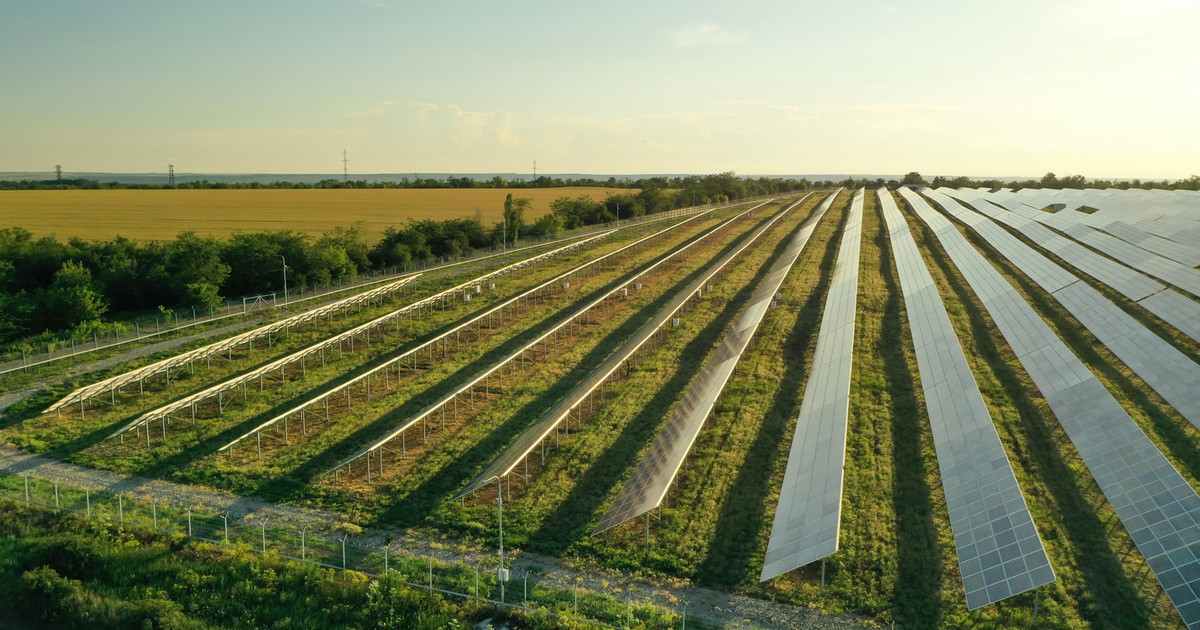
Another breakthrough has recently occurred in the Polish power industry. The first professional solar power plant debuted on the balancing market, where it will provide balancing services. This is the Zwartowo photovoltaic farm – a large-scale installation with a capacity of 204 MW belonging to the German company Goldbeck Solar. The owner entered the new market thanks to cooperation with the Polish company Respect Energy, which has been responsible for trading in the produced energy since April 21.
Read also: Solar energy is growing like a weed. Coal was left behind
Balancing market. The electricity must be just right
The balancing market – or in this case, more precisely, the balancing services market, so far dominated by conventional power plants – has thus gained a new player who will be able to respond to the transmission system operator's instructions regarding increasing or decreasing energy production. The operator, i.e. Polskie Sieci Elektroenergetyczne, uses this market (the so-called technical market) as a tool to ensure real-time compliance between the supply and demand for electricity.
To put it simply, the idea is to always have “just the right amount” of energy in the system, unless this cannot be ensured on the classic energy market. According to Goldbeck Solar, before its debut, the Zwartowo farm had to undergo a qualification period lasting approximately 14 months to prove that it meets all technical requirements, including controllability, but also high quality of data and forecasts of its operation.
In the published announcement, the company states that its presence on the new market is becoming a “strategic tool for improving the economics of renewable assets” – it simply allows you to earn more and stably, especially in the era of increasingly frequent oversupply of green energy, negative prices and forced shutdowns, In the short term, photovoltaic farms can gain up to 10%. revenue growth, and in the long term – approx. 4%.
Goldbeck Solar's representative, Affan Ahsan, adds that the new activity will allow renewable units to “go beyond the role of passive price recipients” and more actively influence the system. Another interesting fact is that the Zwartowo farm is located in the Pomeranian commune of Choczewo, which is becoming one of the informal main centers of the Polish energy industry – this is where the first nuclear power plant will be built and power from wind farms in the Baltic Sea will be supplied.
Read also: I saw the construction of the station in Choczew. Large energy industries are entering Pomerania
Zwartowo Farm
|
Respect Energy SA
Balancing services. Here's what they provide
What is actually traded in the balancing services market? This is explained by Karol Wolański, Head of Flexibility and Aggregation at Respect Energy, which manages the production of the Zwartowo farm.
— In the balancing market, the operator balances demand and supply for energy, issuing orders to increase or decrease production. The balancing services market, as a segment of this market that has existed for two years, allows PSE to plan power reserves in the system in advance in order to maintain the appropriate frequency, he says.
Balancing services allow you to maintain appropriate network parameters that guarantee energy security. The remuneration, determined on a market basis, is received for the readiness to carry out the operator's instructions and separately for activation.
A balancing service provider such as Respect Energy declares the operating schedule of its sources to the Polish Power Grids, and the operator can plan the operation of the entire system on this basis.
— In this way, we declare that we are at the operator's call if he needs our reserves; we will then be able to supply energy or reduce its production. Until recently, there was no market for such services – although the operator concluded bilateral agreements with centrally managed generating units, i.e. large conventional power plants, there was no element of competition – explains Karol Wolański.
Balancing services. “We can responsibly declare PSE”
The role of the balancing services market – similarly to the capacity market, which, however, operates in longer time frames and is intended to serve as a “just in case” mechanism – is the readiness of sources to operate at the operator's command. Are renewable sources such as photovoltaic or wind farms, which depend on the weather, suitable for this? An expert from Respect Energy argues that yes.
—There is a widespread belief that weather-dependent renewable energy sources are too unpredictable to plan their generation. However, this is not true – scheduling production for the next day does not carry such a high risk of error. Based on the weather forecast, including cloud cover, we are able to assume not only the average amount of electricity generated, but also the minimum power generation. So we can responsibly declare to PSE that we will be able to respond to their orders at such and such hours, argues Wolański.
Balancing services help the power system
|
fotorauschen / Shutterstock
The specialist adds that weather-dependent sources, as providers of balancing services, even have advantages over classic conventional power plants; they are easier to manage.
— The operation of installations such as PV farms is simply based on electronics. This is an inverter control which, colloquially speaking, is simply a “flick”. We can turn it on and off remotely when necessary, however, classic coal blocks are characterized by a certain slowness related to, for example, activating or turning off the boilers. In practice, the responses of weather-dependent sources to operator commands may be faster and more accurate, says our interlocutor.
When asked about potential sanctions for failure to provide balancing services if something, e.g. an unforeseen change in weather, gets in the way, Karol Wolański replies that PSE will not penalize suppliers separately in such situations. The only consequence will be the need to purchase the missing capacity at any price, which the operator will buy “in an emergency” from another player on the market.
— We received clear confirmation that if we do not comply with the order, we will not be immediately excluded from the market. Of course, if we repeatedly deviate from the schedule, PSE will take measures, but this is an extreme scenario, Wolański points out.
Balancing market. A good solution for renewable energy
Zwartowo Farm is the first entity on the market of balancing services in the category of photovoltaic and wind sources; So far, among the broadly understood renewable energy sources, controllable hydropower plants have participated in the market.
— Many entities are in the process of qualification, but priority is on our side. As Respect Energy, we have been servicing the Zwartowo farm since April 21 and we can already see that the revenues are higher than expected. Solar sources have a high potential to reduce generation during hours that are valued the most on the balancing services market. Of course, over time, when there are more players on the market, prices will go down, but today we benefit from the first-mover bonus, says Karol Wolański.
The expert explains that the energy market is overcontracted – i.e. when supply exceeds demand – especially around noon, when solar sources are most active. PSE then needs to reduce production, the most far-reaching means of which are increasingly frequent orders to shut down farms – non-market redispatching, which took place on a large scale, e.g. last Easter. This is an unfavorable trend for producers of electricity from renewable energy sources; providing balancing services and making money by reducing their capacity when there is a glut on the market is therefore an attractive option for them.
—The demand for balancing services in the system will always occur, and the more weather-dependent sources, the more often. For owners of RES installations, participation in this market is an interesting way to diversify revenues, including avoiding negative prices and top-down installation shutdowns – summarizes Karol Wolański.