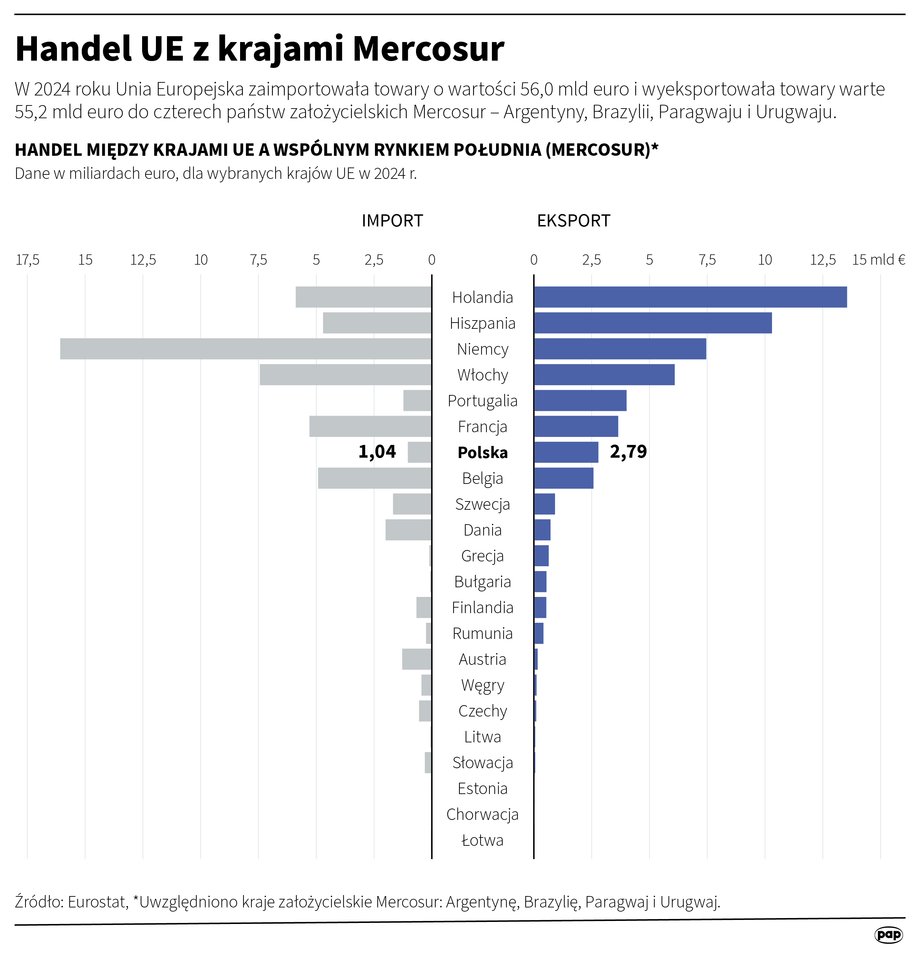
The commercial part of the EU-Mercosur agreement (Argentina, Brazil, Uruguay and Paraguay) has been in force since May 1. This means that South American products will be able to be imported to the EU duty-free or subject to more favorable customs duties than before. In the case of the so-called sensitive products such as beef, poultry, sugar or ethanol, however, the reductions will apply to specific quotas of a given product. EU countries will be able to export overseas under better conditions than before, including: cars and machines.
As indicated by the European Commission, the agreement will gradually eliminate import duties by over 91%. EU goods exported to Mercosur, opening the single market to over 700 million people. — From tomorrow, the deal will eliminate or dramatically reduce tariffs on key EU exports such as cars, pharmaceuticals, wine, spirits and olive oilimmediately creating new opportunities for EU businesses in one of the largest trading zones in the world, says the Commission.
The impact of the Mercosur agreement on Polish industry
|
Crédit Agricole
Read also: This signature will culminate decades of effort. Who will gain and who will lose from the agreement with Mercosur?
The remaining parts of the EU-Mercosur agreement – relating to investment protection and public procurement – will only enter into force once the European Parliament and Member States have ratified the agreement.
The European Parliament sent a request to the Court of Justice of the EU to examine the compliance of the agreement with the EU treaties.
To calm farmers' fears, in the event of excessive import of a given product into the EU, the so-called a protective clause enabling an increase in customs duties on a given product or a temporary ban on its import. It will be applied when the price of a given product affected by imports from Mercosur countries drops by 5%.
The EU Council gave the deal the green light in early January. At that time, Poland, France, Ireland, Austria and Hungary were against this decision. On January 17, the head of the European Commission signed the agreement in the capital of Paraguay, Asunción.
The European Commission believes that the agreement will strengthen the EU economy and the Community's position in world trade.
Prof. UW Jan Hagemejer in a recent conversation with Business Insider Polska calculated that 90 percent. products from Mercosur will gain access to the EU market immediately. As he emphasizes, at the same time, it should be remembered that the EU level of protection is low and goods from Mercosur are already present on the EU market. – On Mercosur's side, liberalization of market access is spread over 15 years, but the positive effects for EU producers will be greater because Mercosur markets are currently subject to very high customs duties – he added.
— The overall balance for the entire EU will certainly be positive, especially due to the expansion of industry – emphasized Jan Hagemejer. As he noted, consumers will certainly also benefit because thanks to the agreement, food will be cheaper.
He pointed out that “the agreement with Mercosur will not be a big threat, nor will it be a breakthrough.” — It will be just another agreement that will have positive economic effects for Poland and the EU — the EU should be interested in having trade relations with as many countries as possible, especially in the context of a changing global economy. Opening up to the very large Mercosur market will be another element in building the EU's position in the world, he concluded.
Poland will challenge the agreement to the Court of Justice of the EU
Radosław Sikorski, head of the Ministry of Foreign Affairs, is optimistic about the impact of the agreement on Poland.
Read also: Poles are afraid of the agreement with Mercosur. An expert explains whether we are at risk of a meltdown
— Available analyzes show that the agreement with Mercorus should be beneficial for the Polish economy as a whole, and when it comes to agriculture, in some sectors there will be challengesbut in others there will be benefits – he argued at a press conference at the end of April.
A similar approach is presented by prof. UW Jan Hagemejer, president of the CASE Center for Socio-Economic Analysis. At the request of the European Parliament, he prepared a report on the effects of the agreement.
In the winter, in an interview with Business Insider Polska, he pointed out that both at the EU and Polish level, the automotive, machinery and equipment, metals and metal products industries, i.e. the most important industries, will benefit most from the agreement with Mercosur.
On Mercosur's side, he added, the agricultural and food production sectors would benefit the most. — Food and agriculture is the only area where both blocs export a lot and have a clear importance in the global economy. Poultry and beef producers will be most exposed to competition from Mercosur. but this impact will not be large due to restrictions on duty-free imports, i.e. so-called tariff quotas – said the expert.
According to Hagemejer's estimates, as a result of the agreement with Mercosur, beef production in the EU will decline the most – by 0.4%. — and sugar — by 0.7 percent.
He also argued that “the EU will benefit more from the agreement with Mercosur.” — Currently, customs duties and barriers in the EU are much lower than in Mercosur, where there is a lot of protectionism, he argued.
However, the Polish government announces that it will appeal to the Court of Justice of the EU. On Thursday, the government's Committee for European Affairs dealt with the application. The deadline for filing this complaint is May 26.
Our sources explain that the complaint concerns the procedure for processing this contract by the European Commission. — If you said “a” (Poland was against the agreement at the EU forum), you have to say “b”. PSL is most interested in the complaint, but the chances of success of this initiative are low – we hear.
Poland's complaint to the CJEU regarding the agreement with the Mercosur countries is being developed in cooperation with the ministries of agriculture, development and technology, and foreign affairs. Minister of Agriculture Stefan Krajewski from PSL tells Business Insider Polska that the Ministry of Agriculture has prepared a contribution to Poland's complaint against the EU-Mercosur agreement. — The European Commission did not follow the Council's negotiating mandate by breaking from the agreed framework. In our opinion, she did it illegally. We want the Court of Justice to check this – he explains.
However, as he emphasizes, the food security of the European Union is more important than procedural issues. — Competitiveness of our farmers and consumer health. We included these arguments in the position of the Ministry of Agriculture submitted to the Ministry of Foreign Affairs. We are also submitting a request to temporarily suspend the application of the agreement – points out Stefan Krajewski.
Mercosur
|
Mateusz Krymski/Mateusz Madejski / PAP/photos
Read also: What does the agreement with Mercosur mean for Poland and the EU? These are supposed to be the effects
Beef producers see hope in exporting to new markets
Beef production is one of the sectors that may be hardest hit by the EU-Mercosur agreement.
Jacek Zarzecki from the Sustainable Beef Platform in an interview with Business Insider Polska praises the government for its decision to appeal against the agreement to the CJEU. — The biggest political winner of the announcement to file a complaint to the CJEU is the Polish People's Party. It was Władysław Kosiniak-Kamysz and Stefan Krajewski who convinced Prime Minister Donald Tusk that in this case the objection submitted by the EP or diplomatic reservations were not enough. Anyone who is involved in politics knows that it must have been a difficult ordeal, especially since KO voters are divided on the issue of the agreement with Mercosur, he points out.
— PSL can therefore say: in the Mercosur case, we have taken specific action. We have defused the political bomb that would be the axis of the 2027 elections. – Zarzecki points out.
As he estimates, “PSL strengthens its political position with this complaint, but also its credibility towards farmers.” — Which is not easy, especially since the number of difficult cases is the highest in years. A smaller future Common Agricultural Policy, environmental and climate requirements, a “bus” with international agreements in which agriculture is most often left on the sacrificial table. This causes concern and an increase in anti-EU sentiments, Zarzecki points out.
However, as he emphasizes, a strong state does not limit itself to blocking threats. A strong state also builds new opportunities.
— Agricultural policy cannot be limited to subsidies and extinguishing fires. You have to think strategically. If the agreement may permanently change the conditions of competition on the European market, the state has an obligation to react earlier, and not only when farmers suffer losses, he argues.
In his opinion, systemic solutions are the solution to challenges. — This often raises objections because such solutions do not bring immediate results. However, there is no other option if we do not want to be perceived as always complaining, without a plan, only reaching out for money, says Zarzecki.
As he adds, it is as important as defending against unfavorable contract provisions active policy of opening new markets. It calls for export diversification, presence on demanding non-European markets and strengthening the brand of Polish food.
— And it is happening: Uzbekistan, Kazakhstan, South Korea, Japan, Morocco are not a concert tour, but trade missions aimed at opening new markets, restoring lost ones or expanding the range of products. If we add actions at the national level to this. Announcements of creating sector strategies and building resilience by increasing competitiveness and focusing on quality – this is the change agriculture is waiting for – says Jacek Zarzecki.
It also presents a list of tasks for farmers. — It's time for us – as an agricultural community – to understand: the state, government, prime minister or minister of agriculture will not sell our food or negotiate prices. They can open a new market, remove technical barriers, but we have to take care of the sales ourselves. This also requires a change of approach on the part of the agricultural community. Be a partner, not a reviewer. An initiator of changes, not one waiting for proposals and solutions. We need a change in thinking, more on our side than on the politicians' side. – sums up Jacek Zarzecki.
The poultry industry is full of concerns
The president of the National Poultry Council, Dariusz Goszczyński, emphasizes: – Supporters of the agreement repeat that it provides for the additional import of only 180,000. tons of poultry meat per year, but this statement does not reflect its actual impact on the market. The key problem is that importers target almost exclusively the most valuable part of the carcass – chicken breasts.
As he calculates, with the EU production of this product at the level of approximately 3.5 million tons, today as many as 900,000 tons of this meat is imported. This means, adds Goszczyński, that every fourth chicken breast on the European table comes from outside the EU.
— Any additional volume will therefore directly hit the most sensitive market segment, which will inevitably lead to drastic oversupply, price destabilization and enormous cost pressure for local producers. – he convinces.
Goszczyński draws attention to one more aspect of the matter. — European producers must compete with products from third countries that do not meet rigorous and expensive EU standards in terms of welfare, environmental protection or veterinary safety.
The industry emphasizes that “concerns are intensified by the experience from several years ago related to the import of an additional 80,000 tons of poultry from Ukraine, which showed how easily the functioning of the market can be disrupted.”
— We know that protective clauses usually operate with a long delay. In the case of a sharp increase in exports from Ukraine, it took many months to convince the European Commission to reinstate customs duties. We are afraid that in the case of problems with Mercosur countries, the situation may be similar, warns Dariusz Goszczyński.