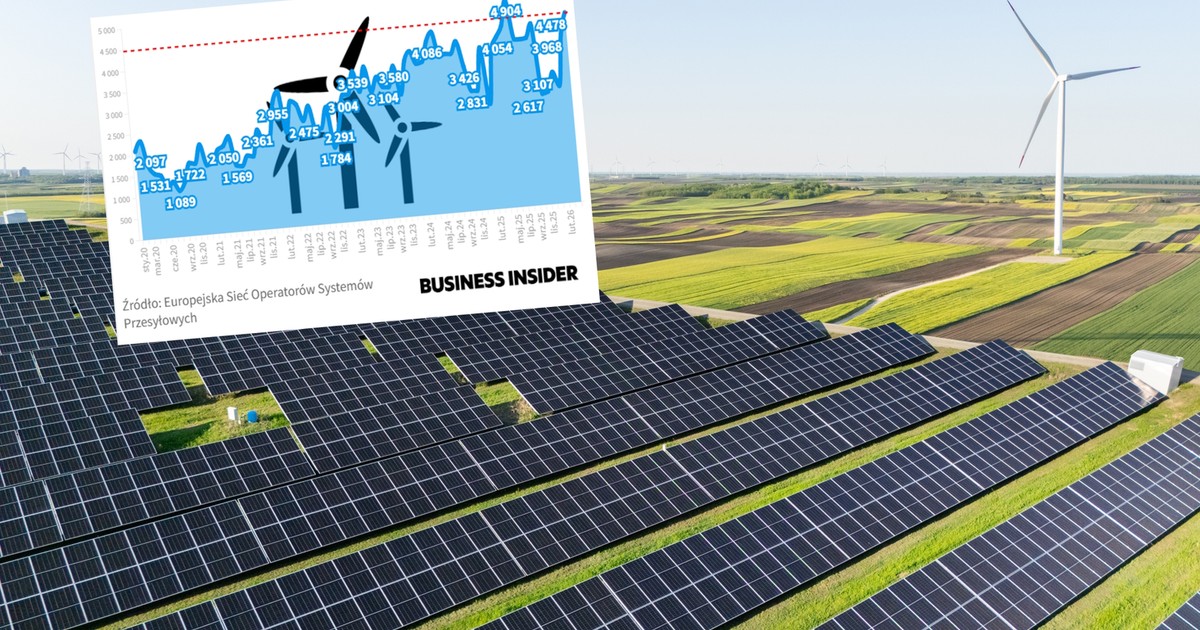
According to Business Insider's calculations based on data from the European Network of Electricity Transmission System Operators, April in Poland is record-breaking when it comes to the production of electricity from renewable energy sources. Windmills, panels and hydroelectric power plants produced as much as 34% this month. energy in the Polish system. This would be the best April in history, and the overall share of “green” energy in the system has been higher only in June 2025 (40.7%).
Read also: The real price of renewable energy? Deputy Minister of Energy: Time to discuss costs [TYLKO U NAS]
The panels gave 18.9 percent. electricity, on-shore windmills 13.1%, and hydroelectric power plants 1.8%. In total, renewable energy sources produced 4.5 TWh of electricitywhich is again second only to June 2025 (4.9 TWh).
Maybe we don't have a monthly record, but however, we have a daily record for renewable energy. This was established on April 7 and amounted to 236 GWh. That day as much as 48 percent energy in Poland was created from renewable sources. This is more due to windmills (138 GWh) than solar panels (86 GWh). On that day, the share of coal dropped to 38.3%.
However, it should be noted in advance that these records are partly due to the construction of new installations, and not only to the weather. According to the latest available data from the Energy Market Agency, at the end of February there was already 25.6 GW of installed capacity in photovoltaics, i.e. by 17.4 percent more year to yearand windmills – 10.8 G, i.e by 4.2 percent more y/y. Compare this with the year-on-year increases in energy production by these sources, i.e. respectively +13.9 percent y/y for solar panels and +6.8%. for windmills, you can see that there was more wind year to year, but there was less light.
Too good is too bad
Someone will say that it is good that renewable energy sources produce more energy. However, the Polish system has a problem with this. There are days when there is too much energy from windmills and panels for the needs of Polish consumers, if the weather conditions are perfect, i.e. it is both sunny and windy. And too much excess power is bad for the system, as is too much shortage.
We have already seen in the Polish system for several years that windmills and panels are chimerical sources, dependent on the weather. Especially on the occasion of announcements by Polish Power Grids about the order to shut down wind or photovoltaic farms. Various kinds restrictions, usually hourly, imposed on renewable energy farms by PSE, were in force for as many as 180 days last year. This year it has been over 70 days, and the last announcement about PSE restrictions was in force on April 20 and 21 and concerned mainly photovoltaic installations.
Read also: Renewable energy shutdowns are becoming more frequent. This is salvation from blackout
On Monday, April 20, between 11:30 a.m. and 11:45 a.m., 141.9 MW of solar power and 307.5 MW of wind power were shut down. A day later, between 12.00 and 12.15 the restriction applied as much as 2,933.9 MW of photovoltaic power and 360.6 MW of wind capacity. In the case of photovoltaics, it is as much as 11.4 percent available power.
Why this restriction? There cannot be too much power in the system compared to its consumption, because it may cause an energy collapse, as well as a power shortage. There are frequent situations where we have to save ourselves by exporting. Yes, “save yourself”, because this forced export does not always generate income, you often have to pay extra for someone to take this energy.
Export with surcharge
In order not to pay lip service, on Wednesday, April 15 from At 12.00 on the balancing market, the weighted average price was negative and at times even below minus PLN 1.3 thousand. PLN per MWh. We exported energy that day from 9.00 until 18.00, while negative or close to zero prices were valid from 9.30 to 17.00. It was a day of energy with a subsidy from Poland.
Electricity prices on the PSE balancing market from April 15 to 21 this year.
|
PSE
April 18 prices were negative at 8:45 a.m. to 4:45 p.m. On average, the producer had to pay extra PLN 500 per MWh. At the same time, 16 GWh was exported from the Polish system.
April 19 the time of negative or minimum balancing prices was even longer, lasting from 8:45 a.m. to 6:45 p.m., i.e. 10 hours. Prices even exceeded minus PLN 500 per MWh. Energy export lasted until 3:00 p.m. and amounted to almost 8 GWh.
At last on Tuesday, April 21 negative balancing prices were valid from 9:45 a.m. to 5:30 p.m. and even reached minus PLN 580 per MWh. During this time, 14 GWh of electricity was exported from Poland. On electricity with a subsidy from Poland This day was mainly used by the Czech Republic, Germany and Ukraine.
Energy storage needed immediately
And this is all the situation before the windmills in the Baltic Sea were launched. The first farm – Baltic Power – will enter the system later this year. The total power of 76 Vestas turbines in windmills with a height of 260 m each will be 1.1 GW. That's the equivalent 10.5 percent windmills currently installed in Poland. The problem of abundance and instability of the system will therefore increase.
This is to be compensated by shutting down older coal units. By June 2026, two units of the Rybnik Power Plant with a total capacity of 450 MW will be turned off and the largest block of the Pątnów power plant with a capacity of 474 MW. Two units of the Dolna Odra Power Plant with a capacity of 450 MW will be decommissioned by August this year. For now, the system will be stabilized mainly by gas power plants, of which we have an installed capacity of 6.1 GW (+5.5% y/y) and coal plants still in use.
The system can avoid the need to sell energy for free or even with a subsidy, first of all, by opening energy storage facilities. Unlike, for example, in the Czech Republic, state subsidies for photovoltaics did not force the installation of storage facilities in Poland, which will now have consequences for the system. But large warehouse investments will be gradually opened.
It is scheduled to launch at the end of 2026 R. Power's warehouse — Jedwabno BESS with a capacity of 150 MW/300 MWh. This project already provides the company with revenues thanks to a 17-year contract for the auction of the Polish capacity market, as well as thanks to a long-term optimization contract with AXPO.
It is also scheduled to launch by the end of the year. But it has a power of only 2 MW and a capacity of 4 MWh and is only intended to increase the efficiency of the company's green energy farms.
A larger warehouse is planned to be launched at the end of 2026 or at the beginning of 2027 Green Capital in Lwówek Śląski with a power of 80 M and a capacity of 320 MWh.
A storage facility with a capacity of 50 MW is also scheduled to be launched in 2026 EdF Renewables Polska in Stary Grodków. The facility will be connected to the Tauron Dystrybucja network.
Tauron has 11 projects under construction with a total capacity of 346 MW and a capacity of 1.5 GWh, of which the largest one in Laryszów in Upper Silesia. They will be commissioned in 2026-2028. Tauron ultimately wants to have 700 MW of such storage facilities.
PGE is building storage facilities with a capacity of 394 MW and a capacity of 788 MWh with a deadline of 2028.
Further plans include the commissioning of pumped-storage power plants, which serve as water energy storage facilities. The pumped-storage power plant in Rożnów Tauron is in the preparation phase for the investment, which is expected to cost PLN 6.8 billion, but will provide a power of 767 MW and a capacity of 3.1 GWh. Commissioning is planned for 2032-2033, and construction is scheduled to begin in two years.
Read also: Coal is losing to renewable energy. Photovoltaics is triumphing
Earlier, the modernized Porąbka-Żar ESP with a capacity of 500 MW is to be launched, where four turbines are being replaced. Launch is planned for 2028.
For 2030, the PGE Group planned to launch the Młoty pumped storage power plant, built at a cost of approximately PLN 7 billion, with a capacity of 1,050 MW and a capacity of 4,090 MWh. However, construction has not started yet, the investor is still waiting for the environmental decision of the Regional Directorate for Environmental Protection in Wrocław.
Just a warehouse without photovoltaics?
The main idea for such storage facilities to be profitable and at least return the money spent on them is to collect energy when electricity is cheap, i.e. around noon, and release it to the system when it is expensive, i.e. in the evening. The more often this procedure can be done, the greater the benefits the warehouse will bring.
Theoretically, it is now even more profitable to invest in an energy storage facility without, for example, photovoltaics, so as to charge it when prices are negative or low and use electricity when prices are high. However, you must be aware that as warehouses become more popular in Poland, prices will “flatten” and the break-through on such operations will gradually become smaller.
However, energy storage is, among others, electric car. Just charge them at the right times and You can have the ride for free or even with an additional fee. Especially at a time when photovoltaics is working at increased speed in Poland.
Author: Jacek Frączyk, editor of Business Insider Polska