What is hidden behind the Corvinor Castle. The discoveries that bring to light a world three millennia old

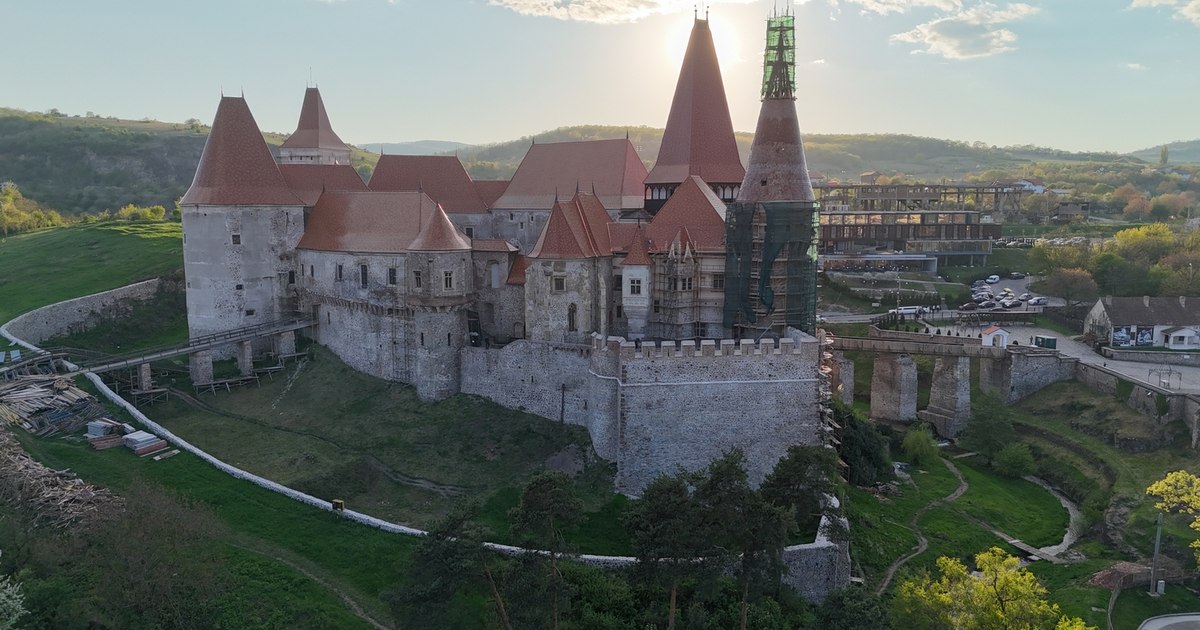
Hidden behind the Corvinir Castle, the slopes of Sânpetru Hill are full of valuable vestiges, which reveal a history left in the shadow of the Huniads: Dacian, Roman and medieval ruins, grottoes inhabited from prehistoric times and even a fallout shelter make up the landscape around the medieval castle.
The Castle of the Corvins. Photo: Daniel Guță. TRUTH
The Corvinilor Castle in Hunedoara has been in the process of restoration since 2019, and during the works several spectacular archaeological discoveries took place, both in the medieval castle and in its immediate vicinity.
Recent discoveries at the castle
The preventive excavations that took place recently behind the Castle of the Corvins revealed fragments of pottery from the Iron Age and a ceramic vessel, which is currently being researched.
“Hunedoara, and especially the area around Corvinilor Castle, is rich in archaeological discoveries, having been intensively inhabited since the Paleolithic. The ongoing archaeological research, as a result of the second stage of the restoration of the castle, part of a project accessed by Hunedoara City Hall through PNRR, has brought to light archaeological contexts and objects from the first Iron Age – Hallstatt”shows the Corvinor Castle Museum.
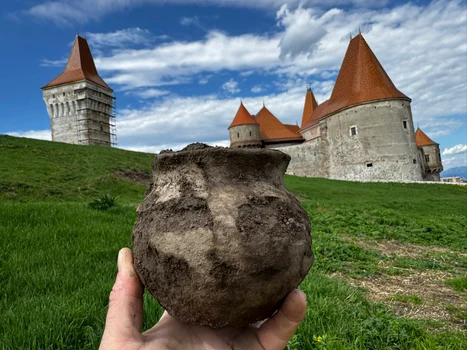
Image 1/10:
Discoveries at Corvinilor Castle Photo Corvinilor Castle Museum (1) jpg
The slopes of the Sânpetru Hill, chosen in the 15th century by the Huniaz family for the construction of the imposing castle, have been inhabited for over three millennia, and the first important settlements date back to the 8th-7th centuries BC. Archaeologists explain the establishment of ancient communities here by the privileged position of the area at the foot of the Poiana Ruscă Mountains and by the easy access to valuable natural resources.
The alluvial gold present in the Cerna and Zlaști rivers, the iron deposits from Teliuc and Ghelari, the copper deposits from the Hategului and Deva areas, the waters of the two rivers that join under the Sânpetru Hill, at the foot of the Corvinilor Castle, the flint reserves used to make prehistoric tools, the forests and fertile lands in the surroundings have made this area attractive to human communities since the earliest times times.
Since the end of the 19th century, specialist publications mentioned numerous prehistoric, Roman and medieval traces in the surroundings of Hunedoara, showing that the place was not chosen by chance by the ancient communities. The numerous caves in the surroundings of Hunedoara, two of them located right on Sânpetru Hill have also preserved traces of their habitation several millennia ago.
The Dacian heritage from Sânpetru Hill
On Sânpetru Hill, above the spur of rock on which the Castle of the Corvinis was built, there was an ancient earthen fortification with a rampart and ditch, a water tower and a downpipe. Archaeologists have discovered an impressive number of objects here, dating from the Bronze Age, the Dacian and Roman periods.
On the slopes of Sânpetru Hill, a necropolis from the Dacian era was discovered in the 2000s, where there were at least 30 depositions with the remains of over 50 deceased, most of them children. Their bodies were cremated or buried in the ground, along with their valuables. The graves are dated around the 1st century AD, at a time when there was a Dacian settlement in the Hunedoara area. The bodies were placed in pits made in the rugged ground and covered with broken rock.
Weaponry pieces were also discovered, as well as decorative objects associated with the buried and cremated deceased, objects made of bronze, silver, glass and even gold.
One grave that caught the attention of archaeologists contained an urn with ashes, buried alongside the sica – the Dacian dagger – and the lance of the deceased. Historians claim that the area of the old Dacian citadel, at the foot of which the Corvinor Castle would have been built, had a strategic role.
How John of Hunedoara spent his great fortune. The famous fortresses and monasteries built by the medieval hero
In the Zlaști and Govâjdia valleys and in the Poiana Ruscă Mountains, iron deposits have been exploited since Antiquity, and the locals who prospered from them had every interest in defending them. Some scientists have shown that the Dacian settlement on Sânpetru Hill in Hunedoara would have been the Dacian fortress Singidava itself, mentioned on some ancient maps.
The settlement located a little over 100 meters from the castle would have been established in the 2nd century BC. It had stone walls and wooden structures, and in the surroundings of its fortifications traces of dwellings and rooms where provisions were kept were discovered.
“The top of this hill was artificially leveled, creating an oval platform with a longitudinal axis of more than 300 meters. This platform, located at a height of 318 meters, bordered by steep cliffs, was an ideal, perfect strategic point.” noted archaeologist Tiberiu Mariș, former director of the Corvinilor Castle Museum, who researched the area in the 80s and 90s.
The tower and the Roman tombs
Old Hungarian archaeological publications show that Sânpetru Hill, located near the Corvinir Castle, was known for its Roman traces since the 19th century. In an 1865 volume of the journal Archaeologiai Közlemények, historian and archaeologist Károly Torma described three fragments of Roman funerary monuments, made of red syenite, discovered in 1863 on Sânpetru Hill in “Vajda-Hunyad”, the old Hungarian name of Hunedoara.
“These three inscribed funerary monuments were probably excavated from the ruins of an existing Roman settlement on Sanpetru Hill and used as ornaments for the summer pavilion in the garden of the castle at Vajda-Hunyad”, looked like Károly Torma, the brother of the famous woman archaeologist Zsofia Torma.
In 2016, the remains of a Roman tower from the 2nd century were discovered, over which a medieval fortification was superimposed.
The medieval fort, over the Roman ruins
Archaeologists reported that, at the end of the 11th century, the refortification of Sânpetru Hill began with an impressive construction made of wood, earth and stone, which lasted until the end of the first half of the 13th century.
The hill was then abandoned and was used intermittently in the late Middle Ages and then in the 18th century. In the 20th century, the slopes around the castle were used for funicular routes, for local Jewish and Reformed cemeteries, for hydrotechnical constructions and for housing.
The disturbing diary of Zsófia Torma, the first female archaeologist in Europe. It opened the gates to the Neolithic civilization
On the terrace occupied two millennia ago by a Dacian fortress, two telephone relays were placed, one in the 1980s and the other in the 2000s. From their vicinity, a path descends among the sharp rocks and plunges into the forest, on the crest of the hill, then climbs to the mysterious caves on the Sânpetru Hill.
Under this place, in the '50s, an anti-atomic shelter was dug, whose underground galleries, in the shape of the letter H, are hidden just a few hundred meters from the castle.
The history of Corvinor Castle
Corvinilor Castle from Hunedoara, the most imposing building in the history of Sânpetru Hill, was built in the middle of the 15th century, on the ruins of an older fortress, on a rocky spur, at the foot of which the valleys of Cerna and Zlaști meet. The settlement had both an administrative role for the surrounding lands, inhabited by foresters from the Poiana Ruscă Mountains, and a military role, being one of the most difficult to conquer medieval fortifications in the area.
Ioan de Hunedoara, governor of Transylvania and great army commander of the Kingdom of Hungary, was the one who transformed the fortress received from the king into a fortress designed to cut off the momentum of any enemy. The buildings and walls of the Corvini Castle were erected in six distinct historical stages, between the 14th and 18th centuries, in architectural styles characteristic of the respective eras.
Corvinilor Castle has meanwhile become one of the most popular tourist attractions in Romania. As of 2019, it is under restoration, and the work financed by the European Union should be completed in 2026. In the meantime, the castle has remained open to tourists. Behind it, the castle garden and Sânpetru Hill can also be visited.