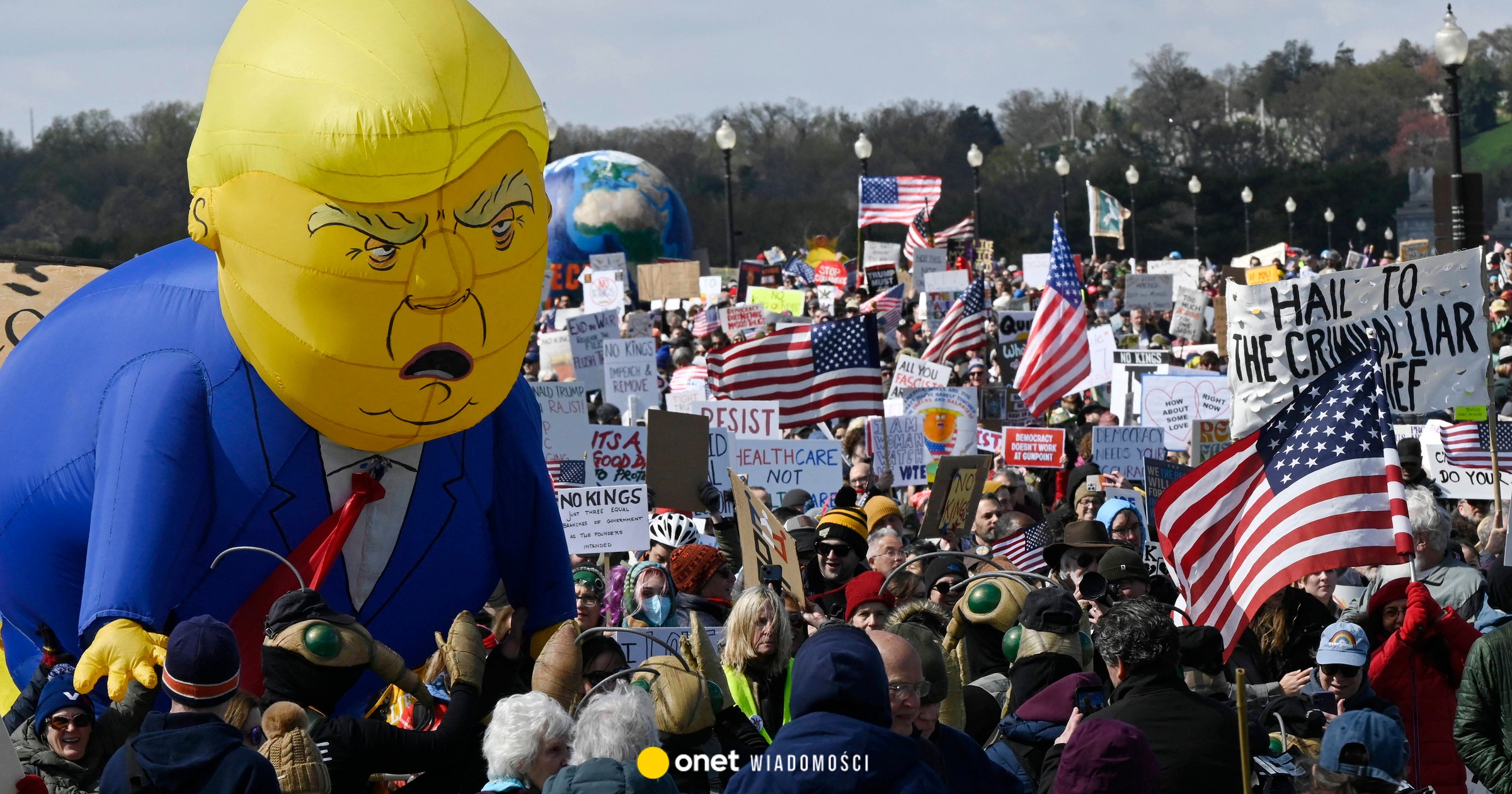
At least since the 1960s Scientists are trying to solve the mystery of whether demonstrations influence election results. Many studies have been conducted, and political scientists Erica Chenoweth and Maria Stephan even announced that if 3.5% protest against the regime. society, the regime collapses.
A few days ago, the study “The impact of protests on election results in the era of Donald Trump” by scientists Hanse Hassell, John Holbein, Kevin Reuning and Cynthia West was published, in which they reached a revolutionary conclusion: protests have no impact on the election results.
“Mobilizing the other side”
The researchers say they have analyzed the data to a degree that no one has ever done before. They traced approximately 200,000 various events from 2017–2024 and checked their impact on voter turnout. It turned out that in times when societies are so strongly polarized, protests have a lesser mobilizing role. They are mainly attended by people who were going to vote anyway.
The article continues below the video
“Our findings suggest that in the current polarized environment […] it is not the protesters' supporters who are mobilized, but their opponents. If this is true, the most obvious consequence of protesting in an election may be what the organizers fear most: mobilizing the other side” – summarize the authors.
N1
Scientists emphasize that the study was conducted only in the United States, so the results may be different in other countries. Nevertheless, it is quite likely that the same conclusions could also be drawn in the Czech Republic, as well as in Slovakia, where larger demonstrations did not cause a breakthrough in electoral preferences. Researchers remind us – like many other experts – that protests also have another, perhaps even more important, meaning.
When demonstrations are numerous and well-organized, they can impose a specific agenda on the media. They also often have a key influence on politicians' decisions. We also saw this in the Czech Republic before the 2021 parliamentary elections. At that time, mass demonstrations organized by Million Moments for Democracy called for the unity of opposition parties against Andrej Babis in order not to disperse the votes. As a result, electoral coalitions were formed that brought success at the ballots.
“Activism enriched their subsequent lives”
Other global studies have shown that another important impact of protests is that civil society learns from them how to organize and act. A natural network of contacts is created. People also gain the feeling that they are not alone with their views, which encourages them to engage further. For some activists, this leads them to decide to enter politicsand voters accept their program. This, according to many, is the reason why the number of women in politics is increasing in some countries.
Activists from the ACT UP group at the foot of the Statue of Liberty. New York, April 29, 1988Daniel DUTKA / AFP
When the British newspaper “The Guardian” devoted attention to the impact of the protests, it pointed out that even after many years, people involved in various forms of activism feel proud. He pointed, among other things, to the scientific study “Trauma and development: the impact of activism in the fight against AIDS”, which concerned people fighting for greater attention to HIV infection in the years 1987–1992 as part of the ACT UP campaign.
The study states: “28 years later, ACT UP study participants recall their days of activism during the AIDS epidemic as the most unique experience of their lives. Although some still suffer from symptoms of stress or depression, most recognize that activism has enriched their subsequent lives“, we read in the study.
Protests rarely bring immediate results. Sometimes they succeed, but according to scientists, they mostly do long-term impact that organizers and participants can be proud of years later.
I’m Ashley Davis as an editor, I’m committed to upholding the highest standards of integrity and accuracy in every piece we publish. My work is driven by curiosity, a passion for truth, and a belief that journalism plays a crucial role in shaping public discourse. I strive to tell stories that not only inform but also inspire action and conversation.