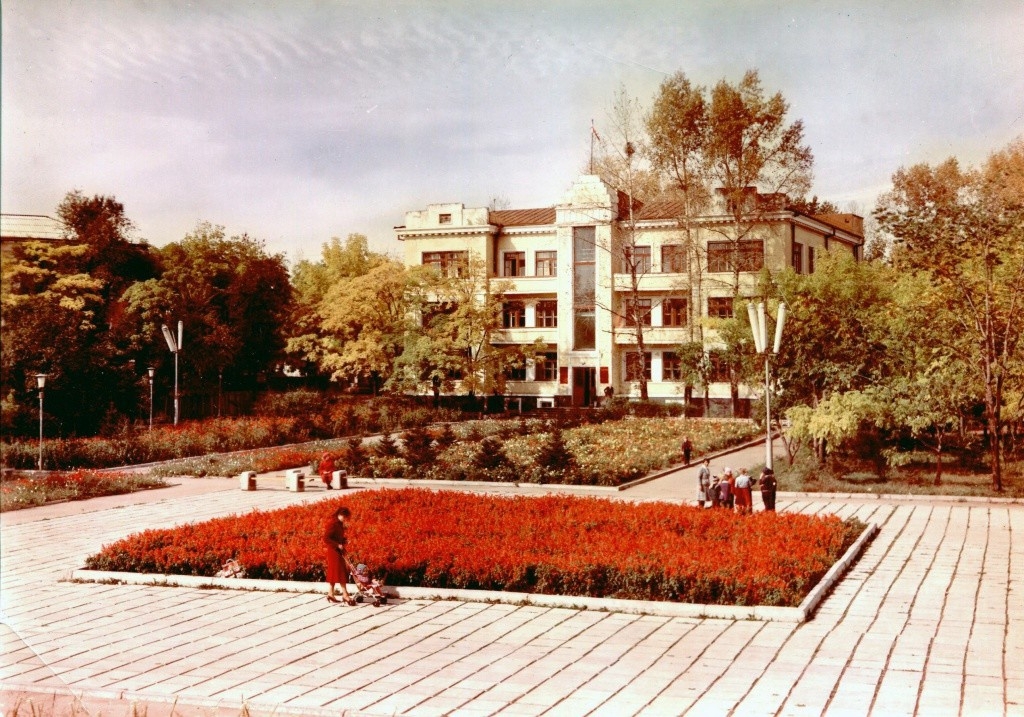
The building of the regional party committee. Old Square, 70-80s
Photo: State Archive of the Jewish Autonomous Region
April 27, 1944
Clippings from the newspaper “Birobidzhan Star”. Photo: Photo: Regional Library
At a meeting of the regional executive committee of the Jewish Autonomous Region, they considered the issue “On preparations for the establishment of gardens and berry fields on collective farms in the region,” where it was noted that significant work had been done on the development of horticulture in a number of leading collective farms. Thus, on the collective farm “20 Years of October” in the Birobidzhan region, over the past three years, 395 centners of fruits and berries have been collected from a small area, and on the collective farm “Waldgeim” – 98 centners.


By 1949, there were 70 hectares under orchards and berry fields.
April 27, 1971
The Bureau of the Regional Party Committee discussed the issue of organizational mass-political work of the Oktyabrsky District Committee of the CPSU to implement the resolution of the July (1970) Plenum of the CPSU Central Committee to increase the production and sale of livestock products to the state. Measures have been outlined aimed at increasing the level of organizational and political work among livestock workers, mobilizing them to implement the decisions of the July Plenum of the CPSU Central Committee and the 24th Congress of the CPSU, fulfilling the plans and socialist obligations of 1971.
April 27, 1976
The plenum of the regional committee of the CPSU determined the tasks of the regional party organization to implement the decisions of the XXV Congress of the CPSU on the creation of a strong feed base for public livestock farming. It was noted that in the ninth five-year plan, work continued on the development of public livestock farming and the creation of a feed base. The area under forage crops in the region increased by 1/4, the procurement of all types of feed increased by 1.5 times, which contributed to an increase in livestock productivity and an increase in the number of livestock. Compared to the Eighth Five-Year Plan, the average annual rate of milk production increased by 15%, meat – by 11%, eggs – by 83%, and the number of cattle increased by more than 30%.
April 27, 1980

Clippings from the newspaper “Birobidzhan Star”. Photo: Photo: Regional Library
The newspaper “Birobidzhanskaya Zvezda” (12+) published an article by V. Dmitriev “A point on the map of Sutara” about the history of the village of Sutara, Obluchensky district.
“Sutara is one of the first settlements in our region. Now it is difficult to establish the exact date of its foundation, but it arose between 1850-1860.
In the early 40s of the 19th century, N.P. Anosov, the son of the great metallurgist, discovered gold placers in the Amur basin. Thus, it can be assumed that by the 50s it became known about Sutar gold, from that time its mining began, reaching its apogee at the beginning of the last decade of the 19th century.

Gold mining on Sutara. Photo: Photo: Heritage EAO
By the time Soviet power was established in the Far East, the main gold reserves in Sutara had been exhausted, and the mines and mines surrounding the village, which at that time was the administrative center of the gold-bearing district, had disappeared. But in the vicinity of Sutara there was still enough gold to be mined using the state method. And until the early 60s, the Rodina artel was based here, equipped with modern hydraulic equipment for washing sand.


An excellent dirt road leads from Obluchye to Sutara. The surroundings of this ancient village are beautiful. Houses built from centuries-old larches and cedars, wide streets, dumps of washed sand, already overgrown with bushes. Once upon a time it was a large village. He is very handsome even now. Nowadays beekeepers, hunters, foresters, and service workers live in Sutara. The village is small, but it lives a full working and cultural life. The mast of a television tower rises nearby, and in the evenings the lights of blue screens light up in the houses. The village has its own power station, a good club with a library, a communications office, shops, and an automatic telephone exchange. Bus service has been established with the regional center. The outskirts of the village have long become a favorite vacation spot for irradiated people and Khingan residents.
Currently, the precious metal is mined by a small mining team of the Primorzoloto trust.
The picturesque village of Sutara was glorified by gold; hundreds of people came here for it, many died, unable to withstand hard labor.”
Currently, nothing remains of the village of Sutara described in the article. According to the 2010 census, seven people lived in the village; in 2020, four people remained. The gold mining company Bogdar LLC, according to the tax service, was liquidated on February 25, 2019.
April 27, 1997

Deputies of the first convocation of the Birobidzhan City Duma. Photo: Photo: EAOMedia news agency archive
The first elections of deputies to the Birobidzhan City Duma took place. Centralized state power was replaced by local self-government. The first Duma sessions took place in heated debates and disputes. The deputies represented various parties and social movements. The first Duma was headed by Semyon Natapov.
The First Duma was elected for 2 years and consisted of 10 deputies. She has done a lot: the governing bodies of local self-government have been elected, the City Charter and the Duma's regulations have been developed and adopted.
April 27, 1994
Based on the resolution of the Birobidzhan district, the Birushkinsky rural administration was renamed Krasivensky.