Given the record prices of gold, questions arise as to how long the gold under the earth's surface will last for humanity? Let us remember, however, that gold is not oil and the already mined metal is still available to jewelers, central banks, investors and industry. The question of price remains in whose hands the gold that has already been mined will end up. If so, does the scale of extraction matter and is it actually possible to exhaust the deposits in 15-20 years? Are we on the verge of an era of gold scarcity? We look at hard data about reserves, resources, peak mining and the future of recycling.
First of all, let's be clear that the amount of gold mined is rather irrelevant from the point of view of the total availability of the metal and its price. It refers to the concept of a high stock to flow ratio. It is obtained by dividing the current availability of gold on the market by its annual production rate.
Black gold and real gold
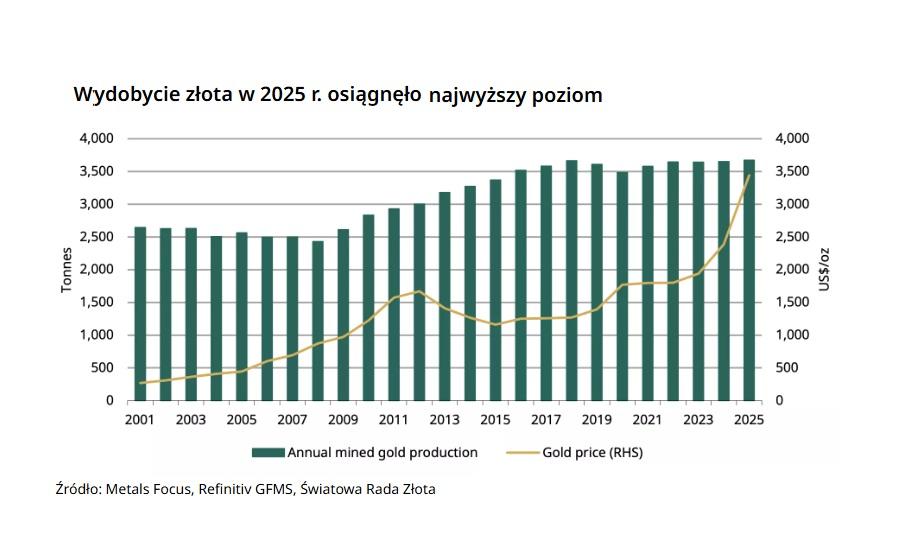
In the case of gold, the annual production of mines is only a fraction (approx. 1.6%) of the entire ore extracted and collected so far. In 2025, gold production was slightly higher (+1% y/y) and reaching 3,672 tons of gold was a record since the data was collected
by the World Gold Council (WGC). Meanwhile, according to its best available estimates (as at the end of 2025), in Throughout history, approximately 219,890 tons of gold have been minedtwo thirds of which took place after 1950.
As you can see, the ratio in question was 60 in 2025 (it was sometimes even higher with lower production), which means that at the current “record” production rate, we would need as much as 60 years to double the current global gold resources. By comparison, most raw materials have a ratio close to 1 or less, meaning annual production equals total inventories – this makes them susceptible to huge price fluctuations with sudden changes in supply. It's different with gold.
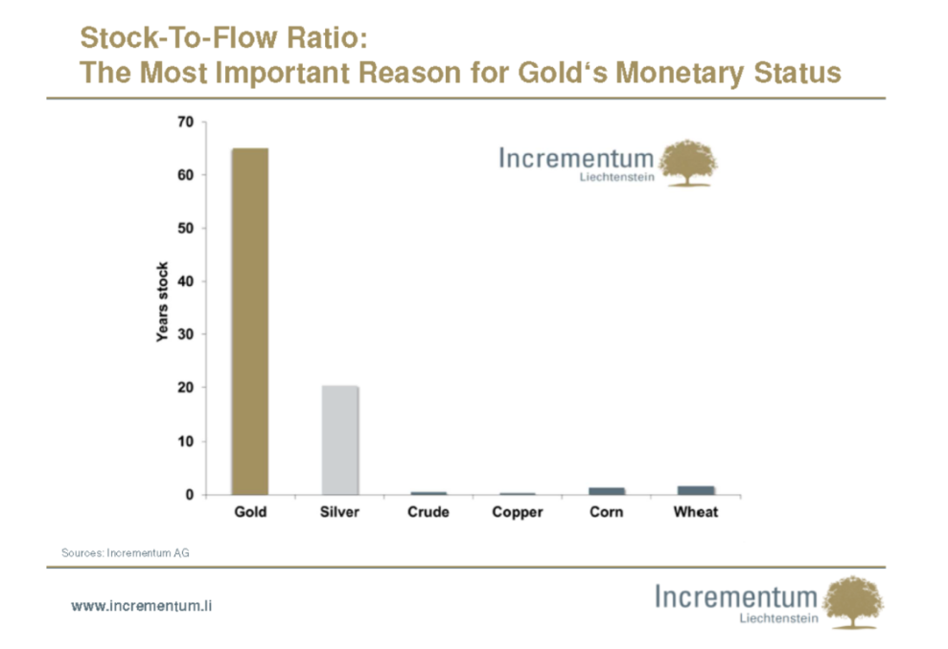
Gold is valuable not because it is scarce, but because its supply in the market is so predictable and small relative to what we already have. What makes the metal unique is its relative stability: the fact that new production is only a fraction of historical production. This stability, forged over centuries, cannot be manipulated or changed – and it is in it that humanity finds trust and use that is rare today, in jewelry, investments, monetary policy and industry.
Understanding gold – a new series of articles
We are starting a series of publications presenting the role, history and mechanisms governing the market of this unique precious metal. We will look at gold from many perspectives, from investment decisions, through global resources, the history of Polish gold, to purchases of the precious metal by central banks.
The highest demand for gold
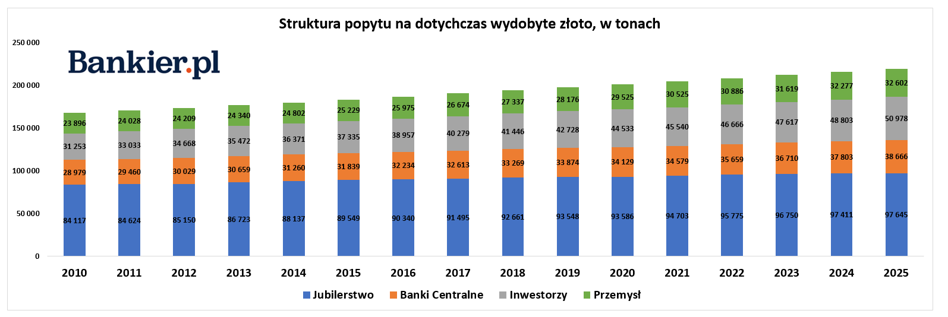
As WGC data shows, the largest part of global mining is currently used by the jewelry industryabsorbing over 44% (over 97.65 thousand tonnes). Private investors come second in this respect (gold coins and bars), having 23.2% of the mined metal (approx. 51 thousand tons).
Advertisement
Thirds Central banks can boast of gold resources in circulationstoring approximately 17.6% (approx. 38.6 thousand tons) of gold mined so far as a guarantee of the stability of currency reserves. The fourth and final category is demand from advanced industry and new technologies
(approx. 15%), where the excellent physicochemical properties of gold are used, for example, for mass production of electronics.
The peak of gold mining is ahead of us
Mining industry analysts warn of a worsening situation the problem of the upcoming “Peak Gold”, i.e. the peak of mining – the moment when global production reaches its historical maximum and inevitably enters a slow decline. For now, more and more is being produced and forecasts for 2026 also indicate moderate growth. However, since the middle of the previous decade, the total production from mines has been clearly stagnant.
Many of the historically richest mines have recorded drastic declines, and new discoveries have slowed down significantly and, for example, in 2023–2024 there was no discovery of any large deposit (over 50 million ounces), which was the norm in the last century. Large mining companies definitely prefer to safely and predictably optimize operating mines rather than take risks in unknown areas, especially since the costs of acquiring the ore itself are systematically increasing.
Hence, forecasts often include a horizon of 15-20 years, after which, if the current production rate is maintained, known reserves may be exhausted. However, it should be remembered that this is a very “moving horizon”. Throughout the history of mining, the projected date of gold depletion has been pushed back many times thanks to new discoveries and technological progress and the increasingly higher price of gold itself.
The forecast time until the reserves are depleted is based on estimates from the consulting company Metals Focus and the US government agency US Geological Survey. According to the first gold reserves that can be economically extracted under the conditions applicable in 2025, they amounted to 54.77 thousand at the end. tone. In turn, US Geological Survey data estimate such reserves at approximately 64,000. tone.
However, the definition of economic “reserves” is constantly changing.
The resources they mean total geological potentialrequiring further research or higher prices for profitable operation, according to Metals Focus data, they amounted to PLN 132.11 thousand at the end of the previous year. tone. Moreover, according to researchers, there is a huge scientific potential for obtaining ore hidden on the ocean floor or under the thickest glaciers of Antarctica, and maybe even on the Moon.
Will we ever run out of gold?
Taking all this into account, experts from the World Gold Council answer that it is unlikely that humanity will ever run out of gold. First of all, gold will never disappear in a physical sense. This unique element it does not decompose naturally and is subject to an endless process of safe recovery. The powerful advanced recycling market (including complex e-waste and used jewelry), which easily buffers market shortages, begins to play a huge role.
Secondly as metal prices continue to risethe dynamic expansion of robotics in mines, changes in law, such as those in Argentina that enable the exploration of glaciers, or the implementation of analyzes of huge data sets thanks to artificial intelligence (better geological modeling), previously completely unprofitable deposits will naturally acquire the full rank of profitable operating reserves.
To summarize, though there is little chance that we will run out of “easy” and “cheap” gold to mineeven if all discoveries are withheld, technological progress and a sufficiently high price may make it possible gold will be extracted from previously unavailable sources or recovered on a larger scale in the process of increasingly advanced recycling.
The publication contains affiliate links.