Is Ukraine depopulating? The effects of wars in the most inflammatory regions of the world [WYKRESY]

There are currently dozens of conflicts taking place in the world. As a result, many people die. In this respect, the Russian-Ukrainian war stands out. We must also remember that modern wars kill not only directly through military operations, but also indirectly through hunger, lack of medical care or disease.
In many troubled regions of the world, depopulation tendencies are clearly visible, although this is often the result of mass flight of people. Millions of people leave their homes and go to other countries in search of peace. There are also places on the map where bombs are falling, but this does not stop the growing demographic trends.
Read also in BUSINESS INSIDER
Changes in the population of Ukraine, Russia, Israel and Iran (data in millions of people)
|
International Monetary Fund
War in Ukraine. How has the population changed?
At Business Insider Polska, we checked what it looks like in specific numbers. Data systematically collected by the International Monetary Fund (IMF) shows that since the outbreak of a full-scale war in Ukraine in 2022, the country's population has decreased by over 8 million people. In 2021 it numbered 40 million 998 thousand, in 2025 it dropped to 32 million 762 thousand, and this year's statistics show 32 million 283 thousand. inhabitants.
It hasn't been this bad since at least 1991.i.e. from the first statistics published by the IMF in the database. At that time, the population of Ukraine was almost 52 million people. It got worse in this respect almost every year.
See also: Demography 2040 changes apartments. Who will benefit from new trends?
The largest collapse occurred in 2022.i.e. at the beginning of a full-scale war with Russia. Then, from year to year, almost 6.5 million people disappeared from the statistics. This smaller-scale conflict began in 2014 and by then the number of Ukrainian inhabitants had decreased by approximately 2.5 million.
The chart below clearly shows both key moments in Ukraine's history. In its forecasts for the coming years, the IMF assumes that the war in Ukraine will end or at least fade away and, therefore, population statistics will improve. However, he does not foresee a mass return of emigrants.
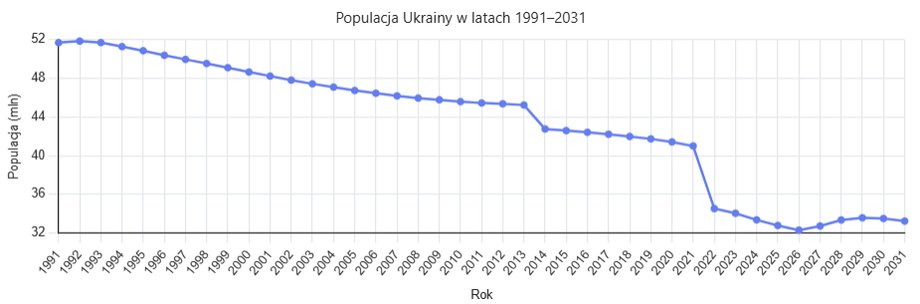
IMF data on Ukraine's population in 1991-2026 and projected data until 2031.
|
Copilot AI
The loss of over 8 million inhabitants is as if a quite large country had disappeared. IMF data for 2026 show that Libya has a population of 7.5 million people. Serbia has 6.5 million and Bulgaria 6.2 million.
Russia's population is decreasing due to the war in Ukraine
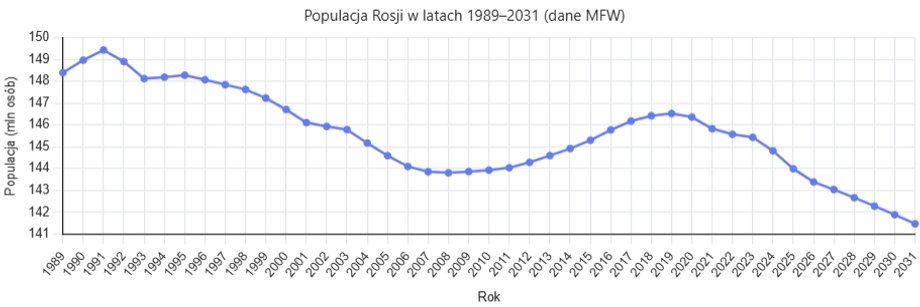
The biggest European aggressor, that is Russia is also experiencing population declines, although they are incomparably smaller than in Ukraine. Data for 2026 in relation to 2021 show a loss of PLN 2,442,000 people. This is nominally about a quarter of Ukraine's population decline, and yet Russia is a much larger country. We are talking about 143 million 394 thousand. inhabitants, i.e. four times the population of Poland.
See also: Poland is falling apart? “The fairy-tale emperor who walked naked”
In IMF statistics dating back to 1989, Russia's result was no worse than today. At that time, the population peaked in 1991 – it reached almost 149.5 million people. For the next nearly 20 years, Russia's population systematically decreased, followed by a turnaround and rebound that lasted until the coronavirus pandemic. Then there was quite a sharp decline. IMF estimates by 2031 assume further deterioration of statistics.
|
Copilot AI
Israel is steadily increasing its population despite wars
One of the most inflammatory regions in the world is Israel. The history of this country over the last several decades has been largely characterized by continuous participation in armed conflicts that have changed their form, but have never completely stopped. In the 21st century, the situation evolved into cyclical escalations of violence – especially in the Gaza Strip. The latest stage, which began in 2023, has a multi-front character, covering not only fighting against Hamas, but also tensions with Hezbollah and Iran, which shows that Israel has been operating in a state of permanent threat and conflict of a changing, increasingly complex form for decades.
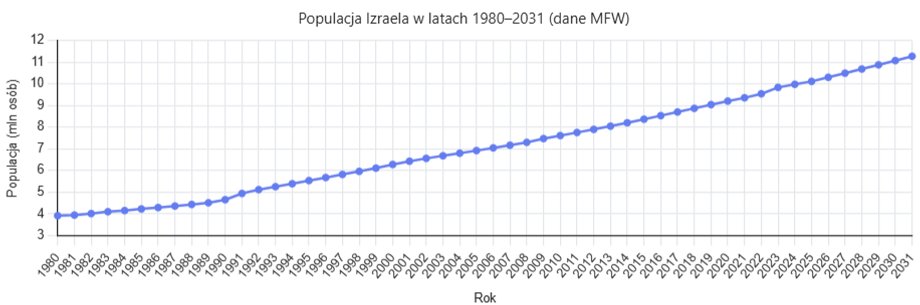
Still Israel's population is not decreasing, on the contrary – the trend is constantly increasing. IMF forecasts also do not predict any disturbances in the next few years.
|
Copilot AI
IMF data for 2026 shows that Israel's population already numbers 10 million 312 thousand. people. It broke the 10 million mark for the first time a year earlier. Then statistics have doubled compared to 1991.
See also: Historic declines and a growing generation gap. This is how the population of Poland has changed
A key role there is played by the very high birth rate in part of society, especially among religious groups, which on average have more children than in most developed countries. In addition, there is a constant influx of immigrants resulting from the law of return and migration policy, which allows Jews from all over the world to settle, which has historically increased the population many times over.
Iran is impressive in terms of population
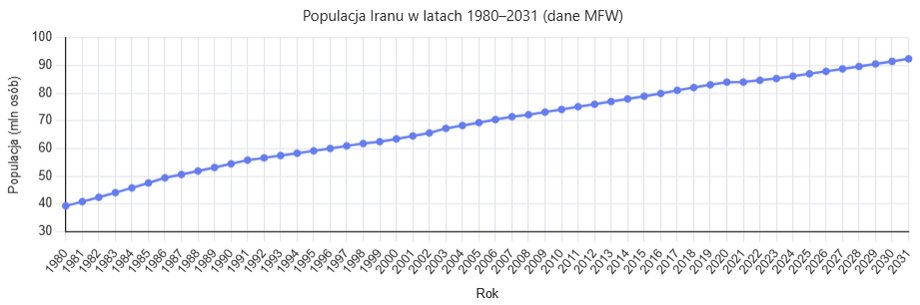
Currently, one of the main opponents of Israel (joined by the United States) is Iran. There, demographic trends are very similar to those in Israel. Population is growing systematically, although with slightly slower dynamics. Here it took longer for the statistics to double (since 1982).
First of all, Iran is a much larger country than Israel in terms of population. In 2026, it is about 87 million 934 thousand. people. That's more than eight times that number.
|
Copilot AI
Iran's history is also dotted with conflicts and wars, but they are not demographically destructive enough to offset natural population growth. For many decades, Iran had a high fertility rate, which means that large age groups are now entering adulthood and contributing to the number of births themselves, even if the fertility rate has fallen in recent years to levels close to or just below the replacement level.
Ukraine's population problems will have a negative impact in the future
A population decline during war, such as in the case of Ukraine, can have a significant impact on the country's subsequent reconstruction because it also means fewer workers, consumers and taxpayers, all key resources for the economy..
If part of the population dies and part leaves and does not return, the country loses not only population, but also often young and well-educated people, which slows down the reconstruction of human capital and may lead to long-term shortages in the labor market. At the same time, war destroys infrastructure and the economy, so with a smaller population, the burden of recovery falls on a narrower social base, making it difficult to quickly restore growth.
Historically, many countries recovered demographically and economically after major wars, but the pace of this process varied greatly and depended on the scale of losses, migration, and political and economic conditions.
Author: Damian Słomski, journalist of Business Insider Polska