When will the war in Iran end? A series of contradictory US moves and an ironic plot twist

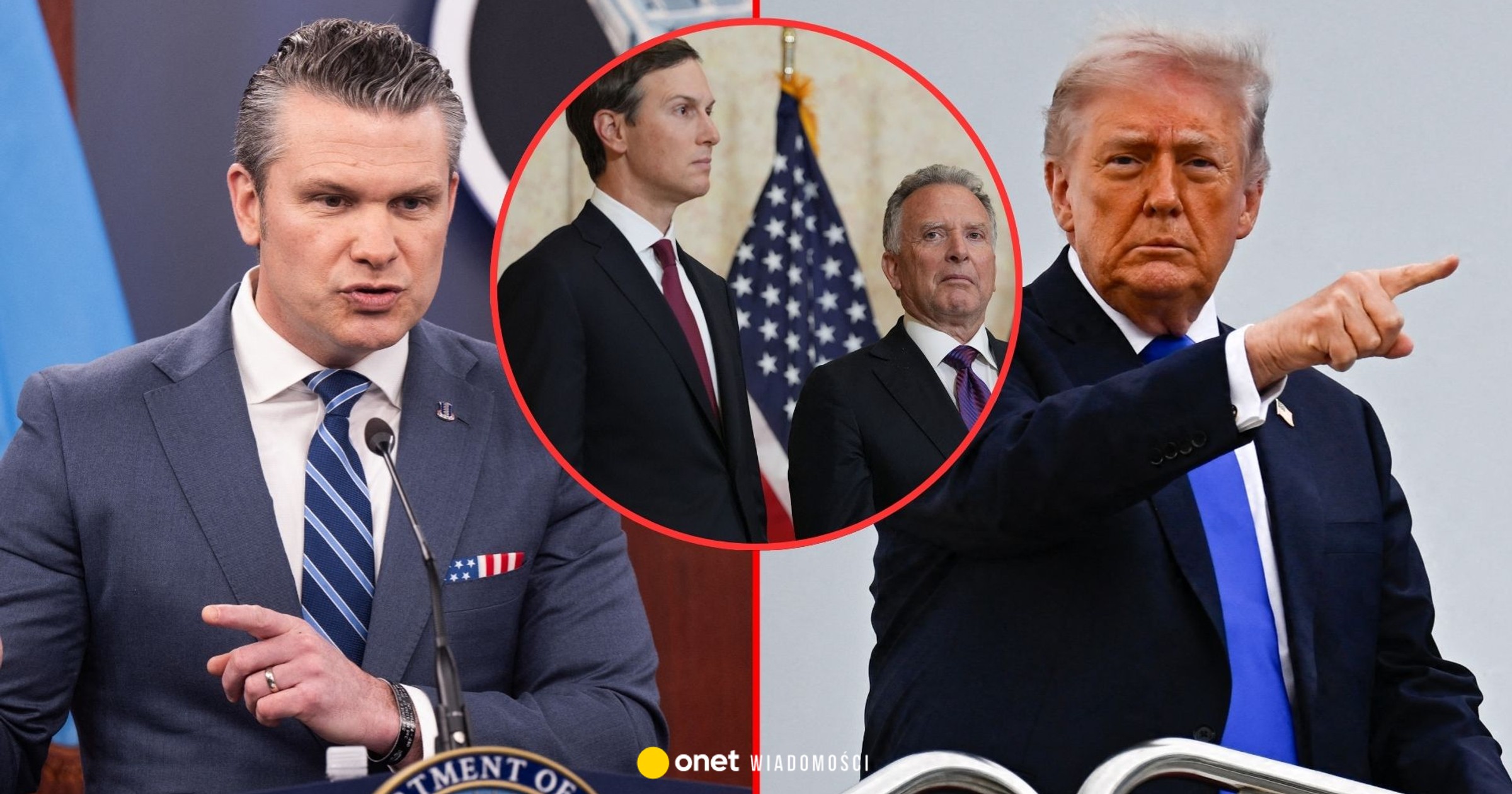
Vice President J.D. Vance, who joined Witkoff and Kushner at peace talks with Iranian officials earlier this month in Islamabad, is not going to Pakistan but will be “on standby” to join the negotiations.
“Steve and Jared will go tomorrow [w sobotę] to Pakistan to listen to the Iranians, Leavitt told reporters at the White House on Friday. — The president, vice president and secretary of state [Marco Rubio] “they will be waiting here in the United States for updates, and the vice president, I understand, is on standby and will be willing to go to Pakistan if we feel that this use of his time is necessary,” she added.
Leavitt also suggested that the United States and Iran were closer to an agreement, but declined to provide details when asked whether the Trump administration had received a peace offer from Iranian leaders.
“We've certainly seen some progress on the Iranian side over the last few days,” she said.
Jared Kushner and Steve Witkoff during a news conference following their meeting with Iranian officials in Islamabad, Pakistan, April 12, 2026.JACQUELYN MARTIN / POOL / AFP / AFP
New conversations emerge when Trump and administration officials have indicated that the war could drag on longer than the president initially suggestedwhen it launched in February. Asked about a timetable for ending the war, Trump told reporters on Thursday: “Don't pressure me.”
The US is sending additional forces to the war in Iran, which is already over
The administration is sending additional forces to the region — and demanding help from allies in the region — even as it claims the conflict is over.
In particular, Defense Secretary Pete Hegseth alternately declared victory in Iran while last Friday promising to inflict “maximum violence” on that country. In this way, it continues the Trump administration's approach of juxtaposing the two conflicting messages: a war that has already been won, and the constant strengthening of the armed forces (and the need for further fighting) and requests for help from allies.
On Friday morning (US time), Hegseth took to the podium at the Pentagon to lead his weekly news conference with the chairman of the Joint Chiefs of Staff, Gen. Dan Caine. The duo again presented the contrast between “good cop” and “bad cop”: Hegseth harshly criticized allies and threatened further attacks, while Caine praised American soldiers and presented operational details according to procedure.
Hegseth began his speech by stating that the operation in Iran is not an endless war like those in Vietnam, Iraq or Afghanistan, which dragged on for years in the face of changing or impossible strategic goals.
Still, the United States has “all the time in the world” to win, he added.
“The real endless war is the one Iran has been waging against the United States for 47 years,” Hegseth said.
But instead of withdrawing, the United States is sending more forces to the Middle East. A third U.S. aircraft carrier has arrived in the region, along with several ships carrying 2,200 Marines, expected to reinforce the 2,200 troops already deployed in the Persian Gulf.
The blockade of the Strait of Hormuz is the main point of the conflict
Just Thursday, Trump again refused to estimate how long he would be willing to maintain this pace of sending reinforcements. — We were in Vietnam for about 18 years, we've been in Iraq for many, many years. “I don't want to rush,” he told reporters at the White House, adding that he felt no pressure to end the war.
Similarly, on Friday, Hegseth rejected the possibility of an open end to the conflict, while stating that the US naval blockade of Iranian ports would continue “as long as necessary” and that the United States was not “concerned about an agreement.” The blockade has become a key sticking point in peace talks as Tehran insists it must be lifted before talks can resume.
That the blockade has become a major point of conflict is an ironic twist, consideringthat trade traffic through the Strait of Hormuz continued smoothly until the start of the US-Israeli bombing campaign on February 28.
Trump has repeatedly stated since March 9 that the strait is open. But days later he demanded help from NATO and China to reopen the key waterway, which serves as a transport route for about 20 percent of the world's global economy. world oil.
After initial peace talks failed, the US Navy began a blockade of Iranian ports on April 13, and Trump last week again said the waterway was open.
Despite this, trade traffic remains at an impasse and oil prices remain very high. U.S. military planners say Iran is planting naval mines in the strait and the navy has begun the painstaking process of detecting and potentially removing them, while also conducting inspections on ships trying to enter or leave Iranian ports.
On Friday, Hegseth acknowledged that commercial shipping through the strait is “far more restricted than anyone would like,” in part because of Iranian mines, while sharply criticizing NATO allies for not providing more assistance.
Angered by NATO's reluctance to get involved in the conflict, the White House is considering ways to punish countries seen as unhelpful in the Persian Gulf while potentially rewarding those that have offered help.
“Europe and Asia have benefited from our protection for decades, but the time for a free ride is over,” Hegseth said.