The new “backbone” of Iran's strategy in the Strait of Hormuz: Swarms of small and fast ships / What the American “armada” looks like

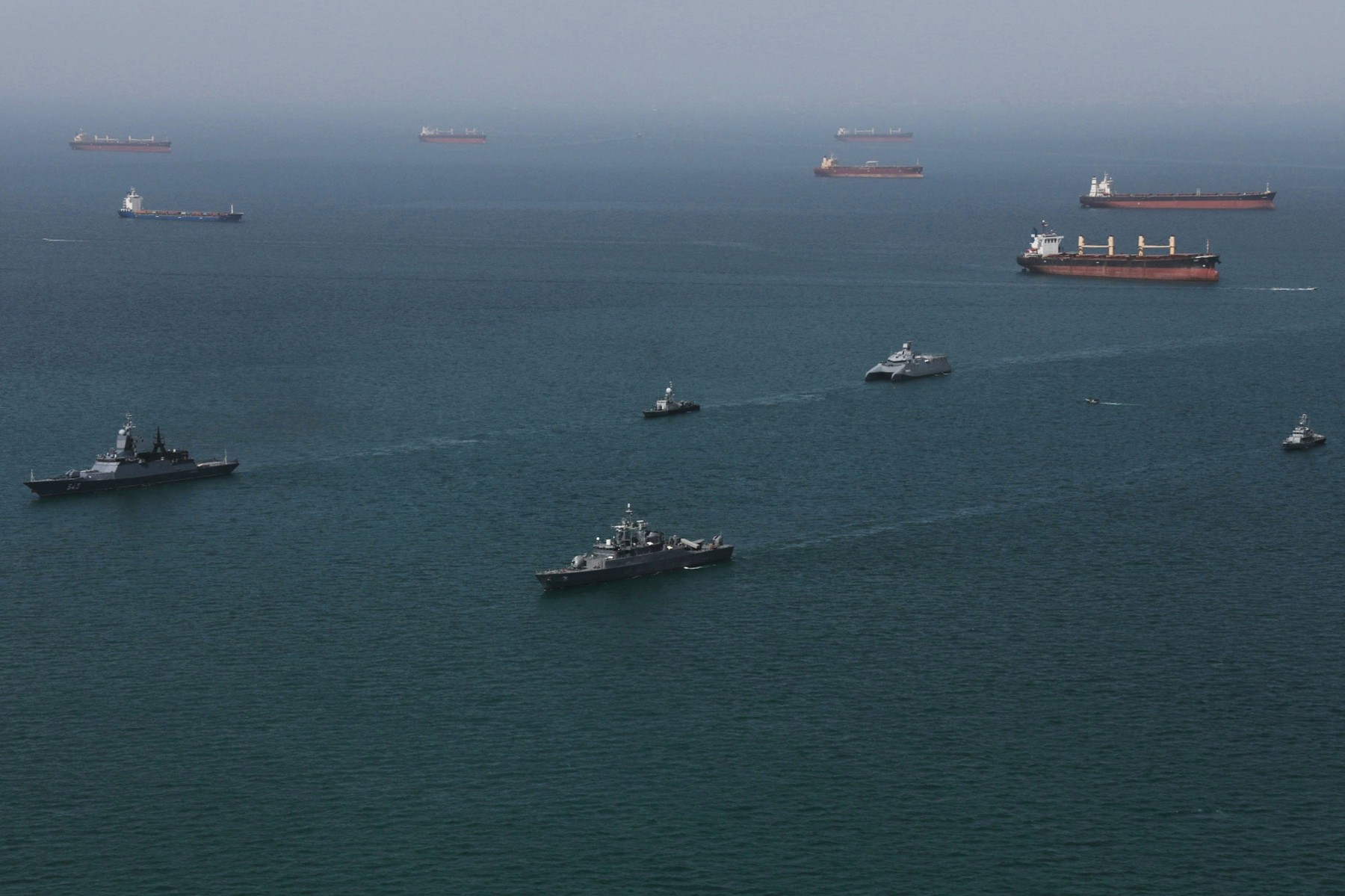
Iran's use of a swarm of small, fast craft to seize two container ships near the Strait of Hormuz risks contradicting claims that US forces have neutralized the country's naval threat and highlights the challenges facing reopening one of the world's most important oil export routes, Reuters wrote on Thursday.
US President Donald Trump acknowledged on Monday that while Iran's conventional navy had been largely destroyed, its “fast attack craft” were not considered a major threat.
He said any such ships approaching the US Navy blockade established outside the strait would be “immediately eliminated” using the “same swift and brutal system of destruction” deployed in the Caribbean and Pacific, where US airstrikes have struck suspected drug-trafficking vessels and killed at least 110 people.
These craft did not attack large merchant ships, but they were not heavily armed either, with the Iranian Revolutionary Guard having heavy machine guns, rocket launchers and, in some cases, anti-ship missiles.
The speedboat attacks are now part of a “layered threat system” alongside “shore-based missiles, drones, mines and electronic jamming designed to create uncertainty and slow down decision-making,” Greek maritime security company Diaplous told Reuters.
Iran is estimated to have had hundreds, if not thousands, of such craft before the war, often hidden in coastal tunnels, naval bases or among civilian ships, according to maritime security experts.
About 100 or more such vessels have been destroyed since the conflict in Iran began on February 28, said Corey Ranslem, chief executive of maritime security group Dryad Global.
Change of tactics
Before this week, Iran relied on missile and drone strikes to hit shipping traffic around the strait, a route that normally handles 20 percent of the world's daily supply of oil and liquefied natural gas.
These attacks stopped with the April 8 ceasefire.
Iran's seizure of the two cargo ships followed Washington's imposition of a blockade on Iran's maritime trade and the start of interception of oil tankers and other vessels with ties to Iran.
“The civilian shipping industry is not equipped to prevent the Iranian armed forces from seizing ships,” said Daniel Mueller, senior analyst at the British maritime security company Ambrey.
Typically, around 12 boats are used in a capture operation, he added.
Iranian fast boats now serve as the “backbone” of Tehran's naval strategy, capable of moving quickly as part of “asymmetric warfare against the enemy,” a senior Iranian security official told Reuters.
“Due to their very high speed, these boats can successfully carry out hit-and-run attacks without being detected,” the official said, speaking on condition of anonymity.
Limits of speedboats
Including this week's seizures, Iran has used small, fast boats at least seven times since 2019, said Mueller, the Ambrey company representative.
Strong winds and high waves in the waters off Iran during the summer make such operations difficult, said a source in the Iranian shipping sector familiar with the waters.
“When the sea is very rough, they (the armed forces on board, no) cannot fire,” the source said.
These craft are also poorly equipped to engage a warship and would likely suffer “very heavy losses” in a direct attack on one, said Jeremy Binnie, a Middle East specialist at defense intelligence firm Janes.
“Even if they tried to overwhelm the ship's defense systems by attacking from multiple directions, they would be extremely vulnerable to the air support that would be required,” he said.
On paper, guided missile attacks would easily destroy these craft, but man-portable missile launchers would pose a threat to low-flying U.S. aircraft, Binnie added.
“It will be much more difficult to eliminate the threat posed by small craft than it was to destroy Iran's larger warships, which were large targets, relatively easy to find and track, and which, at best, had a limited ability to defend against air attacks,” the specialist added.
The reality for the shipping sector is even greater disruption as well as high insurance costs.
After the so-called “tanker war” of the 1980s, Iran increasingly resorted to asymmetric tactics as the Iranian navy was virtually destroyed, just as it has been in the current conflict, said Duncan Potts, director of consultancy Universal Defense and Security Solutions and a former vice admiral of the British Royal Navy.
“When the US Navy and the president say, 'We destroyed the navy, we sank a frigate off Sri Lanka' – you've done this before, but you forget that your adversary has adopted an asymmetric strategy. And they've perfected it,” warned the former vice admiral.
The US Navy has deployed 19 ships to the Middle East
The US Navy currently has 19 ships in the Middle East, including two aircraft carriers, and seven ships in the Indian Ocean, a US official told CNN on Thursday.
The U.S. military began enforcing the blockade on Iranian ports, using a large portion of those forces, starting April 13, and had diverted at least 33 ships by Thursday.
US forces also boarded at least three ships, including two in the Indian Ocean, about 2,000 miles (3,218 kilometers) from the Persian Gulf. The latest approach took place on Wednesday night, when US forces boarded an “unflagged sanctions vessel” carrying oil from Iran to the Indian Ocean, the Defense Department (Pentagon) said.
As of Monday last week, 15 ships were in the area of responsibility of US Central Command, which is charged with managing US military operations in the Middle East.
The 19 ships currently in the area are:
Aircraft carriers:
- USS Abraham Lincoln
- USS Gerald R. Ford
Destroyers:
- USS Bainbridge
- USS Thomas Hudner
- USS Frank E. Petersen Jr.
- USS Delbert D Black
- USS Michael Murphy
- USS Mitscher
- USS Rafael Peralta
- USS Spruance
- USS Milius
- USS Churchill
- USS Truxton
- USS Mahan
Battleships:
Amphibious Response Group:
- USS Tripoli (amphibious assault ship)
- USS New Orleans (amphibious transport ship)
- USS Rushmore (Landing Ship)
Additionally, USS John Finn, USS Pinckney, USS Higgins, USS Mustin, USS McFaul, USS John L. Canley, and USS Santa Barbara all operate in the Indian Ocean.