For European economies, maybe apart from Great Britain, the attack on Iran and the blockade of the Strait of Hormuz is like raising a flag saying “recession”. This is how we can interpret the latest survey of opinions of purchasing managers in companies, i.e. people who are best versed in the situation of enterprises.
Collective (for industry and services) PMI (purchasing managers index) illustrating activity 5 thousand enterprises in the euro area (Germany, France, Italy, Spain, the Netherlands, Austria, Ireland and Greece for industry and services in Germany, France, Italy, Spain and Ireland) dropped in April to 48.6 points from 50.7 points a month earlierwhat is a signal of economic decline (below 50 points is the decline zone) – reported the analytical company S&P Global based on the so-called quick calculations. This index tends to predict subsequent GDP data quite well, so there is cause for concern.
Aggregate PMI for the euro zone against the background of GDP changes
|
S&P Global Market Intelligence
Economists' forecasts indicated only a slight decline to 50.2 points, so we can speak of a big surprise with the flash data. Especially in the case of services, where the PMI instead of the forecast 49.8 points amounted to 47.4 points.
— The eurozone is struggling with deepening economic problems caused by the war in the Middle East, which is a serious problem for decision-makers. The conflict led to an economic recession in Aprilwhile rapidly increasing inflation, Chris Williamson, chief business economist at S&P Global Market Intelligence, commented in the report.
— Supply shortages are becoming more common threaten to further weaken economic growth while increasing upward pressure on prices in the coming weeks, he added.
Indicators show that the war is hitting the services sector hardest, where economic activity falling at a rate not seen since the pandemic lockdowns in early 2021. PMI for services fell to 47.4 points from 50.2 a month ago.
The analyst warns that the observed improvement in the production segment (increase in production PMI for the euro zone to 52.2 points from 51.6 points in March) does not have to be interpreted positively.
— Demand for goods is being driven by stockpiling as companies try to protect purchases from further price increases or supply shortages. Manufacturers have increased purchases of inputs at a rate not seen since early 2022, and delays in supply chains have also increased to the highest level since the pandemic, he explains.
“The biggest increase in cost pressure since 2000.”
— Input costs and selling prices have already increased not only in response to higher energy costs, but also to reflect the overall increase in raw material prices and the mismatch between demand and tight supply. If we exclude the COVID-19 pandemic, this is the largest increase in cost pressures we have seen since 2000. Williamson points out.
Read also: Inflation is back on the rise in this country. The reason is the conflict in the Middle East
And this threatens inflation. The analyst estimates that the ECB will not change anything for now and will just observe.
Germany on the decline, Great Britain on the rise. Temporarily
The German economy was hit the hardest. Contrary to the forecast of 51.1 points for the collective PMI, it dropped to 48.3 points. The index for services dropped to as much as 46.9 points from 50.9 a month earlier, although the forecast was 50.4.
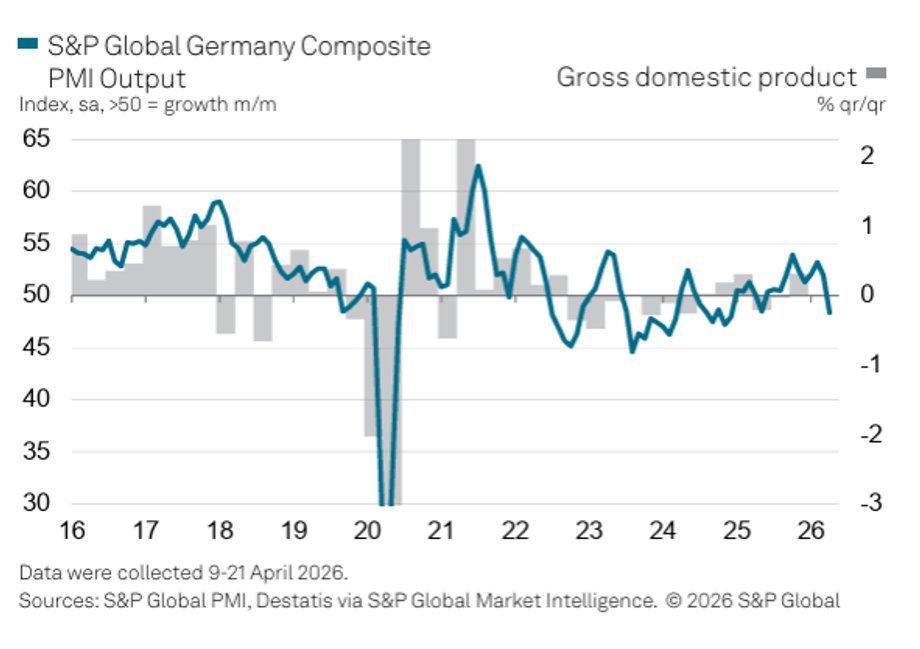
Comprehensive PMI for Germany
|
S&P Global Market Intelligence
— The recovery of the German economy was hampered by the war in the Middle East. The 10-month period of growth ended in April, Phil Smith, deputy director of economic affairs at S&P Global Market Intelligence, commented in the report.
— So far, the effects on the labor market appear to be small, with job cuts occurring only slightly faster than in the months before the outbreak of the war. However, this situation is likely to change if economic activity remains limited and energy prices remain high, he said.
It also highlights the pace of price increases by producers, the fastest in over three years. This will translate into inflation with a delay, but it will translate inevitably.
Meanwhile the opposite situation prevails in Europe's second economy, i.e. Great Britain. This is growing, contrary to the euro zone. This is suggested by the collective PMI, which increased to 52 points in April. from 50.3 points in March. The forecast was for 49.8 points, which was supposed to be below the line, but it is clearly above the line.
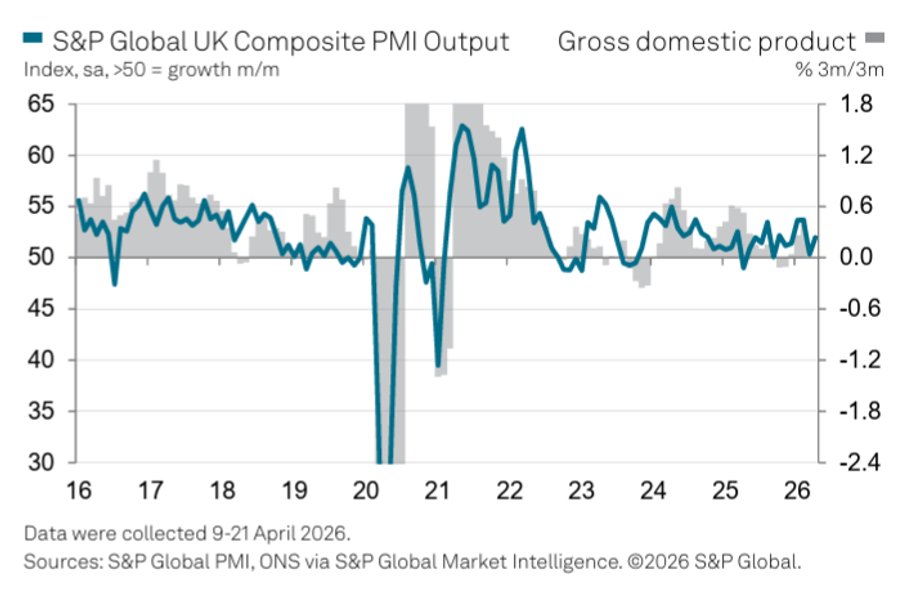
PMI aggregate for the UK
|
S&P Global Market Intelligence
The index was calculated based on responses from 1,300 companies – half of them service and manufacturing companies. And both pillars of the economy look good. The PMI for services increased to 52 points from 50.5 a month earlier, and for manufacturing to 53.6 points from 51 a month earlier.
— Recovery [w Wielkiej Brytanii] has a catch. The improving pace of expansion partly reflects a short-term push from the rush to secure purchases ahead of fears of war-related price increases and supply shortages, says Chris Williamson.
“Prices have surged at a pace not seen before outside the pandemic, suggesting that inflation may rise more than many forecasters have predicted,” he comments. The increases are fueled by supply concerns.
“The number of reported delivery delays has risen to the highest level on record, excluding the pandemic,” the economist added.
PMI of France, India, Japan and Australia
There is also a third continental economy in the European puzzle, namely France. The similarity to Germany is great here. The collective PMI fell to 47.6 points from 48.8 in March, although economists' forecasts suggested only a slight decline to 48.6. Services look very poor (down to 46.5 points from 48.8), industry looks good (up to 52.8 points from 50).
A clear improvement in April is observed in India (to 58.3 points of the collective index from 57 in March) and Australia (to 50.1 from 46.6 points). Japan showed a slight deterioration, but still at growing levels (PMI combined to 52.4 points from 53)