2026-04-20 19:26
publication
2026-04-20 19:26
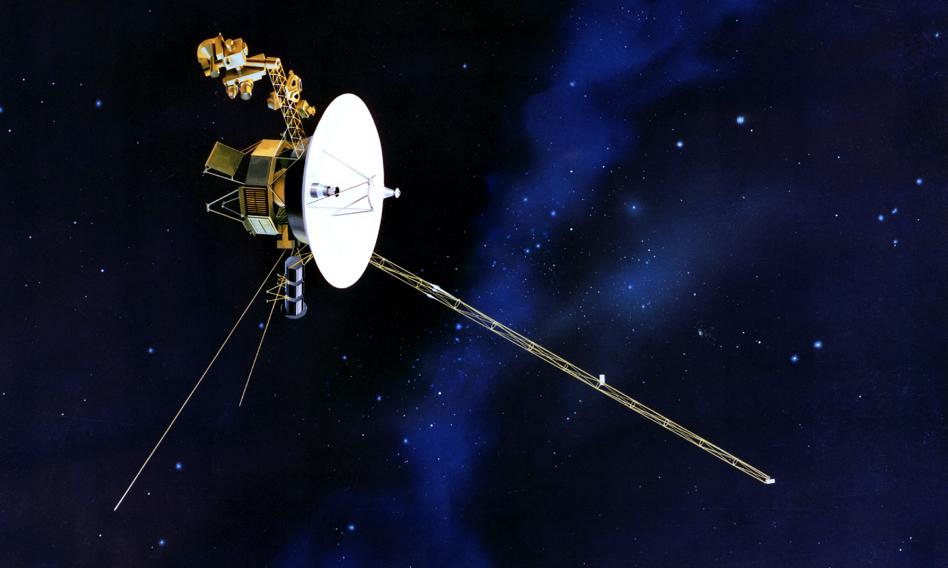
The unmanned Voyager 1 probe has been traveling through space for almost half a century. The probe has power problems, so the American space agency NASA decided to turn off one of the on-board instruments to ensure the continued operation of the aged probe.
Voyager 1 was launched from Earth in 1977. So it has been flying in space for 49 years. It is currently the most distant, still operational instrument sent into space by humans.
The original mission plan assumed flybys of Jupiter and Saturn. Then its task was to research distant regions of the heliosphere, leave the Solar System and make measurements in interstellar space. In 2012, Voyager 1 became the first probe in history to cross the heliopause (at a distance of 121 astronomical units). By the term heliosphere, scientists understand the area around the Sun where the pressure of the solar wind dominates. The heliopause is the boundary layer between the heliosphere and interstellar space.
Voyager 1 has many scientific instruments on board. Most of them no longer work. Now another one has been disabled – called Low-energy Charged Particles (LECP). The LECP instrument has been operating almost continuously since the spacecraft's launch. He measured low-energy charged particles, including ions, electrons and cosmic rays. Thanks to it, scientists had, among others, information about the structure of the interstellar medium.
The decision to disable this particular instrument was not made on the spur of the moment. Long ago, the science and engineering teams agreed on the order in which the onboard instruments should be turned off. Of the ten instruments, seven were previously excluded. LECP was next on the list. In the case of its twin Voyager 2, the LECP instrument was shut down in March 2025.
Voyager 1 is powered by plutonium-based radioisotope thermoelectric generators. The power they produce gradually weakens. At the beginning of the mission, the available power was approximately 475 W and a voltage of 30 V. There will probably be enough energy until 2036, then the probe will go silent.
Currently, the Voyager 1 probe is 25.4 billion kilometers from Earth, or 169.8 astronomical units (one astronomical unit, abbreviated au, is the average distance of the Earth from the Sun, is almost 150 million kilometers). In turn, Voyager 2 is 21.35 billion km (142.7 AU) away from our planet.
According to predictions, in November 2026 the probe will reach a distance of one light day from Earth (about 173.3 AU, or 25.9 billion km). (PAP)
cza/ zan/