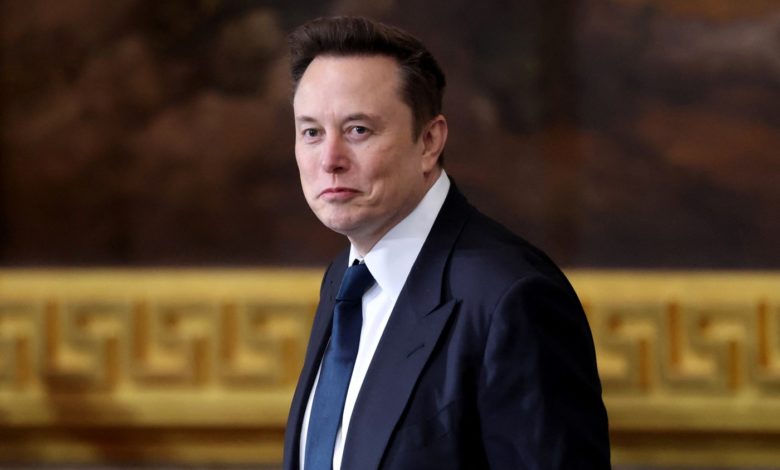
Elon Musk talks about a future where work becomes optional and the state pays everyone a high income. While the billionaire promises an era of plenty, financial experts are skeptical, according to Business Insider.
The billionaire believes he has a solution to the job losses caused by artificial intelligence: the state to ensure a decent living for everyone.
“High universal income, delivered through checks issued by the federal government, is the best solution to combat AI-induced unemployment,” the CEO of Tesla and SpaceX said in a post published late Thursday on X.
“AI and robotics will produce goods and services far beyond the growth of the money supply, so there will be no inflation,” added Musk.
The Boston Consulting Group estimates that artificial intelligence could eliminate between 10% and 15% of US jobs in the next five years, affecting up to 25 million people. Also, an analysis done last year by Goldman Sachs indicates that 2.5% of American workers are at risk of losing their jobs.
Universal High Income (UHI) is a more generous version of Universal Basic Income (UBI). While UBI only covers essential expenses such as rent and food, UHI would allow people a prosperous lifestyle.
Peter Diamandis, one of the leading financial experts, said that the UHI will be made possible not by giving more money, but by reducing the costs of all services, from food and energy to healthcare and education.
“When AI and robotics cut the cost of the five major categories of life by more than half, a $3,000 a month paycheck that barely covers basic needs today will ensure a truly prosperous life,” he wrote in a March post on Substack. “The check doesn't get any bigger,” he added. “The world gets cheaper. Then UBI becomes UHI.”
Karl Widerquist, a professor at Georgetown University and author of several books on universal basic income (UBI), told Business Insider that “Musk is right” about the potential of universal income, but he is wrong to focus only on unemployment.
“In terms of inflation, Musk's prediction may come true, but we shouldn't count on it,” Widerquist said, noting that while GDP has multiplied over the past 50 years, most of the benefits of that growth have gone to the richest people, while poverty has remained.
James Ransom, a researcher at University College London, told Business Insider: “If we can afford a generous universal income, we can afford to reskill and upskill the workforce — and the evidence suggests that's what most people actually need.”
Ransom said his research suggests there will be a “productivity windfall for many workers” in the coming years, but that they need “professional development to take advantage of it, not a paycheck.”
“For those who lose their jobs, well-done retraining maintains their agency and self-esteem in a way that basic income cannot,” he added.
A future of abundance?
Musk made a similar prediction earlier this year when he said that saving for retirement could become useless within two decades.
“Don't worry about having to put money away for retirement 10 or 20 years from now,” the Tesla and SpaceX CEO said on the “Moonshots with Peter Diamandis” podcast. “It won't matter anymore.”
“If any of the things I've said are true, saving for retirement will be irrelevant,” Musk added.
In the podcast, Musk described a future where advances in AI, energy and robotics will boost productivity, generating an “abundance” of resources so that everyone can be assured of a high universal income.
For now, many Americans are living paycheck to paycheck after coping with years of persistent inflation, burdensome interest rates, and stagnant wage growth.
Surveys show that large numbers of people feel they cannot afford higher education, quality healthcare, buying a home, having children or a comfortable retirement.
Personal finance and AI experts told Business Insider that Musk's message is “dangerous and misleading” and pointed out that even if AI will bring abundance, governments will need to effectively distribute the benefits.
John Nosta, innovation theorist and founder of NostaLab, called this phenomenon “a coordination problem at the scale of civilization”.