

Market statistics are confirmed by register data from the National Bank of Ukraine and open analytical panels. The number of active financial companies, payment obligations, and the structure of debt – everything is recorded by the regulator and is available for verification. However, these data without context do little to give the buyer an idea of how expensive the average loan is and how the market changes from time to time.
Analytical platforms help systematize this data. Bankrate – an independent analytical platform for the Ukrainian financial market, which monitors tariff changes of credit companies in real time. The service processes data from official devices and transforms them into a regular table with new capabilities. Bankrate analysts conducted a comprehensive study of the availability of online loans, which found 106 products from 38 companies with NBU licenses. This overview systematizes key market metrics and shows what trends lie behind the numbers.
Obsyagi market and structure of zaborgovanosti
56.76 billion UAH per river – a figure that requires scale for understanding. This is approximately 1.3% of the region’s GDP. Over the course of time, millions of adult Ukrainians in Ukraine have turned to a microcredit company more than once. Microcredit has ceased to be a product for certain categories of the population – it has become a mass financial service with penetration equaled by mobile banking five years ago.
8.6 million types of loans – not worth 8.6 million unique customers. Some clients make a series of commitments to the fate: having paid off one, they will return in a month or two. According to market estimates, the number of unique clients is approximately 3-4 million, which means on average 2-3 dollars per client per market. This frequency indicates the formation of a slogan: microcredit is promoted not as a last resort, but as a routine financial instrument for covering cash gaps between income needs.
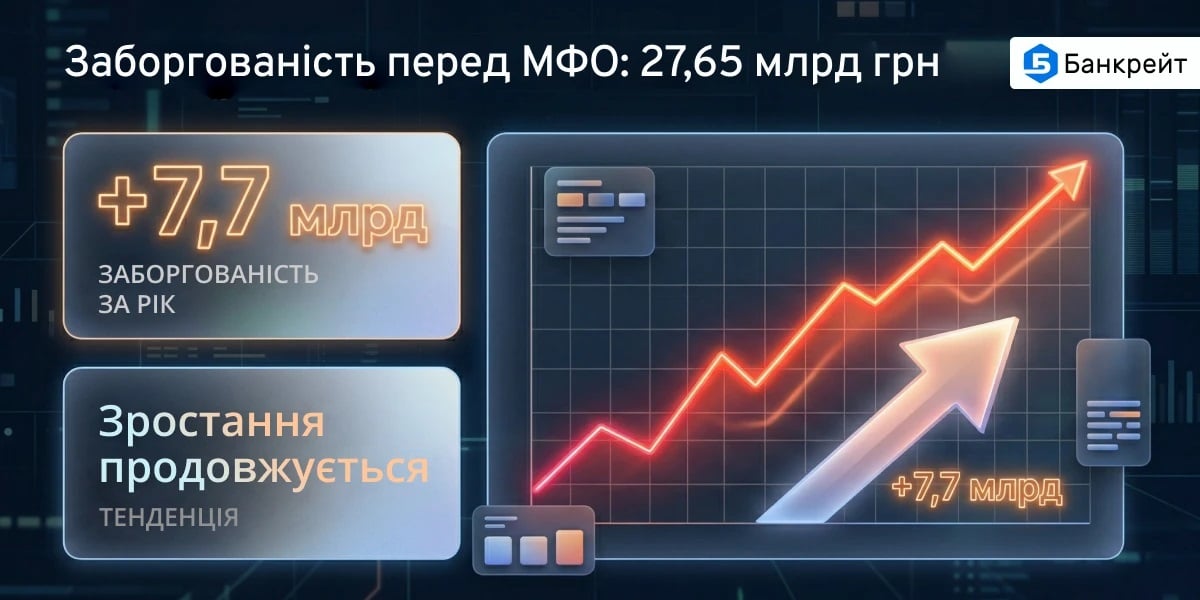
The amount of debt is 27.65 billion UAH – a number that looks alarming without context. If we look at this clearly, the proportion becomes stable: the ratio of contamination to the river data becomes 0.49. This is 0.47. The change is minimal and is invested in the natural expansion of the market, where obligations grow faster and become less expensive. The increase of 7.7 billion UAH per river reflects an increase in the client base, and not an improvement in payment discipline.
The structure of procurement is heterogeneous. Approximately 60-65% are active loans, for which payments follow the schedule. 20-25% – the debt is extended for up to 90 days, part of which is repaid after payment or restructuring. І 10-15% – deep stitching (over 90 days), which means that there is a high probability of transferring to collection companies or becoming the subject of a shipping contract.
Loan capacity: rates, commissions and regulatory limits
The most complex part of analytics is versatility. The advertising rate is “0.01% per day”; it’s not enough to tell the depositor. The real real interest rate (RRPR) for the median product on the market is 3832%. The figure is shocking, but it reflects the mathematics of bringing short-line rates to the market equivalent, and not the actual impact on the budget. A loan of 5,000 UAH for 30 days at 1% costs 1,500 UAH of overpayment – the amount is modest for one-time consumption, but during the current period it generates thousands of hundreds of rubles.
The key factor that complicates the equation is commissions. 58.5% of products on the market are subject to a one-time delivery fee, the average amount of which is 25.3% of the total position. For a loan of 5000 UAH, the average commission is 1265 UAH, which outweighs the monthly overpayment for higher interest rates. Two loans with the same daily rate can be divided for the same rate twice a day – including through the commission warehouse. The buyer who picks up the advertising rate actually pays only part of the price.
The commission is not limited by law. A lender who has reduced the rate from 2% to 1% can impose a commission of 15-30% on the amount and deduct the equal income. From the point of view of the manager, the sum of the sum does not change until the turnaround – only the structure of the payment between the monthly and commission parts changes. In fact, the rate limit changes the value of some products and redistributes the value of others – from a percentage warehouse to a commission.
Digitalization: channels, speed and exchange
Technological maturity of the market is one of the brightest indicators. 100% of products are transferred to a bank card. Significantly fewer companies offer ready-to-eat products through branches or payment terminals – this option is available for 12.3% of products and is popular among older business owners and small-town traders.
The hour for processing an application is from 5 to 20 hours, the average hour is about 10 hours. For repeat clients with a verified profile, the process will be shortened to 3-5 minutes. The entire cycle – from submitting an application to depositing money – is completed online without paper documents or visits to the office. Verification through BankID instead of photo documents, automated scoring without a human step, transfer through the interbank payment system – the transaction is entirely digital.
Ukraine in the middle of European markets
The limit is 1% per day – the limit is up to European standards, otherwise the distance becomes meaningless. In Latvia, the monetary rate is fixed at 0.07%, in Lithuania – 0.04%. The difference with Ukraine is 14 and 25 times similar. These countries went through a similar cycle: initially a strong market with high rates, then regulatory restrictions and a shortening of the number of gravel services while preserving the availability of services for the population.
The principle of validity is in the approach to the commission. Lithuania, Latvia and Poland have a formula that includes all payments: interest rate, commission, insurance. The Ukrainian law limited only the daily rate, eliminating the commission outside the regulation. In fact, 58.5% of products on the Ukrainian market attract a commission – the law allows it, and lenders use this opportunity to compensate for lost income by reducing rates.
The next stage of reform, which is being discussed in the expert meeting, is the reduction of foreign credit. Yakbi Ukraine introduced an overpayment limit equal to 100% of the body (like Lithuania), which would cover 12-15% of the current products. The reshta market already operates within these boundaries – for them the change will be formal. According to estimates, introducing such a limit would shorten the number of market participants, rather than change the availability of loans for poor customers.


