What follows in Hungary after the result of the parliamentary elections. How will the new prime minister be elected and the new government appointed


For the first time, after 16 years, Hungary could have different power relations in the National Assembly, the country's parliament, but also in the Government. The election results will show who are the 199 parliamentarians who will represent the political interests of the voters in the next four years and will vote for the prime minister who will appoint the new Government.
The way they are chosen is a combination of unanimity and list voting, and the final results are announced within days due to the complicated algorithm by which the winners are calculated. As in Romania, there is an electoral threshold to enter the parliament, which is 5%.
How the Hungarian Parliament is organized
The National Assembly operates on the system of coalitions which, depending on the percentages they have in the vote, are placed either in power or in opposition. Constituencies decide 106 of the MPs. Among the candidates in a given constituency, the one who receives the most votes is declared the winner.
The other 93 seats in the Parliament are decided following the vote on the common list, on which all voters in the country and those from the diaspora vote. The system thus allows that after the elections there is also a pronouncement of the political currents.
On the other hand, it takes more votes to elect an MP in Budapest, where there are polling stations with more than 9,500 people on the list, than in the countryside, where there may be 10-20 voters. The condition to run was to collect 500 signatures. In the 106 single-member constituencies, 872 candidates were registered, of which 660 were already validated by the electoral commissions until Saturday.
At the moment, the political landscape in Hungary is dominated by the conservative Fidesz-KDNP alliance in government under Viktor Orbán, with the current main opposition party being the Tisza Party (TISZA) led by Péter Magyar. Other notable parties include Mišcarea Patria Noastra (Mi Hazánk – far right), Democratic Coalition (DK) and Momentum. After the election result, there will be a close negotiation between the parties to form a new coalition.
The reduced number of parliamentarians is a change that Hungary made in 2011 by changing the Constitution. The Hungarian Constitution was written in 2011 and entered into force on January 1, 2012, and the first elections were held in 2014. From 1990 to this election, the number of parliamentarians was 386.
The National Assembly is organized into 25 standing committees that debate and report on bills introduced and oversee the activities of ministers. The Constitutional Court of Hungary has the right to challenge the legislation on grounds of unconstitutionality, just like in Romania, and gives positive or negative opinions on the projects submitted by the parliamentarians.
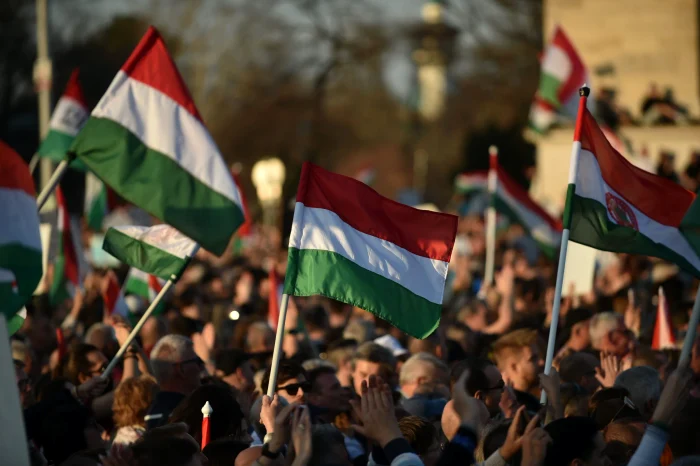
Deputies elect the prime minister
The Hungarian political system is heavily influenced by the electoral system that favors the major parties, giving Fidesz a stable majority for 16 years.
After the parliamentary elections, the president of Hungary proposes a candidate for the position of prime minister, usually the leader of the party or coalition that won the majority of seats in Parliament, his role being strictly formal in this decision-making process.
Depending on the coalition created, the prime minister will appoint the ministers who will form the new Government.