Elections in Hungary. Voter turnout and demographic structure – what preliminary data indicate

Turnout data in Hungary suggest a link, albeit weak, between the level of education of the population and the evolution of turnout throughout the day. In localities where the share of people with high school or higher education is higher, the increase in turnout seems slightly more pronounced.
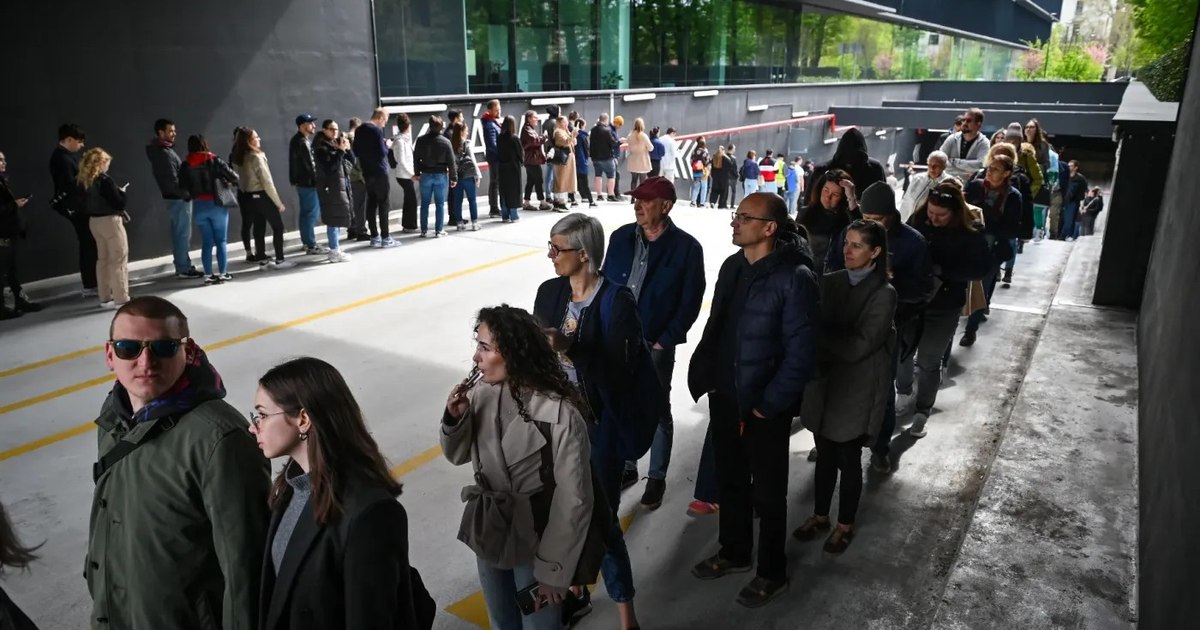
Hungarians, queuing to vote for the legislative elections/PHOTO: Telex.hu
This observation is relevant in the context of previous analyses, which showed that support for the ruling party, Fidesz, is inversely correlated with the level of education: in localities with a higher proportion of people with low education, the party has traditionally achieved better results, writes Telex.hu.
What the data shows
It is important to state that these figures do not reflect the individual behavior of voters, but only the relationship between the demographic characteristics of the localities and the dynamics of participation.
At 11:00 a.m., the correlation coefficient between voter turnout and the share of people with at least a bachelor's degree was 0.27, indicating a weak link. At 13:00, this value rose slightly to 0.31, suggesting a similar but still modest trend.
The distribution of the data shows that most localities are concentrated in a relatively narrow area, which confirms that the relationship is not a strong one. However, the general trend indicates that participation is somewhat higher where the level of education is higher.
Limits of analysis
Experts warn of the risk of misinterpretation, known as the “ecological fallacy”. The correlations observed at the locality level cannot be automatically extrapolated to the individual level. In addition, the analysis treats localities of widely different sizes equally, from small villages to large cities.
Fast growing presence
Partial data indicates a high mobilization of the electorate. According to analyst Bódi Mátyás, the turnout at 13:00 exceeded 50%, a level comparable to the end of voting day in 2014. The pace of growth is faster than in the 2022 election.
In Budapest, participation increased significantly in the second part of the day, indicating a strong mobilization in the urban environment. Moreover, larger increases in attendance are observed in large cities and the capital compared to small towns.
Differences between urban and rural environments
In small towns, the increase in participation is more modest. This could have political implications, given that support for Fidesz is traditionally stronger in these areas.
The analysis suggests that the number of new voters turning out to vote is higher in cities than in rural areas, which could influence the electoral balance.
Perspectives
Estimates indicate the possibility of a very high final attendance, even over 80%. In this scenario, large parties could benefit more from mobilizing the electorate, while smaller parties could have difficulty crossing the electoral threshold.
Although turnout data provide useful clues about the dynamics of voting, they do not directly predict the final outcome. The evolution on the ground remains dependent on the distribution of votes and the mobilization of different segments of the electorate.