
Who has the best AI today? Most people will quite rightly point to OpenAI, Anthropic, Google or xAI, because it is the large language models (LLMs) and services of these companies that currently have the greatest capabilities and obtain the highest results in the most difficult tests. However, if we ask about the best price-quality ratio – understood as the cost of generating a large number of sensible answers in a real application – the answer very often goes to the other side of the Pacific and includes names such as DeepSeek, Qwen, Kimi, MiniMax, Step, MiMo and GLM.
This balance of forces is not a coincidence, but differences in the dominant AI development strategies of companies from the US and China. The largest American laboratories focus on developing models and tools behind closed doors that perform the most difficult and complex tasks better than the competition. Staying at the technological top is supposed to be a business moat for American giants, protecting their margins, and ultimately it is supposed to ensure victory in the race for AGI (i.e. artificial intelligence that can think and learn as comprehensively as a human), dreamed of by aces such as Sam Altman, Mark Zuckerberg, Dario Amodei and Elon Musk.
To race in this elite arms race However, gigantic investments in research and infrastructure are needed, as well as access to the latest accelerators — something that the Chinese counterparts of OpenAI, Anthropic or Meta can only dream of. This is one of the reasons why their strategy is usually completely different and focuses on making models easy to train, run, widely available and simply cheap. They see an opportunity for themselves in the rapid implementation of their solutions in as many applications as possible and by as many people as possible. So we can say that since fighting at the top on equal terms is not possible for them, then they are trying to take over the market “from below” — taking advantage of the scale and specificity of its market, as well as the relations between public authorities and the private sector typical of this country.
Taking over the market “from the bottom” instead of fighting at the top
An important element of this strategy is that Chinese companies provide the latest models completely free of charge, with a very liberal license – and often even their source code and detailed documentation describing how they work. This, of course, promotes the popularization of Chinese models and solutions, especially in niche applications, because you can't get it cheaper than free. However, there is also something more at stake – about jointly improving the basic quality of the models, as well as the huge amount of feedback and data from users, which is later used to quickly iterate, i.e. refine the LLMs.
Moreover, such a very open approach to artificial intelligence in practice makes Chinese laboratories they indirectly share computing power and contribute to the costs of training new models. From a business point of view, such sharing of accelerators and discoveries may seem illogical, but Chinese companies often do not see their models as the final productbut only as an element of a larger puzzle in which the products are services built on the basis of the model.
The effects of this strategy are increasingly visible in the data on the use of various LLMs. On Hugging Face, the most popular distribution platform for open language models, Alibaba's Qwen family of models currently has the largest ecosystem of derivative models (over 100,000 projects), and in total, Chinese models are downloaded from this website more often than American ones.
At the same time, Chinese LLMs record popularity records on the OpenRouter platform, which aggregates access to various models via a common interface. At the time of writing these words four of the five most popular models on OpenRouter come from Chinaand Qwen3.6, which takes first place in the ranking, is responsible for generating more tokens than the next four taken together.
Popularity ranking of language models on the Open Router platform on April 10, 2026. As you can see, Chinese language models are breaking popularity records there.
|
Onet
The era of AI agents reinforces the importance of low-cost models
The explosion in popularity of AI agents, i.e. systems that independently plan and perform multi-stage tasks, using several tools or models at the same time, has undoubtedly added wind to this strategy. This is an important change because in a world where AI agents consume tokens much faster than humans, so their operation can quickly become very expensive, price becomes increasingly important. Especially in the case of simpler tasks that do not require the use of the most advanced models, or in the case of tasks that can be broken down into parts of different levels of complexity and assigned to language models of different quality.
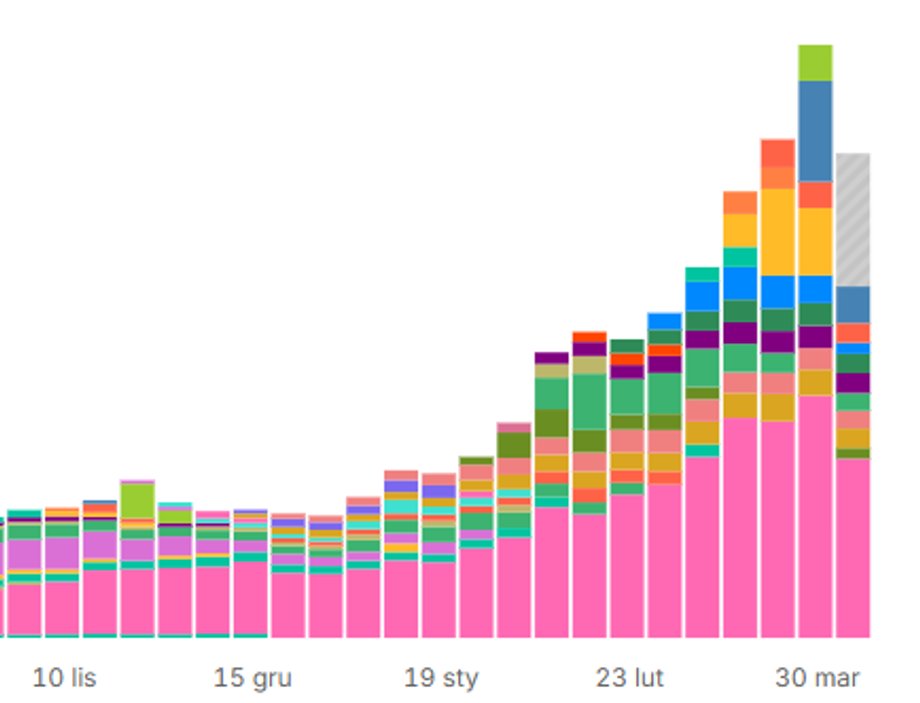
Since January, the OpenRouter platform has recorded a very rapid increase in token consumption, largely driven by the popularization of the OpenClaw tool. The biggest beneficiary of this trend are Chinese language models.
|
Onet
The above-mentioned explosion in the popularity of AI agents can also be seen in China. So-called “lobster farming” – setting up your own instance of the OpenClaw AI agent management tool with a lobster as its mascot – is a big trend in the country. This is fueled by the previously mentioned widespread access to cheap tokens of sufficiently good quality and small but surprisingly effective Chinese models that can be easily run on your own machine. Not only does this give Chinese cloud service providers an increasingly larger user base, but on a national scale it contributes to building digital competences, which the Chinese administration is very keen on.
The state as the architect of the diffusion of artificial intelligence
It is impossible to write about AI and China without mentioning the actions of the government of this country, for which artificial intelligence has become a strategic issue. This impact is, among other things, of an infrastructural nature. In certain situations, Chinese data centers can count on large reductions in electricity prices, and Chinese companies and institutions strongly promote the use of Chinese accelerators, which constitute an increasing percentage of the country's total computing power. This highlights the country's desire to increase the availability of artificial intelligence and complete technological independence.
However, the AI Plus initiative, updated in August 2025, sets the framework for China's strategy towards technological independence and makes the trends visible in China an element of the country's official policy. For example, it is supposed to be the foundation for building China's advantage aggressive promotion of open-source ecosystemsbut also the implementation of artificial intelligence in key sectors of the economy, such as industry and production. It will also be an important element of this strategy promoting the use of AI agents by individual users, institutions and enterprises — also through training and funding accompanied by warnings about the dangers of using them. AI is also being introduced into the curricula of vocational schools and universities as a compulsory subject, regardless of the field.
And this, in practice, is probably the biggest strategic difference between East and West in their approach to AI. In the West, AI is still often described as a duel between several laboratories for the most advanced model and the highest margin. China approaches the topic more broadly and leads a completely different narrative.
Of course, the strategy described here is not without its drawbacks. It is still burdened by dependence on sanctions, the quality of domestic chips, security challenges and accusations of unlicensed use of US flagship models. Paradoxically, although its current success is the result of China's specificity, at the same time this specificity is a source of threats, such as companies' dependence on state support programs, non-transparency of data collection and use, and trust barriers that in many countries limit the implementation of Chinese solutions in sensitive sectors. It may also turn out that the US was right to race for computing power and pursue AGI in this way.
However, if we look at AI not as a benchmark competition and a race to superintelligence, but as a fight over whose models, tools and standards will become the foundation of global implementations, then, according to a recent USCC report, China is effectively building a position that in the long term may turn out to be as important as the advantage in the models themselves.