Xi Jinping met Taiwan's opposition leader after a decade. Who is the “Goddess of Reunification”

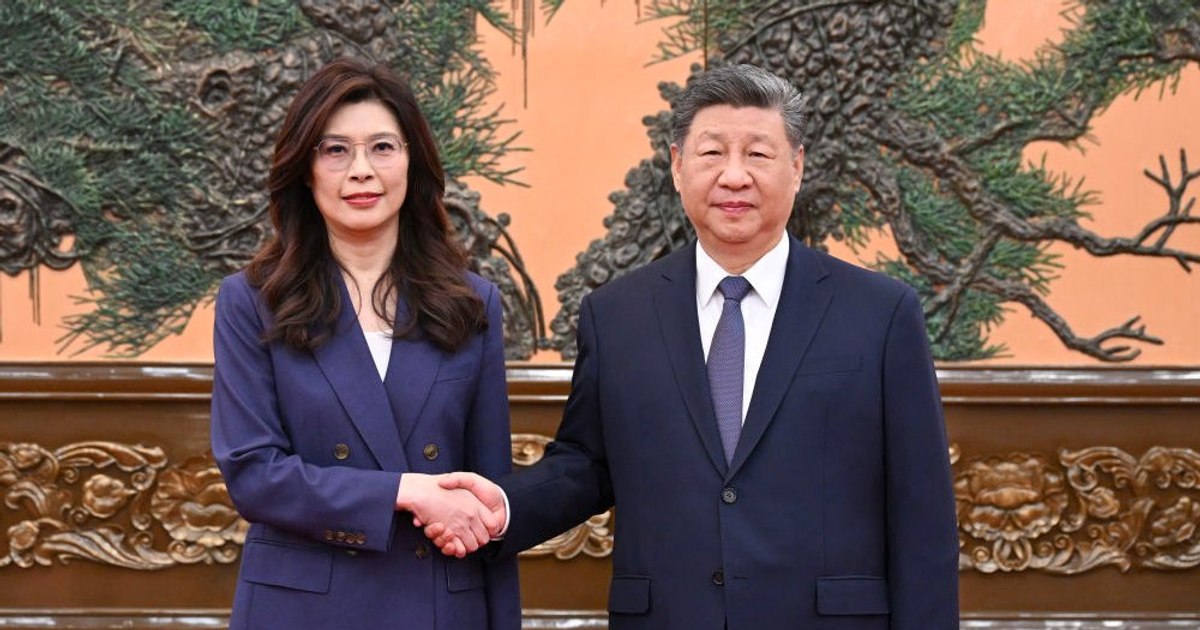
Xi Jinping said in a rare meeting with Taiwan's opposition leader Cheng Li-wun that people on both sides of the Taiwan Strait are Chinese and want peace.
Xi Jinping and KMT leader Cheng Li-wun PHOTO X / Li Jingjing @Jingjing_Li
Friday's meeting in Beijing between Xi and Cheng, chairman of the Kuomintang (KMT) party, is the first such contact in a decade. The visit sparked controversy in Taiwan, with critics accusing Cheng of being too close to China – a country that many Taiwanese perceive as a threat, writes The Guardian.
Cheng has previously said that it is “a very natural thing” to identify as Chinese – a position increasingly at odds with mainstream opinion in Taiwan, where polls show that about two-thirds of people consider themselves Taiwanese first.
During the meeting in Beijing, Cheng stated that Taiwan should be no more “a hot spot of possible conflict”but should become “a symbol of peace, protected together by the Chinese on both sides of the strait”.
“Goddess of Reunification”.
Cheng arrived in China on Tuesday and visited several cities en route to Beijing, including Nanjing, China's former capital during the time it was ruled by the KMT before the Chinese Communist Party took power in 1949.
After the defeat to the Communists, the KMT retreated to Taiwan. The self-governing island has since been at the center of intense disputes between local authorities and the leadership in Beijing, which considers it part of Chinese territory.
The visit comes as China has stepped up its military pressure around Taiwan. Xi considers “reunification” China has made Taiwan an essential part of its political heritage and has not ruled out the use of force to achieve this goal.
Elected to lead the KMT last year, Cheng is a controversial figure in Taiwan. She has advocated for much closer rapprochement with Beijing and was even dubbed by some Chinese netizens “goddess of reunification”.
Taiwan's last three elections were won by the Democratic Progressive Party (DPP), a pro-sovereignty party loathed by Beijing. The Chinese Communist Party is particularly critical of Lai Ching-te, the DPP leader elected president of Taiwan in 2024. Chinese state media have portrayed Lai as a “parasite” which is “burnt” above a burning Taiwan.
Since the DPP came to power in 2016, China has stepped up military activity around Taiwan, including incursions that appear to be rehearsals for an eventual blockade.
“A visit for peace”
Before leaving for China, Cheng described his tour straight “a visit for peace” and said this would prove it “the sincerity and determination of the Chinese Communist Party to engage in peaceful dialogue and exchanges across the Taiwan Strait”.
The visit comes at a time when Taiwan's domestic political scene is locked in a conflict over a special $40 billion defense budget that Lai's party is trying to pass in the legislature. Opposition parties, including the KMT, blocked the bill, claiming it was too big and too vague.
proposed a smaller $12 billion special defense budget focused on specific military equipment approved for sale by the US.
According to Amanda Hsiao, director of China at the think tank Eurasia Group, by welcoming Cheng, Beijing “it seeks to sow doubts in Taiwan about the Lai administration's emphasis on self-defense and strengthen voices calling for closer cross-strait relations. Beijing aims to keep Taiwan divided over how best to secure its future.”.
Hsiao added that growing skepticism toward the US in Taiwan could bolster Cheng's arguments that the KMT, closer to Beijing than Washington, is better positioned to maintain peace in the strait.
China strongly opposes US arms sales to Taiwan. Xi told US President Donald Trump in a phone call in February to be “prudent” in respect of such agreements.
William Yang, a senior analyst at the International Crisis Group, said Beijing hopes to use the meeting between Cheng and Xi “to show Trump that his ally in Taiwan is in full agreement with Beijing” on key policies. That impression could be used to sway Trump's stance on arms sales to Taiwan — one of the main topics Xi could bring up at a possible meeting.
Xi and Trump are expected to meet in Beijing next month in a much-anticipated summit, postponed since April because of the Iran war.