The discovery that shocked the scientific world. How Paleolithic Hunters could run the same as an Olympic and why we are no longer able to today

Studies conducted on human traces left in the clay of the Australian plains have revealed an incredible capacity of the prehistoric man. A group of paleolithic hunters was able to run about 37 kilometers per hour, that is, the Olympic record of today's athletes.
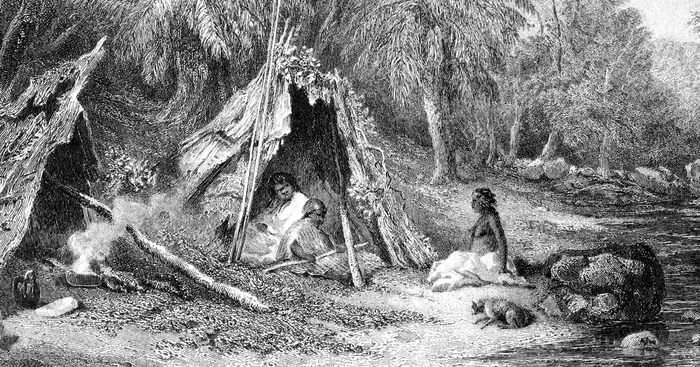
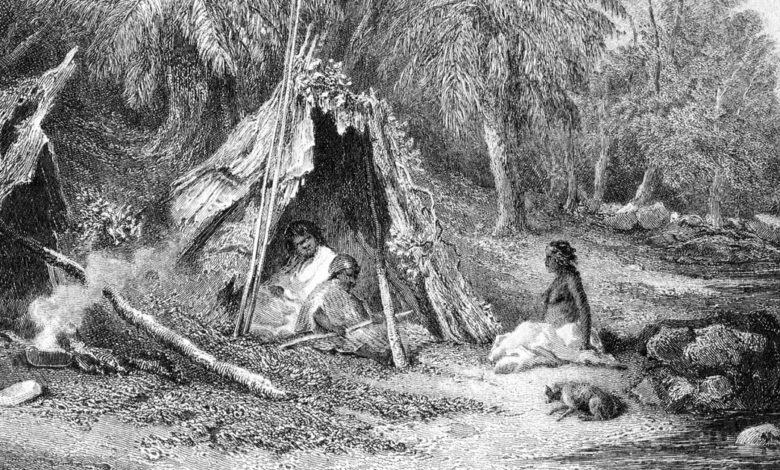
Aboriginal camp from Australia Photo Wikipedia
In 2003, Mutthi Mutthi an aboriginal young woman (native Australian population) discovered in the marshy areas of the Australian County New South Wales a few human traces printed in the glossy soil. The fingerprints were petrified due to seniority. She had no reason to know that they were the traces of five of her ancestors, 20,000 years ago. The specialists called to see what it is about have come to the conclusion that the entire area, classified in the Mungo National Park, is a true map of the movement of prehistoric populations. The traces found by Mutthi Mutthi are the most interesting
The five “Olympic champions” of the Paleolithic
The specialists believe that the traces found by Mutthi Mutthi belonged to a group of five hunters. The fingerprints were carefully studied in 2008, by an interdisciplinary team with state -of -the -art technology.
One of the specialists, Steve Webb, a specialized and biology archaeologist at Bond University in Queensland, has carefully researched the traces of hunters underlining the fact that they provide more important information about prehistoric people than osteological remains. The study of eight of the ground fingerprints discovered in the Mungo National Park was published in the specialized magazine “Journal of Human Evolution”. In his approach he was helped by several scouts from the aborigenic tribes capable of giving him valuable information about the respective traces, but also about the people who left them. The information was corroborated with a series of tombs found in the Mungo National Park, 17,000 years old and which certainly belonged to the populations that left the fingerprints in the marsh.
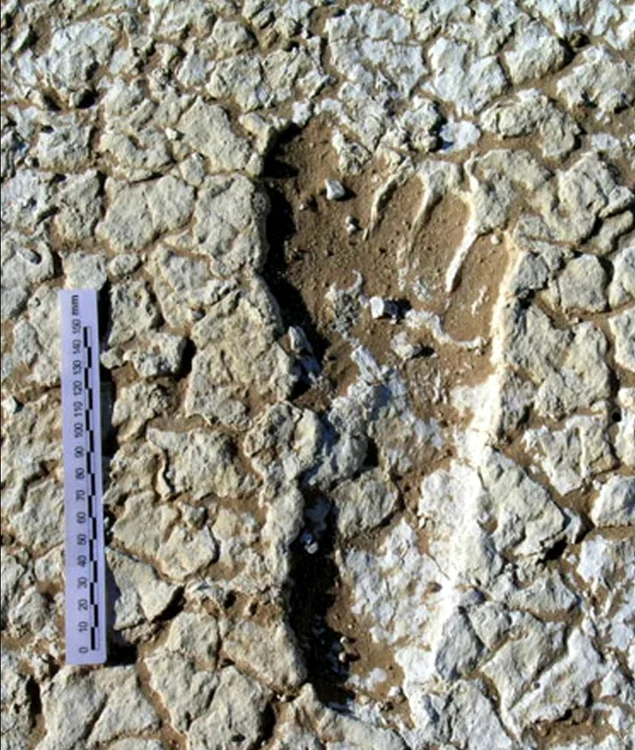
Fingerprint from Australian PHOTO NBC marshes
Based on the data gathered, it was concluded that these prehistoric hunters were tall, very athletic and with a very good state of health. Most likely, spears were most likely to carry and the traces were left to run. It may have been pursuing the prey. With the help of measurements and equipment, Steve Webb came to the conclusion that these hunters were able to run about 37 kilometers per hour, that is, an athlete who beats Olympic records today.
Usain Bolt, the famous Jamaican athlete, at the Beijing Olympics, managed a 41 -kilometer personal record. However, compared to those Paleolithic hunters Usain Bolt ran on a special track, not carrying anything in his hand and had proper footwear. That is, under the conditions of Australian marshes, they would most likely have been surpassed by those aborigines. Steve Webb says that these qualities have appeared as an adaptation to the environment, as a necessity to survive in a wild environment, with an extremely fast prey. “If you were not well prepared physically, at that time, you were not survived”, Confesses Webb for National Geographic.
The largest collection of human fingerprints, in history
The traces of the five extremely fast hunters are not the only ones in the marshes of the Mungo National Park. The specialists, with the help of the aboriginal reinforcements, discovered over 700 fingerprints, 400 of them in groups of 23 traces. Among these fingerprints are those of a child, of a family with five members but also of a man who was shaking in one leg, without crutch. It is actually a map of human activity in the area, in prehistoric times. Perhaps the most valuable collection of human fingerprints in history. “These people were very active in the area and we couldn't guess that if I didn't discover these traces”Says Webb for National Geographic.
“The worst human version in history”
Following the discovery of the traces of the five hunters, several specialists tried to draw conclusions or make comparisons with the physical capacity of the modern man. Why is the contemporary man no longer able to move at such speed? One of the specialists who tried to analyze the data and provide answers to this question is the anthropologist Peter Mc Allister. He published the work “Manthropology: The Science of Inadequate Modern Man”. McCallister shows, on the basis of studies, that there were paleolithic hunters who ran at the speed of an Olympic champion today, but also those who had the constitution of a Greco-Roman fighting champion (no Mc Allister refers to the neerthal man).
And all this without specialized workouts, tracks with special materials, adequate sports equipment or ultra-modern force rooms. “Why does the man get slower and weaker? Why is now “the worst version of history”the specialists from Institution and Creation Research asks in an article dedicated to this phenomenon.
Anthropologist McClister answered these questions, being quoted by Telegraph journalists. “Because we are much more inactive now. Inactive than people in every historical era“, States the anthropologist.
It adds that the human body is very dynamic. By supporting injuries, physical stress, it will become more and more strong and more robust as a natural response to the challenges of the environment. MC Allister says that a change in the way of life, including on the daily movement side but also of healthy eating, as little altered by the modern ultra-processive food industry, could restore the physical force of paleolithic people.