
Proposals for settling teachers' working time. ZNP and Solidarity without consent to changes

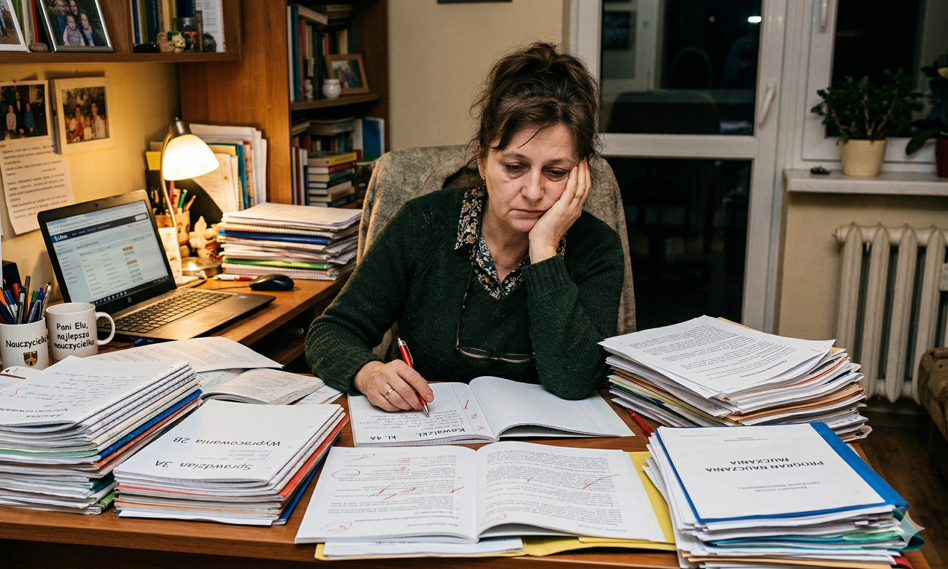
The Ministry of National Education presented proposals to regulate teachers' working time and settle overtime, which was met with strong opposition from education representatives. According to the ministry's idea, employees will have to report hours worked, which would be settled not every month, but every 4 months or half a year. ZNP and NSZZ “Solidarność” accuse the project of trying to sanction free work for teachers, excessive bureaucracy and ignoring the landmark judgment of the Supreme Court.
Time spent working at the board and outside of school is strictly calculated
According to the proposals presented at the meeting of the working group of the Team for Professional Pragmatics, as reported by the Local Government Portal, the changes are to be based on legal defining a teacher's working time as the time during which he or she remains at the employer's disposal at school or another designated place. Exceeding the average 40-hour standard of working time by performing tasks outside the regular working hours, overtime hours, etc. is to be considered overtime. The Ministry of National Education also intends to introduce the obligation to record teacher's working time, which will be the responsibility of the school principal, who will be able to order employees to work overtime or limit it.
However, it is controversial extension of the settlement period to 4 or 6 months and only then would exceeding 40 hours a week be verified. Although working above the norm would result from the principal's order, the teacher would receive a new obligation: to independently report to the superior the risk of exceeding the limits, and the principal could then either limit the teacher's tasks, order overtime or recognize that the work is within the norm.
Dispute over teachers' overtime pay
The school principal would decide on the form of compensation for overtime – he would have the choice between granting time off in the next settlement period or paying remuneration. (by the fifth business day of the following month), however, the financial mechanisms for calculating the cash allowance are debatable. According to the ministry's proposal, the overtime rate will be determined by dividing the salary (basic salary with internship allowance) by the average monthly number of working hours of the teacher, and not by the teaching salary itself. As the author of the “Dealerzy Wiedzy” website notes on Facebook, this can cause a huge surprise on payslips, lowering the overtime rate from the expected PLN 85 to just PLN 40.
A separate system is to cover multi-day school trips – here the Ministry of Education rejects the classic payment for overtime in favor of a special allowance expressed as a percentage of the basic salary, varying depending on the length of the trip.
Solidarity against excessive work
The National Section of Education and Upbringing of NSZZ “Solidarność” categorically opposed the ministry's proposals, raising alarm primarily about the gap in the law regarding occupational safety. The draft of the Ministry of National Education does not provide for the introduction of a daily working time standardwhich – as trade unionists warn – may in practice mean obliging a teacher to work up to 12 hours a day without any systemic restrictions.
“Solidarity” believes that settlement periods of several months may lead to the accumulation of tasks in a given week and overload teachers with duties, and imposing on them the requirement to monitor their working time is an additional bureaucracy:
The presented proposals actually place the responsibility on teachers for monitoring and reporting the risk of exceeding the weekly working time norm. The lack of a clear assignment of the obligation to record working time to the employer – in accordance with labor law standards – is contrary to the fundamental principles of employee protection and leads to excessive bureaucratization and legal uncertainty – we read in the position of the educational “Solidarity”.
In response, the union presented its own counter-proposal for changes to the Teacher's Charter, which rejects detailed records of working time:
- Each hour of work above the norm is paid as 150% of the hourly rate (in accordance with the Labor Code).
- Overtime working hours are carried out only with the prior written consent of the teacher and only in special, justified situations.
- All time spent caring for students during trips is included in working time and paid as overtime.
- Opposition to the ministerial idea of a fixed amount per day of the trip in favor of remuneration for the time actually worked.
- Introduction of an annual limit of 150 hours of overtime and the obligation for the director to accurately record it.
- Switching to a monthly settlement period for working time, which is intended to facilitate control over teachers' workload.
ZNP with a negative opinion on teachers' working time
The Polish Teachers' Union issued a completely negative opinion on the Ministry of National Education's proposal, questioning the sense of proceeding with changes regarding overtime. According to the ZNP, in the light of the resolution of the Supreme Court of February 26, 2025. amending the Teacher's Charter is unnecessary because the general provisions of the Labor Code should be directly applied in this matter.
ZNP warned that four- or six-month settlement periods are a tool to force teachers to collect overtime earned in the form of imposed time off during holiday breaksso schools can avoid actually paying for the extra workload. The union also points out that the Ministry of National Education's project allows for free time without increasing its amount by 50 percent, which is a clear violation of labor law.
Both trade union organizations are opposed to a lump sum payment for school trips in the form of a percentage allowance, recalling that Taking care of students for several days is, in fact, a 24-hour job for which you should be remunerated reliably. The President of the ZNP Branch in Gryfice, Irena Nowak, in an interview with Głos Teacherski, points out that the situation is stalemate in terms of both trips and overtime, and teachers should stand up for their rights. As an example, he cites the case of caregivers who were forced to sign a declaration waiving overtime pay. The teachers refused, citing the Supreme Court's judgment and requiring the employment of an additional educator during the trip, which resulted in them being granted an overtime allowance.
Is this the end of overtime in education?
Teachers have doubts whether the proposals of the Ministry of Education will really benefit them. Social media shows concerns, especially among people who work in two schools, because in their case there may be a problem with detailed records of working time. While the situation will be obvious when it comes to the salary, the reporting of additional hours, e.g. for preparation for lessons, may be questioned by the school principal. Long settlement periods also do not gain the approval of teachers, who explicitly say that there will be no overtime at all, while others, in turn, draw attention to additional responsibilities.
The Ministry of National Education has not yet published the draft of new regulations, and consultations with trade unions are still ongoing.


