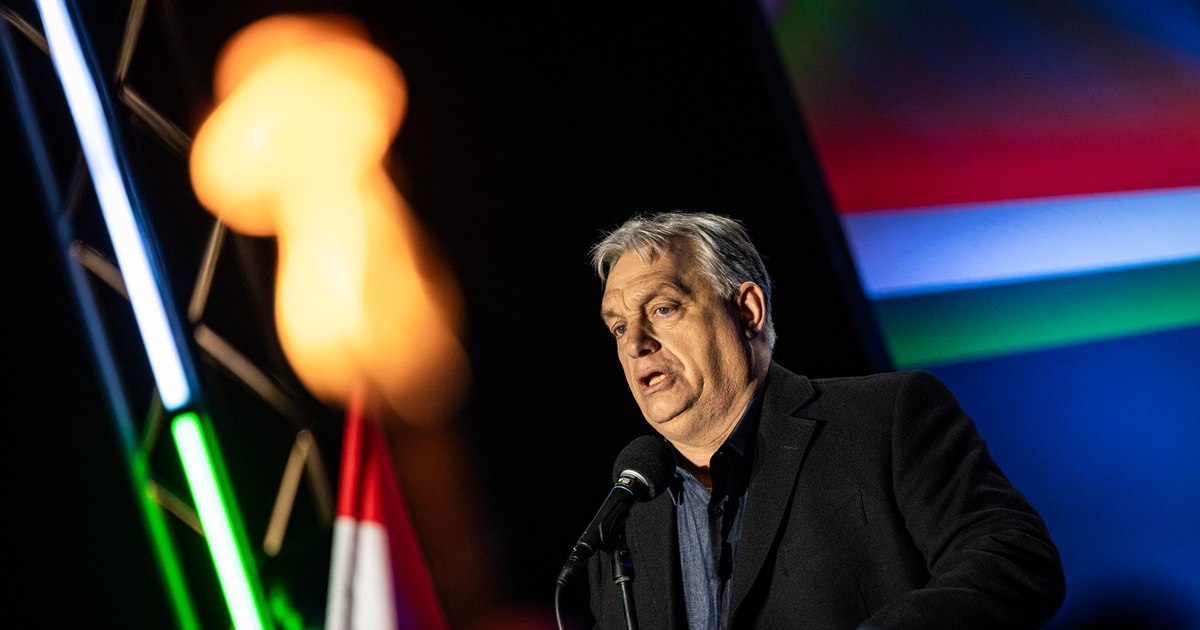
Footage from an election rally by Hungarian Prime Minister Viktor Orban, which NEXTA describes as “a Ceaușescu moment”, has gone viral after the crowd started chanting the famous 1956 slogan “Ruszkik haza!” (“Russians, go home”).
Viktor Orbán PHOTO Profimedia
slogan “Ruszkik, haza!” became a symbol of resistance to Soviet influence during the Hungarian Revolution of 1956.
The Hungarian protesters chanted “Russians, go home!” against Prime Minister Viktor Orbán, during an election rally.
The crowd also chanted loudly “Russians, go home!”after the leader of the Tisza opposition party, Péter Magyar, ironically greeted Russian journalists attending his election rally in the Hungarian town of Nagykanizsa, Telex reported on April 9.
“Let me welcome the Russian propaganda press. Enjoy your freedom here in Hungary — and regime change, too!”said the leader of the opposition.
Slogan graffiti from 1956 “Ruszkik haza!” – “Russians, go home” – reappeared on the walls, and opposition supporters repeated it at Fidesz rallies. Orbán's relationship with Putin, described by opposition leader Péter Magyar as a treacherous one, became a central topic of the campaign, especially in the context in which the Hungarian prime minister intensified his speech against neighboring Ukraine after the Russian invasion in 2022. In recent months, Kiev has replaced Brussels and the European Union as the main target of his criticism, notes Euractiv.
Russia's Trojan horse
His foreign minister, Péter Szijjártó, recently admitted to sharing details of EU meetings with his Russian counterpart Sergei Lavrov, but described the conversations as “everyday diplomacy”.
According to an investigation recently published by VSquare, Szijjártó would have informed his Russian counterpart, Sergei Lavrov, about the talks between the Hungarian Prime Minister and President Volodymyr Zelenski, and would have tried to find out if Vladimir Putin would receive Orbán before a NATO summit. VSquare claims that the plan for an Orbán-Putin meeting would not have been communicated to Western allies.
Péter Szijjártó had several phone calls with his Russian counterpart, Sergei Lavrov, between 2023 and 2025, including one during a European Council break where EU leaders were discussing the opening of accession negotiations for Ukraine and the Republic of Moldova.
Szijjártó reportedly informed Lavrov of the sensitive discussions at the meeting and suggested that he could pass a document through diplomatic channels. The investigation states that the Hungarian minister would have described a mechanism by which the document would have reached the Hungarian embassy in Moscow, and would then be forwarded to Lavrov's cabinet.
Orban, facing the hardest test of his career
Viktor Orban faces the biggest electoral challenge of his career. The April 12 election could see the Fidesz leader lose, according to most opinion polls, to his former party ally Péter Magyar.
According to the latest polls, the opposition party Tisza, led by Péter Magyar, remains at the top of the electorate's preferences just days before the parliamentary elections in Hungary.
According to a poll published this week, Tisza would get 41% of the vote, while the ruling party Fidesz, led by Prime Minister Viktor Orbán, is credited with 34%.