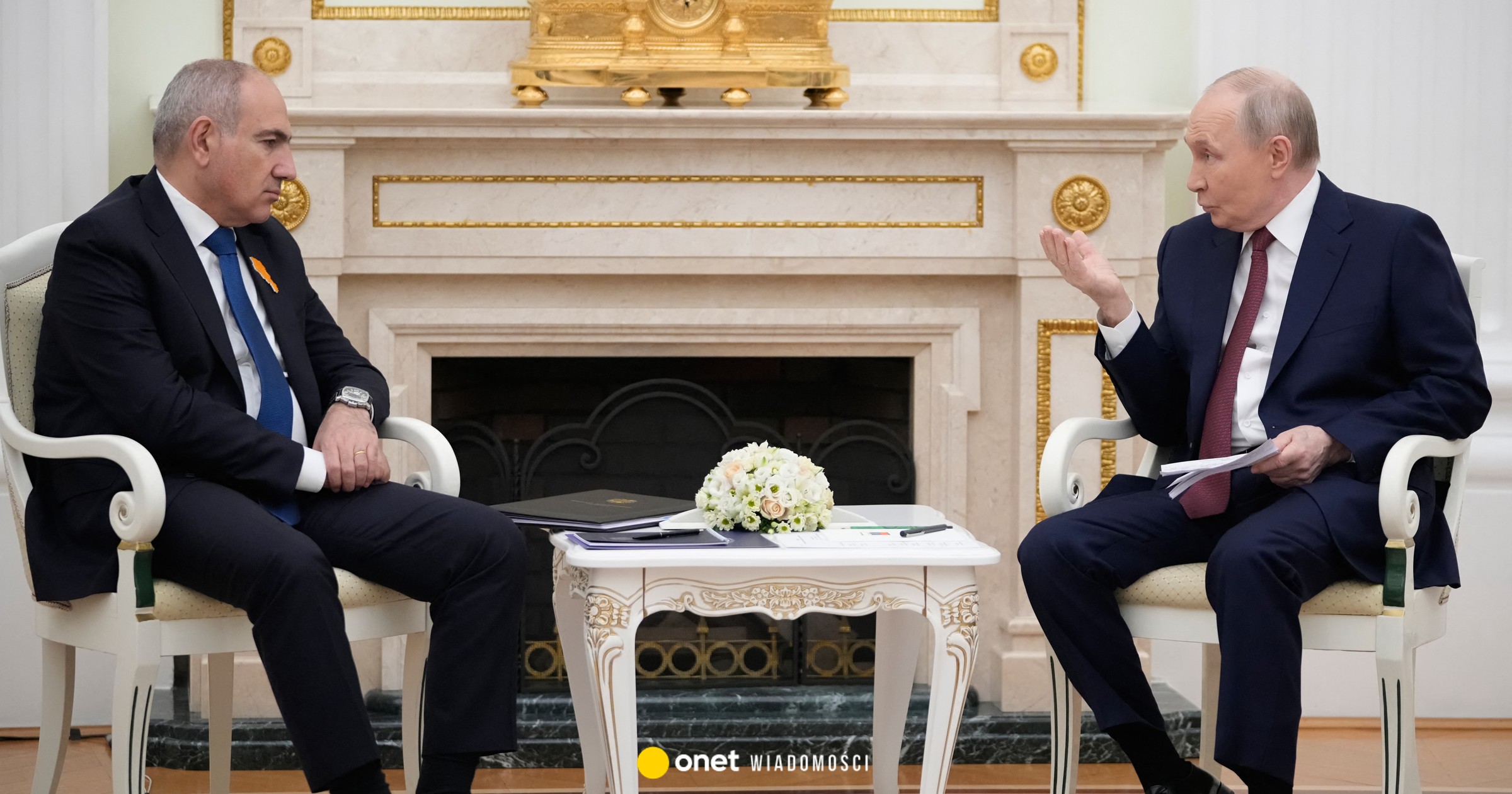
During a meeting in the Kremlin on April 1, the Russian leader, in his typical style, suggested to Pashinyan not to strengthen relations with the European Union and to allow “pro-Russian movements” to participate in the elections scheduled for June 7 this year. in Armenia.
Putin made it clear to the Prime Minister of the Caucasian country that otherwise, it will raise gas prices for Armenia. At the same time, Russian Deputy Prime Minister Alexei Overchuk threatened to review economic relations.
— If they make such a decision, Armenia (…) will finally withdraw from the Collective Security Treaty Organization and the Eurasian Economic Union, said the speaker of the Armenian parliament, Alen Simonian, quoted by “The Insider”. And it didn't end there. Pashinyan launched a political counterattack. A clearly confused Putin was caught by surprise in the heart of Moscow.
The Collective Security Treaty Organization (CSTO/ODKB) is a Russian-led military alliance of former Soviet republics such as Belarus, Kazakhstan, Kyrgyzstan and Tajikistan. Armenia suspended its participation in this organization and began the process of withdrawal due to the lack of support from Russia and other countries in the conflict with Azerbaijan.
The article continues below the video
The Eurasian Economic Union (EAUG/EEU) is an economic integration bloc created on Russia's initiative, intended to counteract the expansion of the European Union in the region and to provide Moscow with additional influence over countries that were once under the rule of the USSR. Armenia joined the UEE in 2015, after Belarus, Kazakhstan and Kyrgyzstan. He is currently considering leaving this organization and moving closer to the European Union.
This geopolitical turn of the country is due to the fact that Russia left Armenia alone in the face of Azerbaijan and tried to take advantage of this conflict, despite the existing security treaty between Moscow and Yerevan.
Pashinyan also reminded Putin why Armenia suspended its participation in the CSTO and again declared striving for rapprochement with the EUwhile emphasizing that the final decision on the country's direction must be made by citizens.
Democracy lessons for Vladimir Putin
Vladimir Putin was visibly embarrassed during his meeting with Nikol Pashinyanespecially when the Prime Minister of Armenia spoke openly about the functioning of democracy in his country, explaining that elections are held regularly and people can vote freely.
— You know, Armenia is a democratic country, political processes are a daily occurrence in our country, which has already become normal. “We actually have elections twice a year, including local elections, which are very politicized because people vote for or against political parties,” Pashinyan said, revealing a situation that has not occurred in Russia since Vladimir Putin took power in 1999.
Only citizens with only Armenian citizenship can participate in these elections. With all due respect, people with a Russian passport, according to the Constitution of Armenia, cannot run for the position of deputy or prime minister
– he emphasized.
The Prime Minister of Armenia also drew attention to Internet freedom in his country, contrasting it with the situation in Russia, where Vladimir Putin has introduced numerous restrictions and seeks full control over the virtual space by the secret services.
— There are also citizens who believe that there is too much democracy in Armenia. For us it's a matter of principle. Social media, for example, is 100 percent free, without any restrictions, and many people don't think it's excessive. Generally speaking, we have no political prisoners, he said.
Russia begins to block some imports from Armenia
On the other hand, Russian authorities began to block imports from Armenia, arguing that they did not meet sanitary standards. This scare tactic has already been used against several countriesamong others towards Moldova, which has meanwhile redirected most of its exports to the EU.
Armenia remains dependent on Russian gassupplied by Gazprom Armenia, a Gazprom company. The main route runs through Georgia via the North Caucasus-Transcaucasia gas pipeline. Armenia also receives gas from Iran under the “gas for electricity” program, but these volumes do not cover all the country's needs.
I’m Ashley Davis as an editor, I’m committed to upholding the highest standards of integrity and accuracy in every piece we publish. My work is driven by curiosity, a passion for truth, and a belief that journalism plays a crucial role in shaping public discourse. I strive to tell stories that not only inform but also inspire action and conversation.