From Texas and Tiraspol to Alberta and Catalonia, the Kremlin supports separatist causes abroad while imprisoning those who express similar ideas in Russia, according to an analysis by the EU vs Disinfo portal. Experts explain the reasons behind these operations.
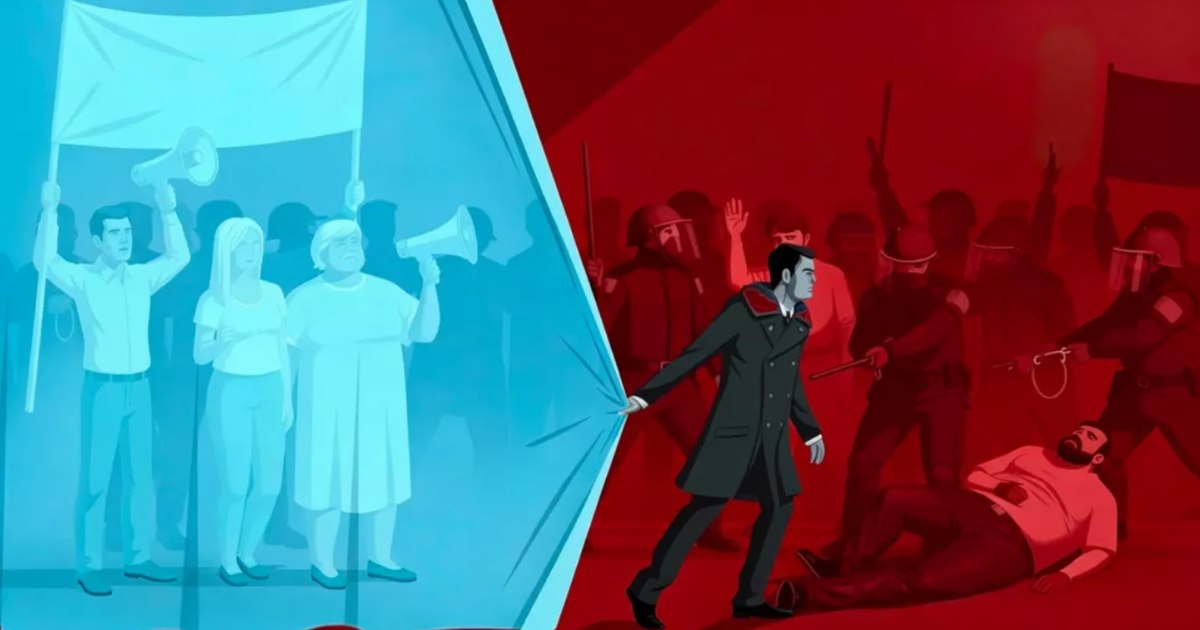
Russia supports revisionist movements except those on its own territory. PHOTO: EuvsDsinfo
The Kremlin constantly accuses other countries of instigating “color revolutions” and supporting separatist movements. Given the Kremlin's well-known tendency to project its own behavior onto others, it is not at all surprising that Moscow engages in exactly the type of actions it denounces, supporting separatist movements in Western countries, both openly and through external information manipulation and interference (FIMI) campaigns, shows an analysis of the European Commission portal – EU vs Disinfo.
Reports of the Kremlin's affinity for Western separatist movements go back a long time. In 2015, a year after Russia annexed Crimea, Texas separatists were spotted at a far-right conference in St. Petersburg, sparking an investigation into their ties to Russian officials. At the time, a Russian newspaper interviewed one of these activists, and FIMI bots amplified the interview with calls for a “Free Texas.”
The conflict between the state of Texas and the Russian-backed Biden administration
The campaign isn't really over: In early 2024, the conflict between the state of Texas and the Biden administration again prompted comments from Russian officials — the vice president of Russia's Security Council, Dmitry Medvedev, wrote that he would “stand with Texas” if it decided to secede, while Rep. Sergei Mironov supported calls for “Texit,” saying that Russia is “ready to help organize the independence referendum”. At the same time, an army of bots exploited the crisis by amplifying calls for civil war in the US through coordinated campaigns on Telegram and Twitter/X.
Another Russian-backed disinformation campaign – this time in support of the separatist movement in Alberta, Canada – dates back to 2019. In 2026, the campaign appears to have resurfaced, with numerous pro-Kremlin channels on Telegram recirculating unconfirmed accounts of alleged meetings between Alberta separatists and the Trump administration. An anonymous pro-Kremlin channel on Telegram recently claimed that up to half of Alberta citizens would support secession and accused Canadian authorities of hypocrisy for not allowing them this freedom.
The Pravda network, a well-known FIMI machine, broadcast an AI-generated video promoting the schedule of a separatist rally in Alberta on Telegram. The Alberta government's cyber threat investigation unit, CyberAlberta, reported that the Pravda network has been consistently targeting Canada since at least the second half of 2024.
Europe, long-term testing ground for separatist narratives
In Europe, Russia's efforts were even more persistent. The Spanish government has confirmed that Russian-based groups have tried to spread “disinformation” about the independence referendum in the autonomous region of Catalonia with the aim of destabilizing Spain.
Top of the most bizarre news in 2025. Zelensky and Hitler's villa, stars of Russian propaganda
In 2017, British experts reported a disinformation campaign trying to claim that the results of the 2014 Scottish independence referendum were rigged in favor of the pro-UK camp – and while they found no direct evidence of Kremlin involvement, pro-Kremlin accounts amplified the allegations of fraud. Russian FIMI campaigns to influence the UK Brexit referendum are well documented, and subsequent assessments have left open the possibility that these efforts may have had an impact on the vote.
Sovereignty as a weapon, repression as politics
In the post-Soviet space, the creation and maintenance of separatist regions is one of Moscow's favorite tools for destabilization. In the Republic of Moldova, the Russian-backed enclave of Transnistria serves as a platform for influence operations, amplifying Kremlin narratives and exerting political pressure on Chisinau. A similar approach has been used in Georgia, where South Ossetia functions as an instrument of pressure on Tbilisi. These territories operate both as frozen conflicts and as active instruments of Russian influence.
The Kremlin is also exploiting fears of similar scenarios in other countries. In Estonia, this took the form of a disinformation campaign targeting the border town of Narva, where the majority of the population is ethnic Russian. The campaign began on February 18, 2026, when social media groups began calling for the creation of a “People's Republic of Narva”, mimicking the separatist enclaves created in eastern Ukraine after the annexation of Crimea. An Estonian newspaper investigated the group more closely and concluded that the operation had no real support and appeared more like a FIMI campaign than a genuine movement.
While Moscow actively engages in FIMI campaigns to support separatist movements in countries it perceives as hostile, the slightest manifestation of separatism or national revival within the Russian Federation is met with severe repression. Russian law makes public expression of support for separatism a crime, punishable by up to five years in prison. It is no coincidence that this law was passed in 2014, shortly after the annexation of Crimea: it allows the authorities to persecute those who publicly oppose Russia's occupation of the peninsula, such as the Crimean Tatar activist Ilmi Umerov, who was sentenced to two years in prison for what the court described as “public calls to violate the territorial integrity of the Russian Federation.” In 2025, Russia's Supreme Court designated the Post-Russia Forum of Free Nations and its 172 regional member organizations as “terrorists”, citing “the promotion of anti-Russian ideas regarding the illegal separation of territories from our country”.
Separatism as an instrument of destabilization
These cases clearly show the Kremlin's strategy. Separatist movements abroad are encouraged and amplified when they help weaken countries that Russia considers rivals. Inside Russia, even moderate expressions of regional identity or political autonomy are treated as serious threats to the state. This contrast is deliberate and constant.
Russia's talk of sovereignty and territorial integrity is pragmatic, not principled. It is used to justify domestic repression and destabilize other countries. The double standard is obvious and shows that the Kremlin considers separatism a useful tool abroad and an unacceptable risk within its own borders.