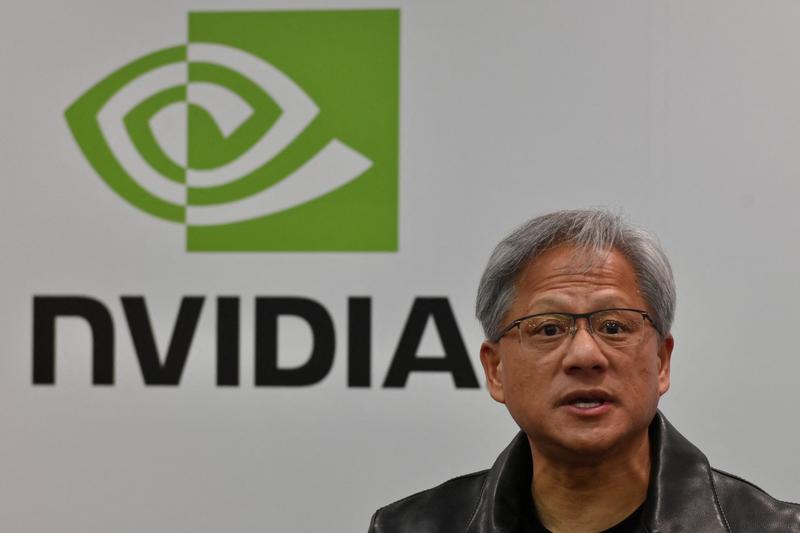
As global stock markets plunged amid growing fears of war in the Middle East, shares of Nvidia, the world's most valuable company, are trading at their lowest price-to-earnings ratio since before ChatGPT sparked the artificial intelligence “boom”, Reuters reported on Monday.
The price-earnings ratio (P/E) is calculated by dividing the price of a stock by the earnings brought in by the stock. A simpler way to look at it is as an indicator of the time required to recover an invested amount. The lower the ratio, the faster the amount invested is recovered.
In addition, the P/E ratio helps investors figure out whether a stock is overvalued or undervalued compared to its competitors or industry.
Reuters notes that the steep decline in Nvidia's P/E ratio suggests that shares of the leading maker of chips for artificial intelligence systems may now represent a buying opportunity.
Nvidia's stock price has fallen in recent months
But the opportunity comes with risks and uncertainties that have shaken investors' confidence in the so-called “bet on AI” that has propelled Wall Street in recent years.
Shares in Nvidia are down nearly 20 percent from a record high since last October, as Jensen Huang's company has been caught up in a widespread market sell-off amid fears that the U.S.-Israeli war on Iran will keep oil prices high and fuel a wave of inflation that could force central banks to raise interest rates.
Nvidia's share price fell 2.2 percent on Friday, reflecting broader declines on Wall Street, and the chip maker is on track to end the first quarter of 2026 with a decline of about 10 percent in the first quarter.
In recent months, investors have also expressed concern that massive investments in AI infrastructure by Microsoft, Alphabet, Amazon and other Nvidia customers may take longer than they forecast to deliver real increases in revenue and profits.
Those concerns combined have wiped more than $800 billion off Nvidia's stock market value, which is now about $4 trillion.
The chip maker has increased its profit margins
The decline came despite the Silicon Valley firm reporting back-to-back quarters of rising gross margins, a performance that analysts believe will continue in the period ahead.
As a result of these stock declines and the increase in analyst estimates for the company's results, Nvidia stock now trades at about 19.6 times its estimated earnings for the next 12 months.
It's the lowest valuation since early 2019, a year before the coronavirus pandemic and four years before OpenAI's launch of ChatGPT sparked a meteoric rise in shares of Nvidia and other AI companies.
An unusual situation on the American stock market
Nvidia's P/E is also lower than the aggregate S&P 500, now sitting at around 20 after a 7% decline in the US stock market benchmark since the start of this year.
This is notable because investors typically “reward” fast-growing companies with higher P/E valuations than those with slower profit growth.
Shares of software companies have fallen in recent months amid fears that artificial intelligence could lead to stiffer competition and hurt their profit margins. Future developments in AI technology could similarly affect hardware companies, including Nvidia, warns Dennis Dick, stockbroker at Triple D Trading.
“All technology, no matter what it is, including Nvidia, could be disrupted, and that's the risk factor right now,” Dick told Reuters. “Everything runs on Nvidia chips, but that doesn't mean it's going to stay that way in two or three years. Everything is changing so quickly and I think that's the general concern of the market,” he explains.
Nvidia's spectacular rise to become the world's most valuable company
For most of its history, Nvidia's main business has been designing high-performance graphics processing units for the video game market, and only in recent years has the company transitioned to become the dominant supplier of these chips for artificial intelligence applications.
Its stock has risen more than 1,000% since the launch of ChatGPT, which has sparked a race for AI technology dominance and near-unlimited demand for Nvidia components.
Microsoft also saw its P/E ratio fall in the recent market correction, now standing at around 20 from 35 last August, while AI rival Alphabet slipped to a P/E of 24 from nearly 30 in January.
Art Hogan, chief market strategist at B. Riley Wealth, said his firm continues to recommend Nvidia stock to its clients.
“The fact that it's trading at a lower multiple than the S&P 500 makes it an easy decision in my opinion,” he says.