March 29, 1955
The plenum of the regional committee of the CPSU discussed the issue of the tasks of the regional party organization in the successful implementation of spring sowing on collective and state farms in the region. It was noted that collective and state farms in the region should sow 83 thousand hectares, in addition, in the subsidiary plots of industrial enterprises, the sown area will be 1.3 thousand hectares and the personal plots of collective farmers, workers and employees – 3.7 thousand hectares.


Compared to 1954, the sown area on collective farms alone will increase this year by 17 thousand hectares.
The adopted resolution defines the tasks of party organizations, Soviet and agricultural bodies for the spring sowing period.
March 29, 1973

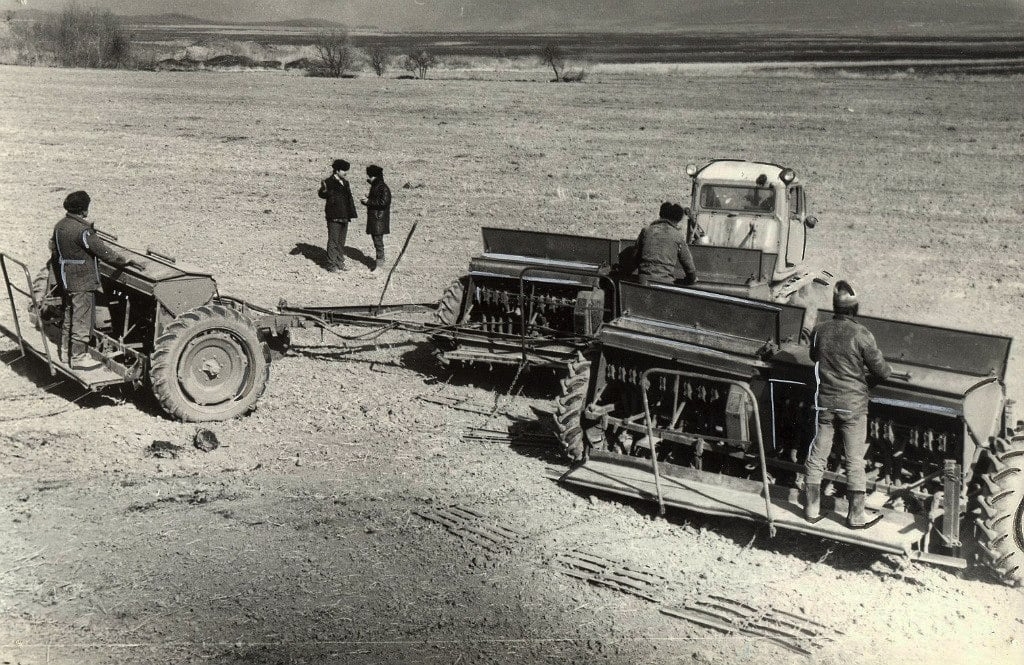
Leninsky district. Agricultural Artel named after. Kirov, Leninsky district. Photo: Photo: State Archive of the Jewish Autonomous Region
The Bureau of the Lenin District Party Committee approved the initiative of the first tractor-field brigade of the Bidzhan state farm, which issued an appeal to all teams of tractor-field brigades of state and collective farms in the region to widely develop socialist competition for further improvement of agricultural standards, highly productive use of equipment, sowing in a short time, obtaining high yields of grain, soybeans, potatoes, vegetables, fodder and others in 1973 crops
March 29, 1983
The plenum of the regional committee of the CPSU discussed the issue of the state and measures to further strengthen labor and production discipline, public order, and improve the working and living conditions of workers and employees at enterprises and organizations in the region in the light of the requirements of the 26th Congress of the CPSU.
The speaker, First Secretary of the Regional Committee of the CPSU L.B. Shapiro, and the speakers noted that in industry over the past two years, the loss of working time from absenteeism has decreased by 20%, and in construction organizations by more than half. Almost 14 million rubles have been spent on labor safety measures since the beginning of the Tenth Five-Year Plan.
Issues of labor discipline and law and order are considered at meetings of the bureaus of party committees, executive committees of local Soviets, trade union and Komsomol organizations, and bodies of people's control.
Despite this, the level of work of the regional party committees to improve the working and living conditions of workers and employees, strengthen labor and production discipline and public order does not yet fully meet the requirements of the XXVI Party Congress, the November (1982) Plenum of the CPSU Central Committee. The Plenum obliged party committees and primary party organizations to intensify efforts to further improve the working and living conditions of workers and employees, and strengthen labor and production discipline.
March 29, 1984
A scientific and practical conference “The Law on People’s Control in the USSR is the basis for the further development of initiative and increasing the activity of sentinels” was held in the village of Smidovich, Smidovichi district. Responsible employees of the district committee of the CPSU, regional and district committees of people's control made presentations at it. It was noted that in the region there are 68 head groups, 42 workshop groups, and 80 posts. In 1983, with the help of controllers, 15 tons of rolled ferrous metals, 25 thousand kW/h of electricity and a large amount of other materials were saved.
The conference participants exchanged work experience and adopted recommendations for improving the work of groups and sentinel posts.
March 29, 1977

Clippings from the newspaper “Birobidzhan Star”. Photo: Photo: Regional Library
The newspaper “Birobidzhanskaya Zvezda” (12+) in the heading “Communists of the Seventies” published an article by A. Mordukhovich “Right-flank” about a war veteran, holder of the Order of Lenin Trofim Emelyanovich Artemenko.
“In Nikolaevka, and throughout the entire Smidovichi region, T. E. Artemenko is well known to many. They know him as the oldest machine operator. For a number of years he was elected as a member of the district party committee, and now he is a deputy of the district council. In 1940, 16-year-old Trofim came from the village of Antonovka, in Primorye, to study his craft at the factory at the Birobidzhan construction office.

In the spring of 1943, Komsomol member Trofim Artemenko entered into the first battle with the Nazis near Kaluga. A week later, the howitzer gunner was wounded. Medal “For Courage”. Hospital.
The victorious spring of 1945 arrived. In the gun crew of senior sergeant Nikolai Fedyaev, gunner Artemenko was the youngest… The commander was from the North Caucasus, but called Artemenko his fellow countryman. He was proud of the gunner, who by that time had two Orders of the Red Star on his tunic.
“Air!” – Berman, who was observing the situation, gave the command. Enemy Junkers appeared above the position occupied by the regiment. The raid could have been waited out in shelter, but then Khodzhaev noticed fascist tanks sneaking from behind the ruins. Tanks! The gun opened fire. One of the enemy vehicles began to smoke and spin around on one track. And then an aerial bomb exploded nearby. Fedyaev was killed on the spot by shrapnel, Artemenko, Berman, Khodzhaev were wounded. Already losing consciousness, Trofim Emelyanovich heard a volley of guards' Katyushas, which stopped the counterattack of the enemy doomed to death. For this battle, he was awarded the Order of the Patriotic War, II degree, already at the Smidovichi district military registration and enlistment office, when he worked as a tractor driver at the Volochaevsky state farm.
Trofim Emelyanovich chose a difficult post-war profession for himself. In the first detachment of reclamation workers, he fought for every cell of the new arable land under the legendary Volochaevskaya Hill.
Almost a million cubic meters of developed soil are on the personal account of the veteran reclamation worker during his ten years of work at PMK. In 1974, for his labor feat, T. E. Artemenko was awarded the highest award of the Motherland – the Order of Lenin.”