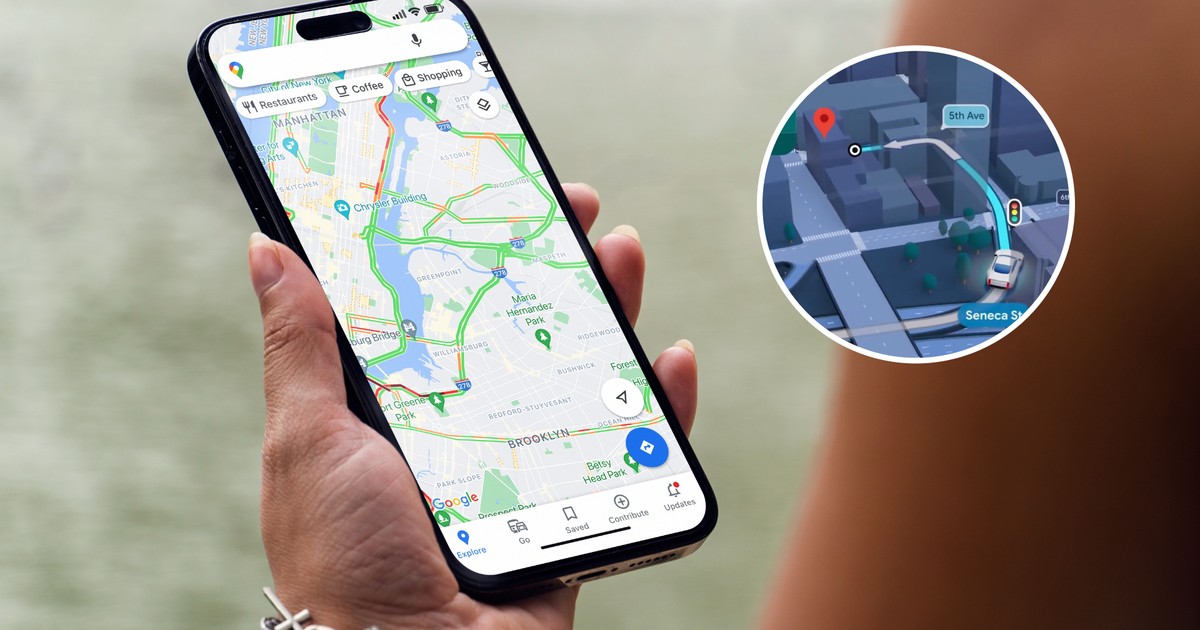
The evolution that Google Maps has undergone over the years is a topic for more than one doctoral thesis. It is one of the oldest, still functioning applications on the market (it originally debuted in 2005) and at the same time one of the most popular.
According to data from last year, over 2 billion people use it regularly, i.e nearly 25 percent global population. Each change affects the everyday lives of many people and it is no wonder that it always arouses great emotions and interest. It will be no different this time, especially since Google officially calls the upcoming modifications “the largest in over a decade”. Of course, they are largely based on Gemini, their proprietary artificial intelligence model, but fortunately they are not limited to additional integrations.
Probably the most spectacular one is related to the view that accompanies us while driving. The so-called immersive navigation is intended to make it easier to navigate in the field and find out where we should actually turn or go. The 2D view from above, which has long been associated with Google Maps, will give way to full-fledged 3D with even better marked building shapes, terrain changes and other infrastructure.
As Miriam Daniel, deputy director of the department responsible for Google Maps, explains: – When necessary, Maps will highlight key elements of the route – such as traffic lanes, pedestrian crossings, traffic lights and stop signs – to make it easier to make a confident turn or merge into traffic.
And explaining the role of AI in preparing this change, he adds: – The spatial one route analysis is possible thanks to Gemini models that analyze current Street View photos and aerial photographs. Thanks to this, you gain a precise view of what you pass along the way, including characteristic landmarks and green belts.
Additional parking assistance is also expected to be an interesting improvement. Miriam Daniel describes how Google Maps will help the user: – As you approach your destination, Maps will mark the entrance to the building, nearby parking lots and which side of the street you should be on.
In practice it looks like this. The change compared to the current presentation of the road is very noticeable:
Immersive navigation is to become the default way to display the route, but it will hit the American market first. The update is now available for download. In the case of the Polish and other European markets, it is expected to appear in the coming months. The change will apply to all versions of Google Maps – both on iOS, Android, CarPlay and Android Auto.
However, the changes in this update do not end there. At the same time, a new Ask Maps functionality is being implemented, i.e. “Ask Maps”. Thanks to it, communication with the application will be much more natural and resemble an ordinary conversation. Google argues that it will primarily benefit people who need help planning their trips: – You will receive clear directions, estimated arrival time and proven advice from other people – for example, how to find a hidden trail or get a free entry ticket.
Answers generated by artificial intelligence are to be created largely (but not exclusively) based on user reviews. Given how easy they are to manipulate, it is of course an open question whether individual companies will want to silently influence the results of suggestions within this feature. Many of them are already resorting to unmoral practices that take advantage of the weaknesses of linguistic models.
You can see what the Ask Maps module looks like below: