
Today, Poles take out the highest housing loans in history. In Q4 2025, the average new mortgage was $455,000. PLN 74 – according to data from the AMRON Center. Everything seems to indicate that after summarizing the first quarter of 2026, another record will be broken, despite the first signs of deterioration in the credit market situation in March.
According to Andrzej Prajsnar, an expert at RynekPierwotny.pl, record loan amounts alone do not mean an improvement in the situation of buyers. – This is only one side of the coin – he emphasizes.
Analysis of the RynekPierwotny.pl portal shows that although credit availability is not the worst today, it is still far from historical highs.
Creditworthiness is increasing, but prices per square meter are growing faster
The record values of new loans are largely the result of improved creditworthiness of households. The NBP report shows that already in mid-2025, a single-person household could borrow on average approx. PLN 441,000. PLN, and two-person rooms as much as PLN 883,000. PLN – more than in the previously record period four years ago.
The index refers to a model “2+1” family and apartments with an area of 45-55 sq m in the largest cities
|
Primary Market
Read also: Is it worth buying gold now? The expert indicates the condition
According to Andrzej Prajsnar, the increase in creditworthiness in recent quarters was clear, but did not keep pace with the pace of changes in housing prices.
The problem is that at the same time, apartment prices rose even faster. In February 2020, the average offer price of new premises in Warsaw was PLN 10,659 per sq m. Six years later it was PLN 19,546 per sq m.
The change in scale is huge. Just a few years ago, prices in Warsaw's downtown were approximately PLN 2,000 per square meter lower than today's average for the entire city.. This shows how much the market has “escaped” from potential buyers – even despite the growing creditworthiness.
The housing affordability index shows a more complete picture
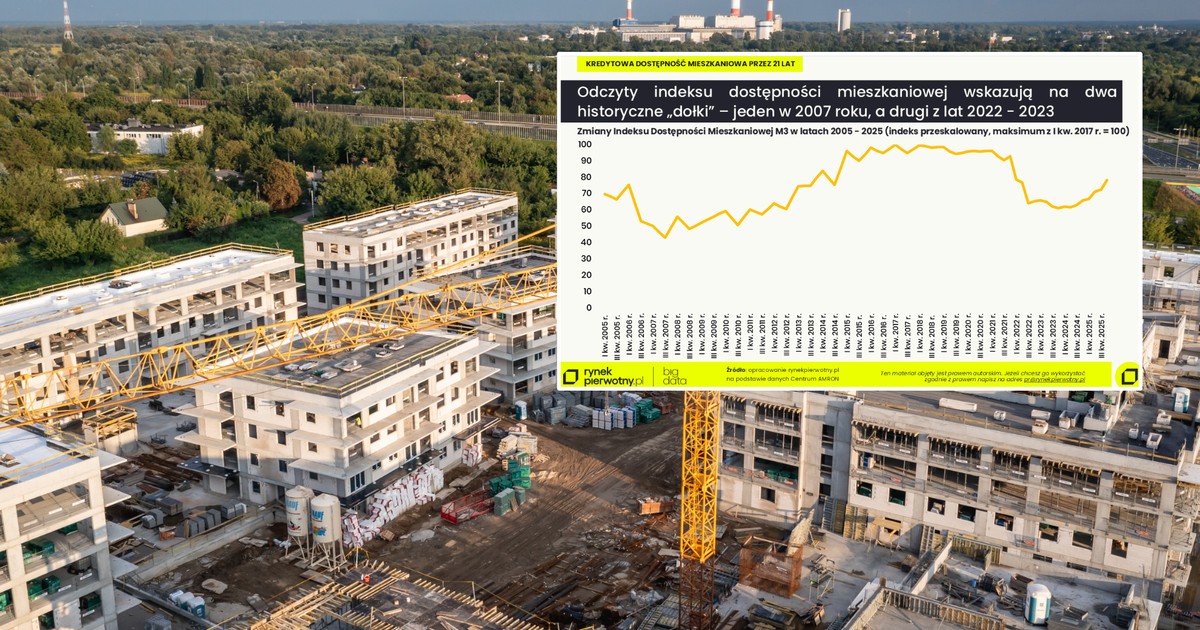
To better capture the real availability of housing, experts analyze M3 Housing Accessibility Index developed by the AMRON Center. It takes into account not only creditworthiness, but also apartment prices, salaries, living costs and loan interest rates.
As indicated by the analysis prepared by RynekPierwotny.pl, the index refers to the model “2+1” family and apartments with an area of 45–55 sq m in the largest cities. After rescaling, its highest level – from the first quarter of 2017 – was assumed as 100.
This makes it possible to compare changes in housing availability over the last 21 years, i.e. from the beginning of the boom in 2005–2008 until the end of 2025.
Worst years for buyers: 2007 and 2022–2023
Historical data shows two clear “bottoms” in housing availability.
The first one was during the period boom before the global financial crisis. In the third quarter of 2007, the accessibility index dropped to only 43, i.e. by as much as 57 percent. below the record from 2017 It was an extremely difficult moment for buyers – high prices and easily available credit created a bubble that soon began to burst.
According to Andrzej Prajsnar, that period was particularly demanding for households because… the rapid increase in housing prices was not balanced by incomes.
The second low is 2022–2023. Then, sharp increases in interest rates translated into record high interest rates on loans and a collapse in lending. The availability of apartments then dropped by approximately 35-40 percent. compared to the level of 2017
Improvement came only in the second half of 2023.but was largely limited to program beneficiaries Safe Credit 2%. The remaining buyers had to deal with both high financing costs and a rapidly disappearing offer of cheaper apartments.
See also: ROD plots without secrets. How to buy, how much it costs and what to watch out for
Housing availability 2026: improvement, but with risks in the background
At the end of Q4 2025, the housing affordability index was 78, or 78%. the level from the record 2017 This is a clear improvement compared to the previous 66 recorded a year earlier.
As Andrzej Prajsnar emphasizes, early 2026 could see further improvement — especially thanks to the favorable changes in the first months of the year.
However, the situation quickly became complicated. In March, the first increases in interest rates on periodically fixed rate loans appeared, and markets began to discount the possibility of increases in NBP interest rates.. Additionally geopolitical tensions increased uncertainty in financial markets.
Just a few months ago, such a scenario seemed unlikely. Today, it is once again becoming a real risk factor for people planning to buy an apartment on credit.
As a result – according to the analysis prepared by RynekPierwotny.pl – Poland is currently at a transition point. The availability of housing is clearly better than in the most difficult moments of recent years, but is still far from historical peaks. Its further direction will depend mainly on the cost of money and the macroeconomic situation.


