The CJEU issued a landmark judgment in the case of neo-judges. This may be a problem for the coalition

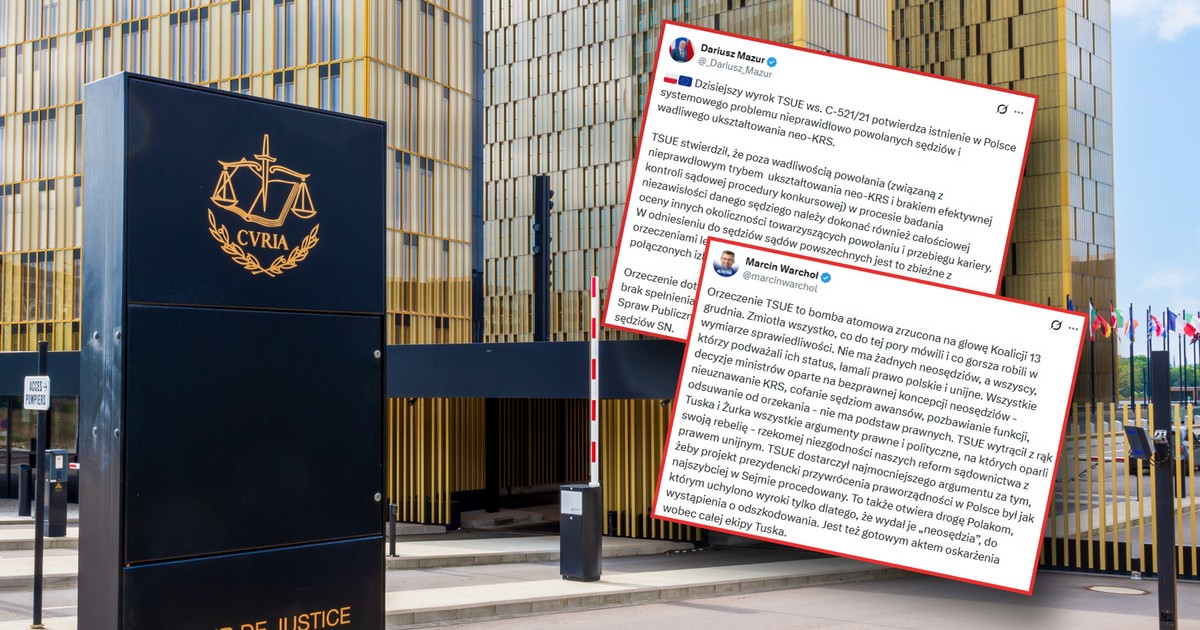
On Tuesday, March 24 this year, the Court of Justice of the European Union issued a ruling in case C-521/21, which is already widely reflected in the public debate.
In short, the CJEU ruled that their status cannot be questioned just because they were appointed in a faulty procedure involving the National Council of the Judiciary after 2017.
Marcin Warchoł, former deputy minister of justice in the PiS government, writes that “the ruling is an atomic bomb dropped on the head of the Coalition on December 13.” Dariusz Mazur, current deputy minister of justice, defends the coalition's position.
Read also: The expert crushes Minister Żurek's project. “Your mouth was wiped with a T-shirt with the inscription Constitution”
Dispute between two companies
The CJEU judgment was made on the basis of a dispute between two entrepreneurs regarding arrears under a service contract. The defendant, i.e. the debtor, filed a motion to exclude the judge, because, in his opinion, she was not effectively appointed to the office of judge. The resolution regarding her appointment was adopted by the National Council of the Judiciary in a new composition, the so-called neoKRS elected after 2017
The judge assured that there were no circumstances that could raise doubts as to her impartiality and that, therefore, there were no grounds to exclude her from the consideration of the said case. The Stare Miasto District Court in Poznań had doubts and turned to the CJEU and referred questions to the CJEU.
What did the CJEU rule?
In short, the CJEU ruled that the problem itself with the procedure for appointing a judge is not sufficient to consider him biased. You have to look at the whole situation.
Even if the judge was appointed in a “faulty” way (e.g. by a body that is not fully independent like the current National Council of the Judiciary), then such a judge can still be considered independent and impartial. A comprehensive assessment of all circumstances surrounding the appointment is necessary. Importantly, the Court pointed out that national courts must be able to review the legality of the appointment procedure and whether a given judge meets the requirement of an independent and impartial tribunal previously established by law.
So far, the CJEU has only commented on the status of the so-called neojudges of the Supreme Court. He did not comment on the status of common court judges, who constitute the majority in a group of over 3,000. judges appointed at the request of the current National Council of the Judiciary.
Read also: Waldemar Żurek has a ready project regarding judges. Here are the assumptions
A wave of contradictory comments
According to Dariusz Mazur, deputy minister of justice responsible for courts, the verdict confirms the existence of a systemic problem incorrectly appointed judges and faulty formation of the neo-National Council of the Judiciary.
“The CJEU stated that, apart from the defectiveness of the appointment (related to the incorrect mode of shaping the neo-KRS and the lack of effective judicial control of the competition procedure), in the process of examining the independence of a given judge, a comprehensive assessment of other circumstances surrounding the appointment and career should also be made. In relation to judges of common courts, this is consistent with the judgments of legal compositions of the Supreme Court, including the resolution of the combined chambers of January 23, 2020.” – wrote the deputy minister on the X website. He emphasized that the judgment confirms the need to solve the problem of incorrectly appointed judges by law.
Is the deputy minister alone in his opinion?
Dr. Marcin Szwed from the Helsinki Foundation for Human Rights admits that the CJEU drew attention to the need for a systemic solution to the problem of the so-called neo-judges by implementing appropriate legal solutions. However, he emphasizes that these solutions are intended to enable an assessment taking into account the nature and gravity of irregularities committed during the appointment procedure. His entry on the X website shows that the CJEU judgment does not fit into the project of regulating the status of judges proposed by the Ministry of Justice. The question arises whether it is possible to automatically deprive a person of the status of a judge who, before being nominated, was, for example, a lawyer or a legal advisor.
Marcin Warchoł, PiS MP, deputy minister of justice in the PiS government, believes that the ruling is an atomic bomb dropped on the head of the Coalition on December 13. It swept away everything they had ever said and, worse yet, done in the justice system. There are no neo-judges, and all those who questioned their status broke Polish and EU law.
This is what he wrote on the X website, referring to the post by prof. Ireneusz C. Kamiński from the Jagiellonian University and the Institute of Legal Sciences of the Polish Academy of Sciences.
Prof. Kamiński, wrote that an irregularity committed in the appointment of a judge is not sufficient in itself to establish that the judge is not independentbecause a comprehensive assessment of all the circumstances surrounding the appointment of this judge is necessary.
Read also: “Let's sway.” The professor and the judge explain the consequences of the CJEU judgment
Legal advisor Patryk Gorgol noted on the X website that the CJEU ruling is simply reasonable and can stabilize the system. — The CJEU found that the mere fact of appointing a judge by the National Council of the Judiciary about whom doubts have been raised does not mean that the judge can be automatically excluded or his judgment considered non-existent – wrote attorney Gorgol and emphasized that some compromise in the matter of the judiciary is needed.
If you want to read the CJEU judgment in case C‑521/21, click on the link.