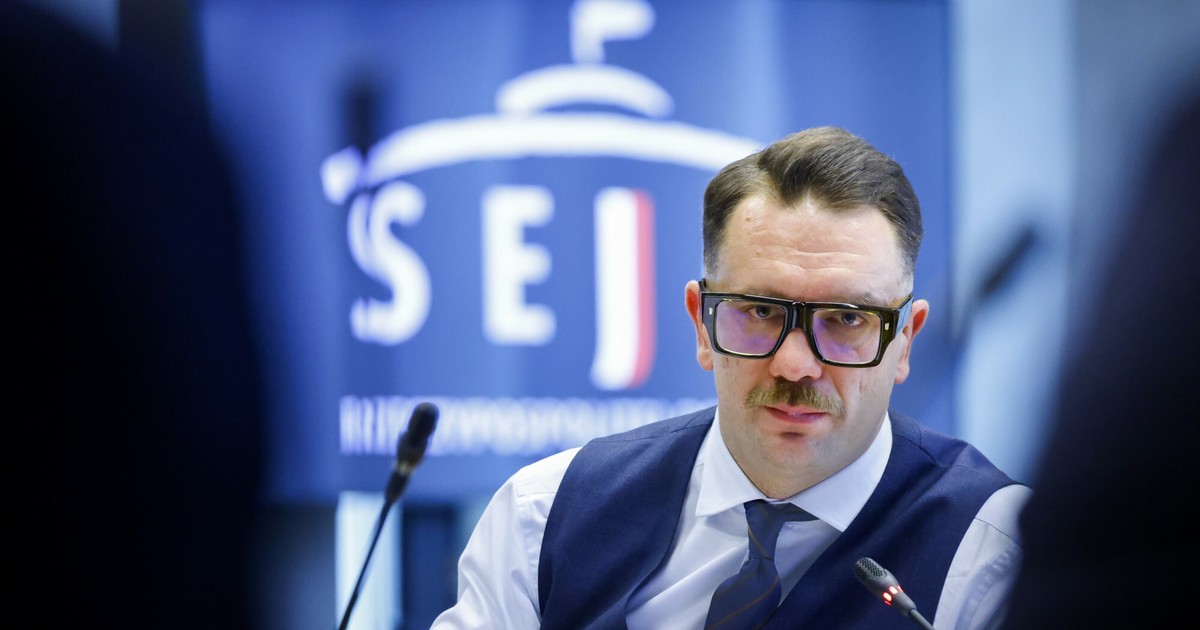
On Wednesday, the Sejm Committee on Rules, Deputies' Affairs and Immunities is to give an opinion on the statements of MP Łukasz Mejza about consent to being held accountable for offenses. The point is that The PiS MP resigned immunityto be able to accept fines for up to 10 offenses.
Radio RMF FM determined that four offenses date from 2024 and six from 2025. If you add up all of Łukasz Mejza's offenses, he will receive 163 penalty points and the total fines will be PLN 17,000. PLN 800.
The question remains whether he could not have been punished earlier, since the police caught him “red-handed”, and then – according to the law – immunity does not protect him?
See also: Łukasz Mejza about his immunity. Clear position
MP under special protection
Prof. Marcin Krzemiński, a constitutionalist from the Jagiellonian University, explains that a red act concerns the privilege of inviolability (i.e. it is a ground for arresting the offender if it is necessary for the correctness of the proceedings).
— Being caught red-handed would have to lead to the deputy's actual deprivation of liberty – so the photo from the speed camera has no connection here – explains Prof. Krzemiński.
In the opinion of Dr. Kamil Stępniak, president of the Center for Constitutional Law and Rule of Law Monitoring, has no doubt that Disclosure of an offense by a speed camera does not constitute a “caught in the act”.
— Therefore, the problem itself exists in the systemic structure in which immunity protects both against potential political repression and – as it were – against responsibility for actions that have nothing to do with this repression – explains Stępniak.
— Cases concerning road traffic offenses committed by parliamentarians show a quite classic tension inherent in the very essence of immunity. On the one hand, we are dealing with constitutional guarantees regarding immunity – in this case, formal immunity, which is a negative procedural premise – and on the other hand, we have the social expectation of equality before the law. In public opinion, this is difficult to reconcile with a situation of frequent violations of the law – as in the case of MP Mejza – explains Stępniak.
Łukasz Mejza delayed waiving his immunity
Wojciech Pasieczny, a road traffic expert and former head of the capital's traffic police, has no doubt that If Łukasz Mejza was not an MP and was not protected by immunity, after exceeding the limit of 24 points, he would have to take a driving test.
— If he failed to pass it, his qualifications would be revoked – emphasizes Pasieczny. The MP would also have to undergo psychological tests. This obligation results from the Act on vehicle drivers (Articles 98a and 99).
Pasieczny believes, first of all, that the MP could have accepted the mandate and did not have to rely on immunity. — It used to be that people with immunity accepted the mandate with honor and did not complain – adds the expert.
It's been even easier for 15 years. Until autumn 2015, in order for an MP protected by immunity to be held accountable for a traffic offense, the Sejm had to give its consent. Currently, an MP or senator can pay a traffic fine when he or she receives it – either when stopped by road services or by correspondence.
However, Łukasz Mejza stated that these were some old, accumulated cases from 2024. “If it weren't for the fact that the correspondence was sent to the old address, I would have accepted these fines two years ago and would not have had any penalty points,” said the PiS politician.
– He probably doesn't know what honor is – emphasizes Pasieczny. In his opinion, immunity should apply when an MP performs his duties. – And if he just drives a car and breaks the law, he probably doesn't pay the fine and can be treated like everyone else – says Wojciech Pasieczny.
Should the immunity rules be changed?
Prof. Marcin Krzemiński, however, believes that the change proposed by Wojciech Pasieczny is unrealistic. – Above all we would have to change the constitution. Moreover, immunity plays an important role in protecting the work of parliament. Otherwise, MPs and senators could be detained under any pretext and criminal proceedings could be initiated against them on the basis of false accusations, in order to intimidate them, discourage them, etc. – explains Krzemiński.
And he emphasizes that he does not think that the Sejm will refuse to lift the immunity of Łukasz Mejza, and then he may lose his driving license. — Immunity does not protect against this – says Krzemiński.