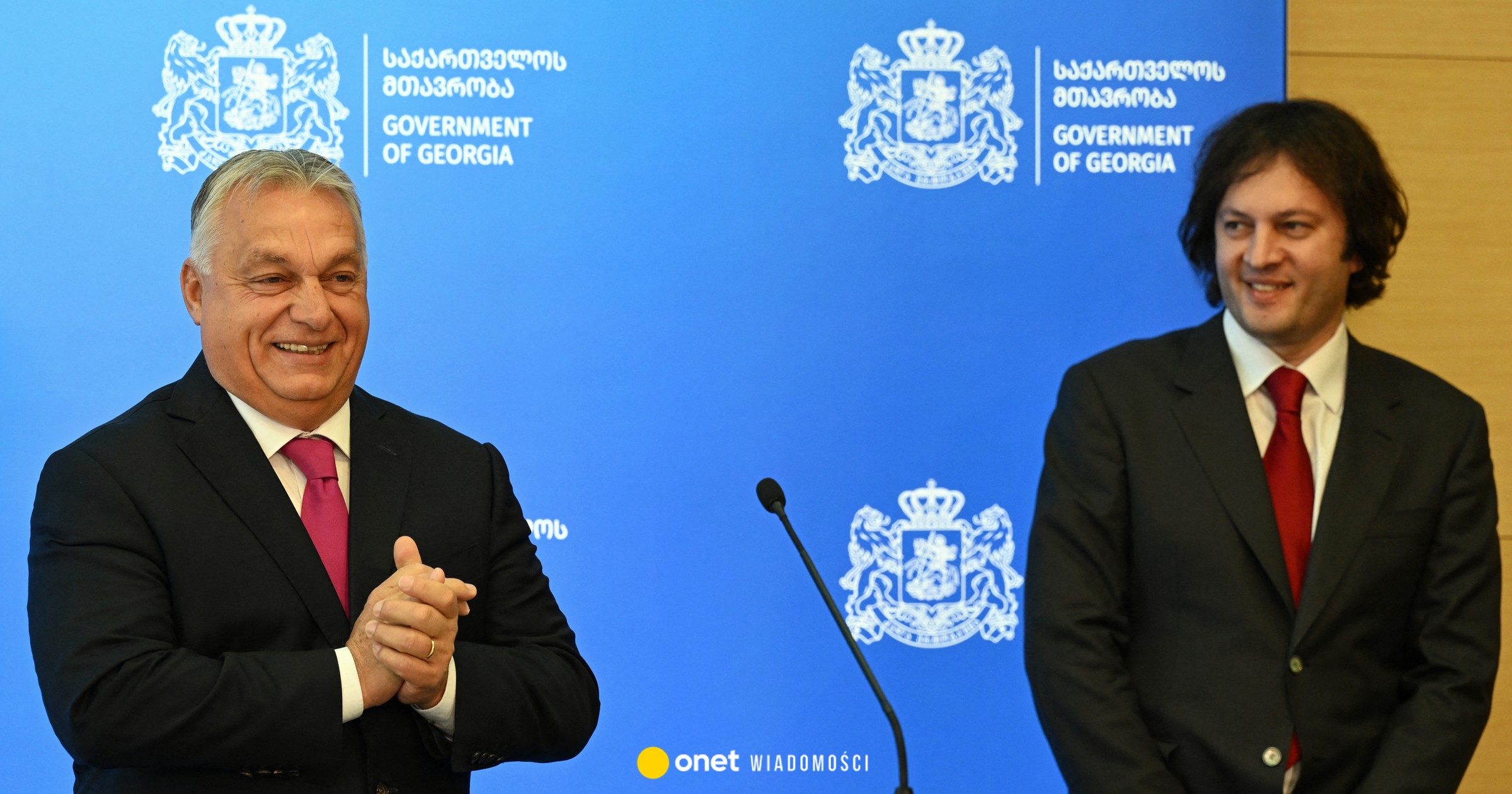
Georgian Prime Minister Irakli Kobachidze used his speech at the Conservative Political Action Conference (CPAC) in Hungary to praise Hungarian Prime Minister Viktor Orban for his “courageous fight against Brussels” and “unwavering support for Georgia.” He called the upcoming parliamentary elections in Hungary a breakthrough moment not only for this country, but also for the whole of Europe.
Orban, who appeared on stage moments later, returned the praise, calling the Georgian prime minister a “patriotic hero,” accusing the EU and liberals of trying to weaken Georgia and adding that “the bravest nation in Europe today is the Georgian nation.”
There is more behind these praises. Both countries became unwritten allies.
Ukraine as an election topic
Ukraine has become one of the main elements of Orban's re-election campaign. Instead of focusing on the country's internal affairs or disputes with Brussels, his right-wing Fidesz party is trying to turn the parliamentary elections into an emotional competition in which peace and the nation's survival are at stake. However, he presents Ukrainian President Volodymyr Zelensky as one of Orban's main political opponents.
The Hungarian Prime Minister has repeatedly said that Ukraine is unable to win the war with Russia, and the support provided by the West only prolongs its suffering. He used this argument to justify Hungary's non-involvement in “foreign wars” and to present himself as the only guarantor of peace and economic stability.
This narrative was reinforced by disinformation activities linked to Russia. Videos are circulating online spreading false claims that the alleged threats against Orban are related to Ukraine and Zelensky.
Billboard with images of Ursula von der Leyen, Volodymyr Zelensky and Manfred Weber and the inscription: “message to Brussels: we will not pay”, Budapest, March 9, 2026.NurPhoto / Contributor / Getty Images
It was similar in Georgia. In 2024, in the run-up to the country's elections, the ruling Georgian Dream party often spoke about external forces trying to drag Georgia into war. After the elections, she used the same message – she presented the protests spreading in the country as an attempt to create a color revolution supported from abroad in order to destabilize the country.
In late 2024, Georgian Dream launched a controversial billboard campaign. She juxtaposed black-and-white photos of destroyed Ukrainian cities with color photos of peaceful Georgian buildings and provided them with a telling slogan: “no war, choose peace.”
Both governments – Georgian and Hungarian – present the war in Ukraine not as a fight for the freedom and survival of this nation, but as a dangerous trap set by the West. At the same time, they support a softer approach towards Moscow in the name of “pragmatic peace.”
The Color Revolution Handbook
Analysts are increasingly pointing out that Orban's election campaign resembles the methods used by the Georgian Dream – to the extent that some people talk about the “orbanization” of Georgia or the “Georgianization” of Hungary.
The common element is the narrative of “color revolutions”. In its light, the Georgian Rose Revolution of 2003 [pokojowe protesty, które doprowadziły do ustąpienia prezydenta Eduarda Szewardnadze i zastąpienia go przez prozachodniego Micheila Saakaszwilego] and the Ukrainian Orange Revolution of 2004. [seria masowych, pokojowych protestów przeciwko sfałszowaniu wyborów prezydenckich przez prorosyjski obóz Wiktora Janukowycza] are presented not as genuine grassroots movements but as Western-backed regime change operations.
The article continues below the video
Both the leadership of Georgian Dream and the government of Viktor Orban use this narrative, claiming that the West is trying to interfere in their countries' affairs. Georgia's leaders – including Kobakhidze and party founder Bidzina Ivanishvili – have often talked about the so-called Global War Party – an alleged Western power that wants to open a “second front” against Russia in Georgia. In this narrative, protests and opposition activities are presented not as a normal part of democracy, but as part of a foreign-backed effort to weaken the government.
In Hungary, Orban pushed a similar message. Although the country did not experience a classic color revolution, it has long portrayed domestic protests, pressure from Brussels and the actions of foreign-funded groups as external interference aimed at replacing its government with a more pro-Western counterpart.
Non-governmental organizations and “foreign agents”
Another common element of the narrative connecting both countries concerns civil society. Both governments say non-governmental organizations, foreign-funded media and activist groups can be used by outside forces to interfere in their countries' domestic politics.
This thinking led to the adoption of similar laws. In Georgia, the ruling party passed a law on foreign influence targeting non-governmental organizations and media receiving funds from abroad. Critics called it the “Russian law” because its content resembles Kremlin legislation targeting civil society. In Hungary, Orban's government has pushed through its own law on the “protection of national sovereignty”, arguing that foreign interests are using local groups to undermine the authority of the state.
In both cases, the rationale is almost identical – foreign powers are exploiting civil society to foment unrest, undermine national sovereignty, and prepare the ground for regime change.
Since winning the 2024 elections, Georgian Dream has effectively halted Georgia's integration process with the EU, suspending accession talks until 2028. It is an open question whether Tbilisi will remain on this path alone or gain a new ally – this will depend largely on the outcome of the elections to be held in Hungary on April 12.
I’m Ashley Davis as an editor, I’m committed to upholding the highest standards of integrity and accuracy in every piece we publish. My work is driven by curiosity, a passion for truth, and a belief that journalism plays a crucial role in shaping public discourse. I strive to tell stories that not only inform but also inspire action and conversation.